
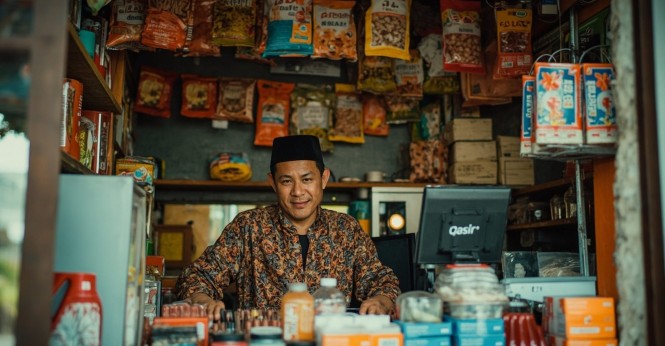
The development of Indonesian MSMEs continues to be in the national spotlight. With a contribution reaching 61% of the national Gross Domestic Product (GDP) or the equivalent of IDR 9,580 trillion, this sector is not just an economic driver—it also supports the lives of 117 million Indonesian workers. But behind these shining numbers, there is a much more complex reality.
Numbers You Need to Know
There are at least several key figures that describe the current position of Indonesian MSMEs:
- 66 million MSMEs actively operating in Indonesia as of April 2026
- 61% of national GDP comes from the contribution of the MSME sector
- 117 million workersabsorbed, or around 97% of the total workforce
- 44 million out of 65 million MSMEs have not been able to access financing from formal financial institutions
- 25% of businesses go out of business in the first two years of operation
- More than80% fail survive until the third year
The last number may be the most painful—but that is precisely what needs to be understood as a motivation, not a burden.
Main Challenges Faced by MSMEs
1. Limited Access to Capital
Of the 65 million MSMEs, 44 million of them have not been able to access formal financing. Banks are still hesitant to provide credit to MSMEs due to limited collateral and minimal financial track records. As a result, many micu businesses develop from their own or third-hand capital—which is often not enough.
2. Digital Literacy is Still Low
Even though the government has targeted 30 million MSMEs to be digitalized, the biggest challenge is not just having an application or social media account. The challenge is to ensure that MSME players really understand how to utilize technology to increase sales, understand customer behavior and optimize operations.
3. Increase in Raw Material Costs
Small industries feel the direct impact of rising raw material prices. From plastics to foodstuffs, everything is experiencing price adjustments that are weighing on their already thin profit margins.
4.Weakening Public Purchasing Power
Low household purchasing power puts pressure on MSME turnover, especially in the culinary and daily retail sectors. Stable macroeconomic conditions do not always mean stable at the individual consumer level.
5Opportunities That Can Be Taken Advantage of
- Digitalization as the Key to Growth
Digitalization is no longer an option, but a necessity. With the right tools, MSMEs can expand their market reach beyond geographic boundaries, manage inventory more efficiently, and make data-based decisions—not just based on feeling. - Consistent Government Support
People's Business Credit (KUR), free training programs, and ultra-micro financing facilities (UMi) continue to be available. The government is also developing five national strategic clusters in the fashion, crafts, maritime and fisheries sectors to create stronger economies of scale. - Adoption of AI Technology
Artificial Intelligence opens up new opportunities for MSMEs to create more effective marketing content at minimal cost. From chatbots for customer service to purchasing trend analysis, AI can be a significant differentiator.
How MSMEs Can Survive and Develop
1. Starting from Basic Digitalization
There is no immediate need for large investments. Start with a digital cashier system that helps record every transaction, manage inventory, and summarize sales reports automatically. Tools like Qasir.id can be a practical and affordable first step.
2. Take Advantage of Government Programs
Many training and financing programs have not been utilized optimally. Take the time to evaluate whether programs like KUR or digital training from the Ministry of Cooperatives can be applicable for your business.
3. Use Data for Decisions
Every recorded transaction is data. This data can tell you about which products sell best, what time sales peak, and when is the right time to restock. Data-driven decisions reduce risk and increase efficiency.
4. Consistent in Branding and Marketing
Branding is not just about having a good logo. It's about consistency of communication, product quality, and customer experience. Combine that with an active digital presence—because your potential customers are already online and looking for solutions like your business.
Conclusion
The condition of Indonesian MSMEs in 2026 shows conflicting facts: great potential on the one hand, real challenges on the other. 66 million MSME players who contribute 61% of GDP are proof that this sector is worth considering. However, the high failure rate also shows that surviving is not easy.
The key is adaptability. MSMEs that succeed in surviving and developing are those who are willing to learn, willing to change, and willing to utilize technology—including even simple ones.