
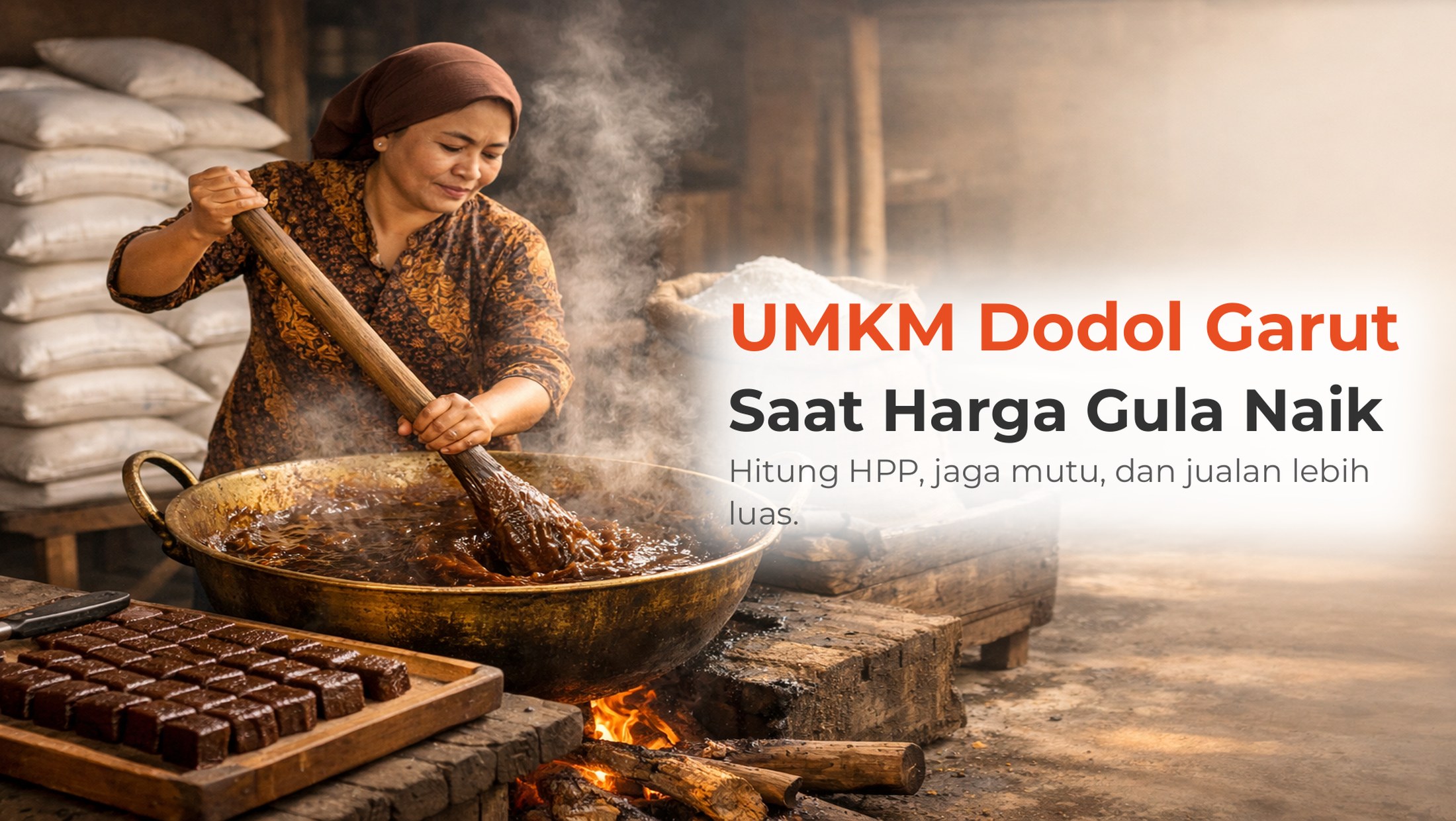
On 9 November 2026, Statistics Indonesia (BPS) recorded the national average price of granulated sugar at Rp19,189 per kilogram, up 0.76 percent from October 2026 and already past the reference selling price of Rp17,500 per kilogram. The increase has reached 98 regencies and cities. For Garut Dodol SMEs this is more than a macroeconomic number: sugar is the largest ingredient in the batter, and a price above the reference figure eats into the margin.
One day later, the Financial Services Authority (OJK) in Tasikmalaya reported that from September through October 2026 it and partners ran 173 financial education and inclusion activities reaching 261,900 participants across Priangan Timur: Garut, Sumedang, Tasikmalaya, Ciamis, Banjar, and Pangandaran. MSME credit outstanding there reached Rp25.22 trillion as of September 2026, up 2.93 percent year on year, and the Sakola program from Bank Indonesia Tasikmalaya channelled Rp6.425 billion to 16 MSMEs. Access to capital is moving; what needs improving is the accuracy of records before raw material prices climb. For Garut Dodol SMEs, both always go together.
Garut Dodol SMEs have one thing few other regions have: a production centre that has survived for decades. Dodol Picnic in Ngamplang, Cilawu District, has run since 1949 on a process that has changed little: stirring the batter over a wood fire for hours, then cooling it overnight before cutting. That tradition explains why Garut dodol always has a market, from travel souvenirs to a household snack.
Garut does not rely on dodol alone. Leather crafts in Sukaregang, silk weaving in Panawuan Village, and food processing businesses around the centre also support the local economy. In June 2026, the Garut Regency Cooperative and MSME Office recorded 223 thousand active MSME players, around 80 percent in food processing. Such a figure means a big market, but it also warns every owner entering it to keep tidy cost records.
Evidence that regional food products are attracting national attention appeared on 4 to 6 November 2026, when the Ministry of MSMEs showcased 12 leading food and beverage MSMEs at SIAL Food and Drinks Indonesia 2026. Products on display ranged from palm sugar and honey to arrowroot flour, tempeh, and fruit chips, mostly from their own regions. Dodol makers in Garut can follow this path to claim a share of a market until now filled only by outside products. The full participant list is on the Ministry of MSMEs news page on SIAL Food and Drinks Indonesia 2026.
Tip 1: Calculate Dodol Cost of Goods Sold by Separating Raw Material Costs from Production Costs
Before you talk about selling prices, work out the cost of goods sold for one batch. The basic recipe used in many Cilawu production centres follows a strict ratio: 20 kg glutinous rice flour, 2 kg wheat flour, 40 kg granulated sugar, 0.5 kg margarine, and 0.5 kg salt per batch. That is 63 kg of ingredients, and sugar fills 63.5 percent of it, so every increase in the sugar price moves almost directly into your margin.
Here is what happens when one batch needs 40 kg of sugar. At the reference selling price of Rp17,500 per kilogram, the sugar cost is Rp700,000. At the BPS national average of Rp19,189 per kilogram on 9 November 2026, it rises to Rp767,560. The difference is Rp67,560 per batch, or Rp1,689 per kilogram of sugar, usually the figure that quietly thins a maker's margin unnoticed.
| Component | Amount per batch | Cost at Rp17,500/kg | Cost at Rp19,189/kg |
|---|---|---|---|
| Granulated sugar | 40 kg | Rp700,000 | Rp767,560 |
| Glutinous rice flour | 20 kg | Follows market price | Follows market price |
| Wheat flour | 2 kg | Follows market price | Follows market price |
| Margarine | 0.5 kg | Follows market price | Follows market price |
| Salt | 0.5 kg | Follows market price | Follows market price |
| Difference in sugar cost | 40 kg | Rp67,560 per batch | |
Separate Raw Material Costs from Process and Packaging Costs
Many makers calculate cost of goods sold as one large number and feel profitable when they are not. Split them into three groups. First, raw material costs that move with the market, such as sugar, flour, and coconut milk. Second, process costs: fuel, electricity, labour, and depreciation of stirring equipment. Third, packaging costs, from plastic and labels to sealing.
Once they are separated, calculate the sugar cost per kilogram of dodol. Sugar makes up 40 kg of the 63 kg of ingredients, or 0.635 kg per kilogram of batter. At the reference price of Rp17,500 per kilogram that is Rp11,111 per kilogram of dodol; at the BPS national average of Rp19,189 per kilogram on 9 November 2026 it becomes Rp12,183. The Rp1,072 difference per kilogram comes straight out of your profit on every kilogram sold.
Record the Purchase Price of Raw Materials Every Time It Changes
The price of sugar keeps moving. On 9 November 2026, BPS recorded the increase in 98 regencies and cities, and ID Food estimates the retail price will rise from Rp19,650 per kilogram in November to Rp19,780 per kilogram in December. A maker still using last month's purchase price will wonder where the margin went. Record the latest purchase price every time you buy raw materials, then recalculate cost of goods sold before setting a new selling price.
There is a safer approach than raising the selling price sharply: negotiate bulk prices with the distributor. Balance it by writing down the lowest purchase price that still leaves a profit. Without that number, the discount given to resellers quietly becomes a way to sell at a loss.
Tip 2: Keep the Dodol Quality That Sells and Build Formal Legal Status
Price can rise and fall, but good taste cannot be negotiated. A product that tastes different from the others pushes customers to another brand and makes it hard for them to return. Maintaining quality therefore protects your customer base while raw material prices are in turmoil.
Control the Critical Points: Ingredient Ratio, Temperature, and Cooking Time
Research on producing this product shows three critical points that determine final quality. First, the ingredient ratio, especially the balance between sugar, glutinous rice, and coconut milk. Second, temperature control while the batter cooks. Third, cooking time, because the batter must be stirred continuously for over five hours so it thickens without sticking.
Four Hours of Stirring Over a Wood Fire Is the Core of the Flavour, Not Merely a Long Time
At the factory that has stood since 1949, a 140 kg batch of batter is stirred for four hours in the stirring room. Every kilogram of batter is fed through a wooden stirrer, and the fire underneath burns firewood with its flame regulated. Once cooked, the batter goes into trays and is cooled overnight before cutting. For a small-scale maker, a step like this cannot be hurried.
Complete P-IRT Licensing and Halal Certification Before Entering the Modern Market
Many home-produced goods already carry a P-IRT label and halal certification, and these are not optional extras. Mandatory halal certification is already regulated by the government and required to operate in the food sector. Businesses holding this legal status have an easier route onto the shelves of modern shops, distributors, and large marketplaces.
This legal status also opens doors. On 2 November 2026, Minister of Trade Budi Santoso encouraged MSME players to join modern retail networks at National Retail Day 2026 in Bandung. For makers in Garut, that is a chance to stop relying only on the local market and reach shelves outside the region.
Tip 3: Use AI and a Digital Shelf to Reach a Wider Market
The packaging is neat and the legal status is complete, but nobody has seen the product yet. Many makers in Garut still sell only through messages and the market. Yet a souvenir product has a market far wider than one district, especially once its name is known through clear writing online.
Write Product Descriptions That Explain the Flavour, Not Just the Packaging
A digital shelf works like a shop shelf, only in the opposite direction, because the buyer is searching. What separates one product from another is not only the variant, but an explanation of the flavour that makes people ask more. Describe each variant's character, for example red bean dodol mixed with green beans, with an aroma that makes people hungry. AI tools can help draft descriptions, but each one still needs checking so no claim goes too far.
Build a Name That Is Easy to Remember and Easy to Type
A trade name that is easy to remember is an asset you cannot buy with much capital. For a product like this, combine the regional name with a taste marker, for example Dodol Garut Kacang Merah or Dodol Kacang Hijau. A name like that tells a buyer where the product comes from and how it tastes, so it is easier to find in a marketplace search box. It also tells buyers the product belongs to a certain region, which is what souvenir buyers look for.
Record Every Order So You Do Not Lose Existing Customers
A customer who has bought this product once has a good chance of buying again, but only if it is still easy to find. Store the buyer's name, the variant they usually order, and their delivery address. With that data, a maker can announce a new variant without buying any advertising. Serving an existing customer also costs less than finding a new one, as our article on why customer data matters for MSMEs explains how to work it out.
FAQ: Questions About Garut Dodol SMEs
Does a Rising Sugar Price Stop Dodol Production?
It can, and that is what happened to a home-based dodol producer in Cilawu District when the sugar price rose from Rp12,000 to Rp14,000 per kilogram. He stopped production temporarily because production cost no longer matched the selling price. To avoid stopping, recalculate cost of goods sold regularly, negotiate raw materials in bulk, and adjust selling prices gradually. Our guide to calculating MSME profit explains how.
Can Home-Made Dodol Be Sold Without a Permit?
Food products produced at home, packaged and sold widely, need a P-IRT licence or another permit matching the scale of the business, and must meet halal requirements. Complete legal status makes a maker easier to place in modern stores. The details of these obligations are discussed in our article on halal certification for MSMEs.
How Much Capital Do You Need to Start Producing Dodol?
It depends on the scale of production. For home production, the starting capital centres on raw materials, the wood fire, large stirring vessels, and packaging costs. Because sugar is 63.5 percent of total ingredients, most of that capital goes to the sugar purchase for the first batch. Negotiating the sugar price in bulk and asking the same supplier for wholesale pricing can bring starting capital down in a real way.
How Long Can Dodol Be Stored?
A finished, properly wrapped product generally has a shelf life of around two months. Keep it in a dry, cool place away from direct sunlight, because heat and humidity change the texture. For home production, the quantity sold per day matters more than making one large batch, because batches that pile up can change flavour before leaving the storeroom.
Business and Finance Tips for Dodol Business Owners in Garut
Separate Business Cash from Personal Cash from Day One
Many home businesses fail not because the product does not sell, but because business money and household money end up mixed together. Separate them from the start, and record every inflow from sales and every outflow for raw materials, packaging, and fuel. Our article on recording income and expenses explains how to start this habit.
Prepare an Emergency Fund for Rising and Falling Raw Material Prices
A sugar price increase of Rp1,000 per kilogram means an extra Rp40,000 for every batch of 40 kg of sugar. If the volume is large, the difference is felt every week. Set aside part of your sales revenue in a separate account as a reserve, and use it only when raw material prices press on you. An emergency fund prepared early is far cheaper than stopping production halfway.
Keep Cash Flow Positive in the Middle of the Production Cycle
Production like this follows a unique pattern: money goes out first for raw materials and returns only after the product is finished and shipped. The gap between the two can take weeks. So calculate when money from the batch in progress will come in, and avoid using money set aside for the next batch. A daily cash recap makes this gap clearly visible.
Review Selling Prices at Least Once a Month
When the sugar price rises, the wholesale selling price does not have to rise at the same moment, but it cannot stay put for too long. Review the wholesale price at least once a month against the latest raw material costs. For makers selling in bulk to resellers, wholesale pricing can be set directly from the cashier app, as explained in our article on the wholesale price feature.
Qasir Features for Dodol Shops in Garut
Managing sales manually can work, but it becomes heavy as batches grow and buyers multiply. The features below cover the work that most often causes confusion, from weighing raw materials to calculating profit on every variant.
Raw Material Management to Track Sugar and Glutinous Rice Flour Stock
Raw material management records how much sugar, glutinous rice flour, and other materials are used each time production runs, so a maker knows how much stock is left before buying again. With this record in place, the latest purchase price can be compared directly against materials on hand, and there are no more surprises of an empty storeroom mid-order.
The Wholesale Price Feature for Selling Dodol to Resellers and Agents
The wholesale price feature lets a maker sell in bulk to resellers at a price already set, without calculating by hand every time an order comes in. Retail and wholesale prices are stored separately, so the margin on both sales channels is clearly visible and the two do not overwrite each other.
Product Stock Settings in the Dashboard to See Which Batches Are Left
Product stock settings let a maker see how many kilograms are finished and still unsold, without counting trays one by one. This data is needed to decide when the next batch should be cooked, and to prevent goods from settling in the storeroom until the flavour changes.
Sales Reports to See Which Dodol Variant Sells Best
Sales reports show which variant moves fastest, for example red bean against sesame or chocolate. That information lets the next batch be directed straight at the variant with the highest demand, so raw materials are not wasted on a variant with little interest.
Cash Recap to See Where the Dodol Sales Money Goes
Cash recap brings money in from sales together with spending on sugar, packaging, and fuel into a single daily record. With this in place, a maker can directly see how much is really left, not only how much went into the drawer. How to manage cash in and cash out is explained in our article on recording income and expenses.
Conclusion
Garut Dodol SMEs have two strengths few other regions have: a product proven to survive for decades, and a flavour consumers already know. The opportunity is clear, as modern retail and souvenir buyers keep opening new doors. But one thing cannot be put off, and that is keeping tidy records of your numbers, especially while the sugar price moves as it did in November 2026.
Manage Dodol Sales in Garut More Easily with Qasir
Several Qasir features can help Garut Dodol SMEs record and run their business day to day:
- Raw material management to see remaining sugar, glutinous rice flour, and other materials before buying the next batch.
- The wholesale price feature to sell dodol to resellers and agents at a price already set.
- Product stock settings so a maker knows how many kilograms of dodol are finished and unsold.
- Sales reports to see which variant sells best and where the sales are going.
- Cash recap so a maker knows how much is really left after raw material and packaging costs.
All of these features run in a single app, so raw material, sales, and cash records do not end up scattered across separate notebooks. For an owner just starting out, everything runs from one device.
Download Qasir for free on the Play Store or App Store, then start recording your first sale. If something is still unclear, read our guide to contacting the Qasir team