
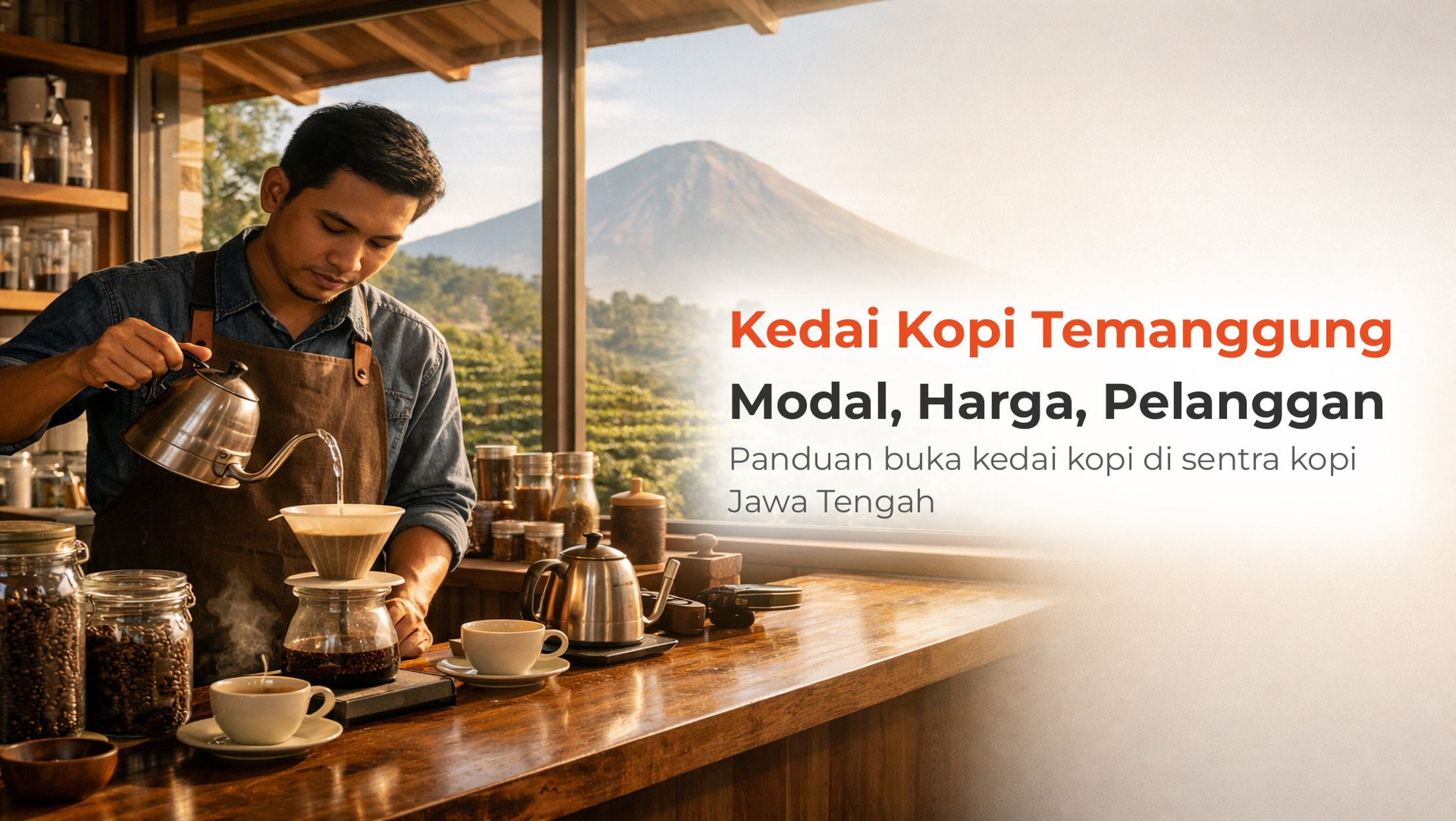
Opening a Temanggung coffee shop in 2026 starts with a striking paradox. The 2026 coffee harvest in Temanggung fell by 40-60% after extreme weather hit the trees during the flowering phase, according to the Temanggung regency agriculture agency (DKPPP) as reported by Harian Jogja — yet arabica prices climbed, and Temanggung coffee appeared at the Nusantara Coffee Week of Pertamina SMEXPO 2026. For anyone building a Temanggung coffee shop, that combination of scarcity and attention is exactly where opportunity sits.
This guide is written for daily coffee shop owners in Temanggung. It covers realistic starting capital, menu pricing built on local bean character, and simple loyalty habits that keep customers returning. A Temanggung coffee shop competes best when it turns local identity — the tobacco-tinged aroma of Sindoro arabica, the chocolate and brown sugar body of Temanggung robusta — into a reason to visit every single day. None of it requires big-city capital or an in-house roasting lab; it requires discipline, local knowledge, and consistent execution.
Temanggung Coffee Shop Profile: Varieties, Flavor, and Growth
Temanggung sits on the slopes of three mountains — Sumbing, Sindoro, and Prau — at elevations above 800 meters above sea level. In June 2026, the arabica harvest covered roughly 1,700 hectares spread across twelve districts: Selopampang, Tembarak, Tlogomulyo, Bulu, Parakan, Kledung, Bansari, Ngadirejo, Candiroto, Wonoboyo, Tretep, and Kaloran. Robusta is the bigger crop: about 12,207 hectares across nineteen districts, according to Antara News. These numbers matter to a new owner because they mean supply is deep: beans are available even in a weak harvest year.
Flavor is where a Temanggung coffee shop can differentiate itself. At the Pertamina SMEXPO Coffee Week 2026, reported by Bisnis.com on 8 November 2026, cuppers described Temanggung robusta as carrying chocolate, brown sugar, and vanilla notes, while arabica grown on the Sindoro slopes is known for a distinctive tobacco aroma. Robusta supply flows from Gemawang, Pringsurat, and Kedu; arabica comes from the Sindoro-Sumbing corridor. That flavor map is your menu development brief: let the beans dictate your signature drinks instead of copying menus from big-city chains, and your menu becomes impossible to replicate elsewhere.
| Aspect | Temanggung Arabica | Temanggung Robusta |
|---|---|---|
| Production centers | Sindoro, Sumbing, and Prau slopes | Gemawang, Pringsurat, and Kedu across 19 districts |
| Growing altitude | Above 800 masl | Low to mid elevation |
| Signature flavor | Distinctive tobacco aroma from the Sindoro slopes | Chocolate, brown sugar, and vanilla |
| Approximate plantation area | Around 1,700 hectares | Around 12,207 hectares |
The business scene is growing alongside the beans. Data from the Central Java provincial open data portal show the number of coffee shops in Temanggung jumping from 2 in 2018 to 28 in 2020, while cafés rose from 21 to 33. For a prospective owner, that growth is a double signal: demand is proven, but with this many shops in town, differentiation is now mandatory. Export ambition is real, too. Rumah Kopi Temanggung, run by owner Toha, serves both B2B and B2C buyers: around ten B2B customers absorb 2-3 tons per month, and shipments have reached Singapore, Malaysia, Taiwan, South Korea, Japan, Germany, and the Middle East. The fourth Gemawang Red-Pick Coffee Festival, opened by Regent Agus Setyawan and reported by Radar Magelang, positioned Temanggung robusta as export-ready through direct buyer connections. Arabica cherry currently trades around Rp22,000 per kilogram, and national budget support (APBN) is funding 500 hectares of new arabica plantings plus 100 hectares of robusta rejuvenation, according to DKPPP via the Central Java provincial government.
For comparison with other Indonesian origins, read our Gayo Lues coffee shop guide to see how another highland region builds its coffee identity. The official Central Java government report (in Indonesian) details the arabica development push in Temanggung, and Harian Jogja (in Indonesian) covers the 2026 harvest drop and rising arabica prices. Our guides to Toraja coffee shops and Bandung coffee shops round out the regional picture for anyone benchmarking a Temanggung coffee shop concept.
Tip 1: Plan Your Temanggung Coffee Shop Startup Capital Realistically
The first question every Temanggung coffee shop owner asks is simple: how much capital do I actually need? Break the answer into components instead of one scary number: the lease deposit and monthly rent, renovation and interior work, an espresso machine and grinder, an opening stock of local beans, and working cash to survive the first three months before the business stabilizes. Do not forget the small line items that never appear in inspiration posts: a water filter, cups and lids, a refrigerator, and a sign. Each is modest alone; together they can equal a month of rent. Priced one by one, the total becomes a plan instead of a guess.
Start small. A compact Temanggung coffee shop with fifteen to twenty seats, a single-group machine, and a focused menu needs far less capital than a full-scale café, and it lets you learn real daily demand before you scale. Funding can come from savings, family, or a cooperative loan; what matters is that repayments match the shop's realistic ramp-up curve, not the optimistic one. Because arabica cherry trades around Rp22,000 per kilogram, green bean costs move with the harvest — so locking in supply relationships early is genuine cost control, not a slogan.
Sourcing beans locally from Gemawang, Pringsurat, or Kedu shortens the supply chain and removes middlemen between the farm and your counter. That keeps more of every cup's price inside your own district economy. Visit farms and roasters in person before signing anything: cupping the beans and meeting the growers turns a transaction into a partnership, and partners are far more forgiving than vendors when a delivery runs late.
Tip 2: Price Your Menu from the Character of Temanggung Coffee
Cost-plus pricing is the default for new food and beverage businesses, but a Temanggung coffee shop should price on value. When your robusta delivers chocolate, brown sugar, and vanilla notes, and your Sindoro arabica carries a tobacco aroma, you are selling a sensory experience that commodity beans cannot copy. Think of each drink as a small story with a price attached: the bean's origin, the roast, the brew method, and the cup all justify where the number sits on the board.
Educate customers at the counter. A barista who can explain in thirty seconds why the house espresso tastes of brown sugar earns permission to charge a few thousand rupiah more per cup — and turns first-time visitors into regulars. Compare what you pay for green bean against what a ready-to-drink cup earns; that gap is your gross margin, and it should be reviewed monthly. Seasonality deserves its own line: when harvest news pushes green bean prices up, customers accept a small, clearly explained adjustment far better than a sudden, silent jump. If you sell beans or drinks in volume to offices and resellers, set tiered pricing with Qasir: see how to maximize sales with the wholesale price feature.
Tip 3: Keep Customers Coming Back with the Story of Temanggung Coffee
Retention is cheaper than acquisition for any Temanggung coffee shop. The most underused tool is already in your hands: the story of the beans. Tell customers that the arabica in their cup grows on the Sindoro slopes and carries a tobacco aroma found almost nowhere else in Indonesia, and that the robusta comes from smallholder farms around Gemawang. Storytelling costs nothing but attention: a two-sentence explanation at the counter, repeated on a shelf card or social media, compounds into a reputation.
Pair storytelling with simple mechanics. A paper stamp card — buy nine cups, get the tenth free — costs almost nothing and builds a habit loop. Consistency matters more than novelty: a regular returns because this week's latte tastes exactly like last week's. Run the loyalty numbers quarterly; if stamp-card holders visit twice as often and bring a friend, the free tenth cup pays for itself several times over. Track who your regulars are with customer data that keeps shoppers coming back, and keep your books honest with a simple habit of recording income and expenses so you can measure whether the loyalty program actually pays.
FAQ
How much capital does a small Temanggung coffee shop need?
It depends on scale, but a compact fifteen to twenty seat Temanggung coffee shop needs a lease deposit, renovation, a single-group espresso machine with grinder, opening bean stock, and roughly three months of working cash. Price each component locally rather than copying big-city budgets — rent and labor in Temanggung sit far below Jakarta levels, which works in your favor. Most owners find the working-cash buffer matters more than any single equipment choice, because it buys time to correct early mistakes without panic.
Arabica or robusta: which suits a Temanggung coffee shop menu?
Use both. Temanggung robusta, with its chocolate, brown sugar, and vanilla profile, holds up beautifully in milk drinks and house espresso blends. Sindoro arabica, with its tobacco aroma, shines as a manual brew or single-origin pour over. Iced milk drinks favor robusta; slow bars favor arabica. A blend for espresso plus one featured single origin gives you range without a complicated inventory, and your supplier can rotate the featured origin with the harvest calendar so regulars always have something new.
Where can I buy local coffee beans in Temanggung?
Robusta is centered on Gemawang, Pringsurat, and Kedu; arabica comes from the Sindoro-Sumbing highlands across districts like Kledung, Bansari, and Tembarak. Established roasters such as Rumah Kopi Temanggung already supply B2B buyers and can be a starting point while you build direct farm relationships. Buying through a roaster also gives you cupping consistency while your own palate develops.
Can Temanggung coffee be exported?
Yes. Rumah Kopi Temanggung ships to Singapore, Malaysia, Taiwan, South Korea, Japan, Germany, and the Middle East, and the Gemawang Red-Pick Coffee Festival connected local robusta with export buyers. Domestically, the café boom in nearby cities gives even small roasters a widening pool of wholesale buyers. Exporting itself takes licensing, consistent quality, and volume commitments, so most new shops should master the domestic market first — then talk to established exporters.
Business and Finance Tips
- Separate personal and business cash from day one. Open a dedicated account for the shop so every rupiah in and out stays visible, and profit becomes something you read from a report instead of guessing at month-end.
- Record every transaction, however small. A missed 5,000-rupiah sale is a lost data point; a month of them is a blind spot in your pricing.
- Keep an emergency fund covering three months of rent, wages, and bean purchases. Harvest volatility, like the 40-60% crop drop in 2026, can move input costs fast.
- Review margins every month. Green bean prices shift with the harvest, so menu prices should be adjusted deliberately, not reactively. Small, deliberate moves beat dramatic overhauls every time.
Qasir Features for Your Temanggung Coffee Shop
Digital Cashier for Recording Shop Orders
The digital cashier turns any phone into a point-of-sale terminal. During the morning rush at a busy Temanggung coffee shop, orders go in with a few taps and the queue keeps moving. It splits payment methods and order types automatically, so end-of-day reconciliation takes minutes instead of an hour.
Manage Coffee and Milk Raw Materials
The raw material feature tracks ingredient stock in real time. You always know how many kilograms of beans and liters of milk are left, so bestsellers never suddenly go out of stock and waste stays low. Set low-stock alerts and the app flags reorder points before the shelf is empty.
Daily Sales Reports for Your Shop
Sales reports compile themselves after closing. Each morning you can see which menu items sold best the day before and plan bean purchases with data instead of feeling. Over weeks, the trend lines show whether a new menu item earns its place or quietly drags margins down.
Accept Non-Cash Payments with QRIS
The QRIS feature lets customers pay from nearly any e-wallet or banking app through one QR code. Checkout gets faster, change-counting errors disappear, and every payment is recorded automatically.
Conclusion
The Temanggung coffee shop opportunity in 2026 is built on a genuine paradox: harvests fell 40-60%, prices rose, and the region's coffee earned a national stage at SMEXPO. Owners who plan capital realistically, price from local flavor character, and keep customers through storytelling will ride that attention further than any trend. The beans already have the identity; your job is to serve it consistently, cup after cup. Start where you are — one machine, one trusted supplier, one story told well — and let the rest compound from there.
Run Your Temanggung Café More Easily with Qasir Features
- Digital cashier: record every order fast, even during the morning rush.
- Raw material stock: track beans, milk, and cups so nothing runs out mid-service.
- Sales reports: see daily and monthly performance in clear charts.
- Cash recap: reconcile the drawer at closing without manual arithmetic.
- QRIS payments: accept non-cash payment from a single QR code.
Everything above runs on the app thousands of Indonesian MSMEs already use. Download Qasir for free on the Play Store or App Store, and explore the Qasir coffee shop business solution to see how it fits your counter.