
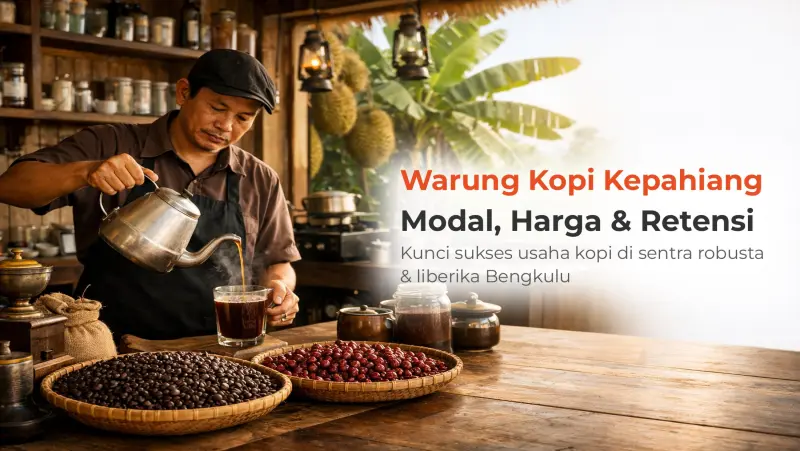
The Bengkulu Province Industry and Trade Office recorded Kepahiang Regency coffee production reaching 20,211.8 tons in 2024, a significant increase from 15,877.52 tons the previous year. Coffee plantation area also expanded to 26,007 hectares spread across six districts, with Muara Kemumu as the largest contributor (6,461 tons). This positions Kepahiang as one of Bengkulu's flagship coffee hubs, supported by 30 coffee processing MSMEs and 102 active cooperatives — the highest cooperative activity rate in the province (95.3%).
Behind the production numbers, Kepahiang coffee boasts a rare flavor profile: banana, tea, and pepper (sahang) aromas emerging from traditional intercropping with banana and durian trees on smallholder farms. The main varieties are Robusta, followed by Arabica and Liberica, processed using traditional methods — red picking, rambang (float sorting), to full wash and honey process. Local brands like Sintaro (Sindang Dataran Robusta), Rapindo Coffee, Chi Nho Nha Coffee, and Khatulistiwa Kopi are gaining recognition beyond the region, with Sintaro once ranked among Indonesia's Top 15 Best Coffees by AEKI 2016.
| Varietal | Main Flavor Notes | Common Process | Farmer Benchmark Price (/kg) |
|---|---|---|---|
| Robusta | Mocha, chocolate, nutty | Full wash, honey | Rp45,000–55,000 |
| Arabica | Fruit, floral, bright acidity | Full wash, natural | Rp65,000–80,000 |
| Liberica | Tropical fruit, floral, herbal | Natural, honey | Rp55,000–70,000 |
Tip 1: Calculate Initial Capital for a Kepahiang Coffee Shop Realistically
Many aspiring coffee entrepreneurs in Kepahiang underestimate capital by only counting rent and equipment. Yet the distinctive character of Kepahiang coffee — requiring special handling from red cherry sorting to traditional drying — adds daily operational costs invisible at the start.
Concrete steps:
- Calculate daily raw material costs: Grade 1 Robusta/Kepahiang coffee beans (farmer benchmark price), local palm sugar, fresh milk, and cup/lid packaging.
- Include equipment costs: grinder, pour over set, cold brew tower, blender for milk coffee, and 0.1g precision digital scale.
- Allocate 3-month reserve fund for bean price fluctuations — green bean prices in Bengkulu can rise 15–20% during delayed harvest seasons.
- Record every expense from day one using a simple financial tracking app so capital doesn't "leak" amid the busy opening period.
With comprehensively calculated capital, a Kepahiang coffee shop can set selling prices that cover fixed and variable costs while maintaining margins for future mini roaster investment.
Tip 2: Price Kepahiang Coffee Based on COGS, Not Guesswork
Coffee prices at Kepahiang shops vary widely: traditional tubruk at Rp5,000 to specialty milk coffee at Rp18,000–Rp22,000. Without Cost of Goods Sold (COGS) calculation per cup, owners hesitate to raise prices when raw materials climb, or silently lose money on flagship menus.
Concrete steps:
- Calculate COGS per standard recipe: bean weight per shot (18–20g), milk volume, sugar, ice, cup, lid, stirrer — down to the smallest unit.
- Differentiate COGS for Robusta-based menus (cheaper) vs Arabica/Liberika (pricier) — don't average prices.
- Add 60–70% margin for milk coffee, 80–100% for manual brew black coffee (barista skill value-add).
- Use Qasir wholesale price feature to set special rates for bulk buyers (other cafes, hotels, events) without renegotiating each time.
COGS-based pricing makes Kepahiang coffee shops resilient to bean price storms and profitable on every cup.
Tip 3: Build Customer Retention Through Loyalty Programs and Consumption Data
Kepahiang locals and coffee tourists have recurring drinking habits — morning black coffee, afternoon milk coffee, evening cold brew. Shops that don't record who the customer is, what they drink, and when, miss natural upsell and cross-sell opportunities.
Concrete steps:
- Create a simple loyalty program: buy 10 get 1 free, or points per cup redeemable for merchandise (tumbler, 100g bean packs).
- Log customer preferences: sweetness level, milk type (full cream/oat/skim), favorite brew method — use this data for personal recommendations on return visits.
- Send personal promo notifications (e.g., "Today Liberika cold brew 15% off") via WhatsApp Broadcast — zero cost, high conversion.
- Analyze daily sales data to know which menus sell best at peak vs quiet hours, then adjust stock and promotions.
Data-driven retention turns one-time buyers into regulars — the foundation of stable revenue for Kepahiang coffee shops.
FAQ: Common Questions About Coffee Shops in Kepahiang
1. What is the minimum capital to open a small coffee shop in Kepahiang?
For a simple take-away coffee shop (15–20 m², 1-group machine, grinder, cold brew tower), initial capital ranges Rp80–120 million including 3 months rent, equipment, 2-week raw material stock, and 1-month operational reserve. This scale suits starting on protocol roads like Jalan Raya Kepahiang or near the town square.
2. Which Kepahiang coffee is most popular with tourists?
Sintaro Robusta-based milk coffee (distinctive mocha notes) and Great Liberica Liberica cold brew (natural process, fruity notes) are favorites. Tourists also seek traditional "kopi rambang" tubruk from local farmers for an authentic experience.
3. Is halal certification required for coffee shops in Kepahiang?
Under Law No. 33 of 2014, halal certification is mandatory for certain MSME categories starting October 2026. While micro coffee shops can use BPJPH's free certification pathway, having a halal label expands the market to the Muslim-majority community in Bengkulu and opens partnership opportunities with certified hotels/restaurants.
4. How to handle delayed harvest seasons that spike bean prices?
The key: fixed purchase contracts with farmer cooperatives (like Koperasi Sintaro or Koperasi Rapindo) at seasonal benchmark prices, and store 2–3 months of green bean stock in humidity-controlled storage. Menu diversification with milk coffee (uses less bean per cup vs manual brew) also absorbs cost pressure.
5. When is the right time to invest in a roaster machine?
If monthly sales volume stabilizes above 15kg beans and finished coffee margin exceeds 65%, in-house roasting becomes cheaper than buying roasted beans. Start with a 1–2kg batch roaster, learn light–medium roast profiles for Kepahiang Robusta (optimal for mocha/chocolate notes), medium-dark for Liberica.
Business and Financial Tips for Kepahiang Coffee Shops
Amid Kepahiang's rapidly growing coffee ecosystem — from farmers, cooperatives, to local brands starting to export — coffee shop owners need strong financial foundations to avoid being merely "busy but not profitable."
1. Separate Business and Personal Finances from Day One
Many Kepahiang coffee entrepreneurs mix bean purchases, barista wages, and household expenses in one wallet. Open a separate account, record every transaction (can use Qasir digital POS), so monthly net profit is clear without "guessing" at month-end.
2. Calculate COGS per Variant, Not Average Across All Menus
Robusta tubruk, Arabica milk coffee, and Liberica cold brew have vastly different cost structures. Calculate COGS per standard recipe for each variant, then set fair margins per menu. Silent loss-makers (e.g., Liberica cold brew using premium beans but priced like regular milk coffee) will erode overall margins.
3. Prepare 3–6 Month Operational Emergency Fund
Bengkulu's rainy season can disrupt bean supply and reduce customer visits. Emergency funds guarantee barista wages, rent, and electricity stay paid even if revenue drops 30–40% for 1–2 months.
4. Evaluate Financial Performance Monthly, Not Annually
With many menu variants and seasonal demand (rising during holidays/harvest, falling during heavy rains), monthly P&L statements let you quickly spot shrinking-margin menus, when to raise prices, and when to reduce specific raw material stocks.
Qasir Features for Kepahiang Coffee Shops
Digital POS for Fast Coffee Transaction Recording During Peak Hours
Qasir digital POS enables recording coffee orders (manual brew, milk coffee, cold brew) in seconds via Android phone — no messy notebooks during long queues. Transactions auto-save to daily reports even when internet briefly drops.
Real-time Coffee Bean, Milk, and Packaging Stock Management
The stock management feature tracks Robusta/Arabica/Liberica beans, full cream/oat milk, palm sugar, cups, and lids in real-time. Minimum stock alerts prevent running out of ingredients during morning or afternoon rushes.
Sales Reports per Coffee Variant for Menu Decisions
Sales reports display revenue and quantity per coffee menu (tubruk, milk coffee, cold brew, manual brew) daily/weekly/monthly. This data drives decisions: which variant to promote, which to standardize recipes, which to discontinue.
Wholesale Pricing for Cafe, Hotel, and Event Partners in Kepahiang
The wholesale price feature enables tiered pricing: retail rates for walk-in customers, special rates for other cafes buying beans/roasted beans in bulk, and event rates for coffee catering at weddings/meetings. B2B sales become structured without repeated manual negotiation.
Conclusion
Kepahiang coffee arrives with unique strengths: banana-tea-pepper aroma profiles from traditional intercropping, complete Robusta-Arabica-Liberica varieties, and an ecosystem of 30 processing MSMEs + 102 active cooperatives supporting each other. Coffee shop opportunities in Kepahiang are wide open — serving locals, coffee tourists, or becoming bean/roasted bean distributors beyond the region.
Success hinges on three pillars: calculate capital and COGS realistically (not guesswork), price based on per-cup cost data, and build customer retention through preference tracking and simple loyalty programs. Add financial discipline: separate accounts, monthly evaluation, and emergency reserves — the foundation for coffee shops to not just survive, but grow into nationally recognized Kepahiang coffee brands.
Manage Kepahiang Coffee Shops More Easily with Qasir Features
- Digital POS — record manual brew, milk coffee, cold brew orders on phone without notebooks, auto daily reports.
- Stock Management — monitor Robusta/Arabica/Liberica beans, milk, palm sugar, packaging real-time; minimum stock alerts.
- Sales Reports per Variant — view revenue & quantity per coffee menu daily/weekly/monthly for menu decisions.
- Wholesale Pricing — set tiered pricing for walk-ins, partner cafes (bulk bean buys), and event catering.
- Auto Cash Recap — cash in/out from transactions auto-recorded, fast drawer close without manual counting.
- Customer Data — save favorite drink history, visit frequency, for loyalty programs & personal promos.
Download Qasir free on Play Store and start recording your Kepahiang coffee shop transactions today.