
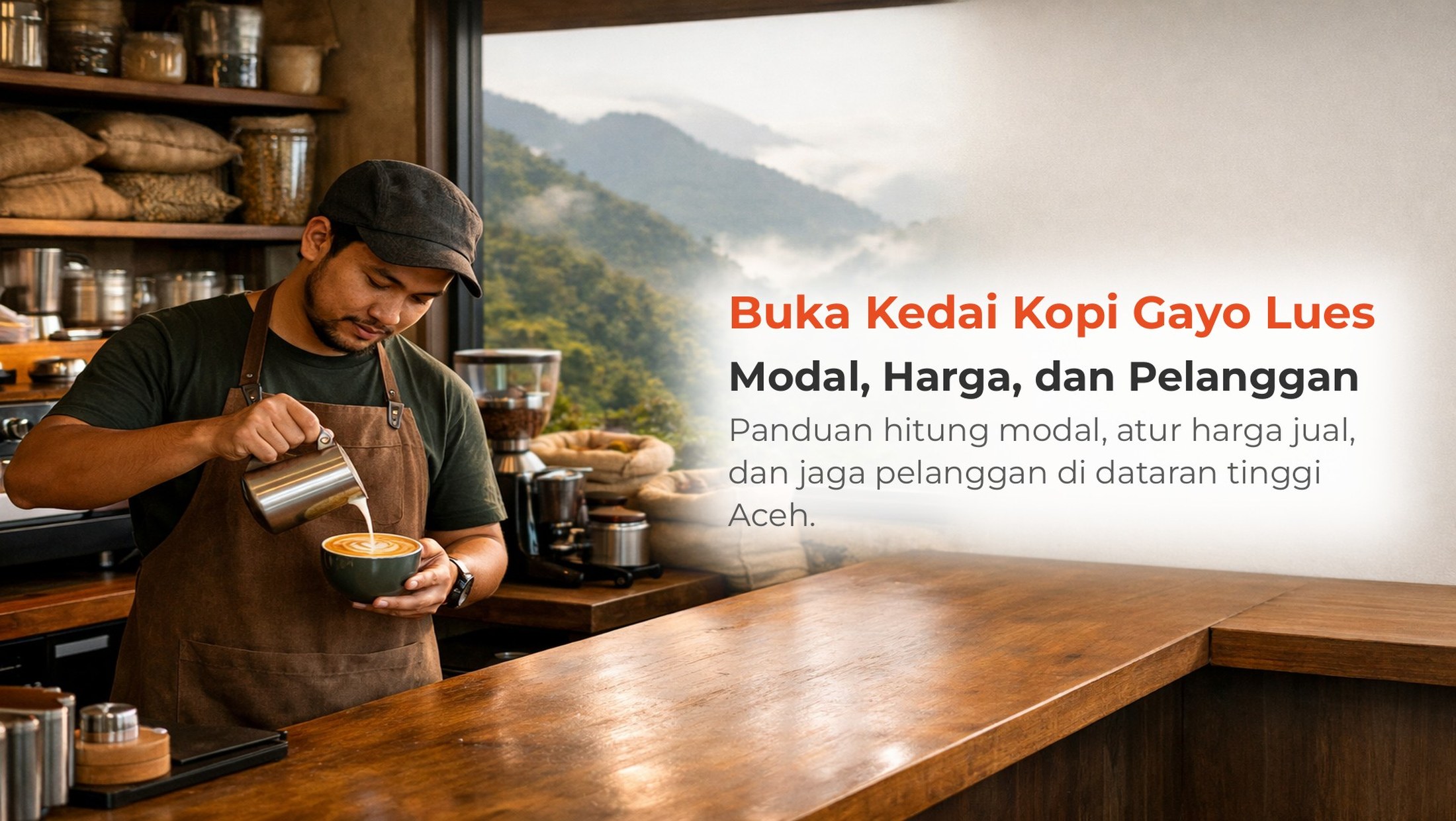
Coffee prices at the farm level have moved from around Rp18.600 per kilogram to around Rp68.000 per kilogram, and the wine coffee variety reaches Rp185.000 per kilogram. The upstream market has a clear entry point, and for Gayo Lues coffee shops that means two things at once: demand is rising, but raw materials are not cheap.
Gayo Lues Regency covers about 5.549,91 square kilometers, with an estimated population of 108.429 people in mid-2025. The full data is in the Gayo Lues Regency in Figures 2026 publication from BPS.
The Gayo Lues coffee profile has its own character, which can be a selling point. Gayo Arabica coffee, cultivated in the highlands, is processed in several ways, from full wet to honey processing. The varieties commonly grown here include Gayo 1 or Timtim, Gayo 2 or Borbor, Ateng Super or Gayo 3, and P88. Research from Syiah Kuala University records Ateng Super with the highest cupping score, around 85,36, and full wet processing with the highest cup quality among the methods tested.
In terms of taste, Gayo 1 or Timtim tends to be lighter and brighter with a sweet spice aroma, Gayo 2 or Borbor has higher acidity and thicker sweetness, while Ateng Super is known for its floral aroma and rich flavor. These differences give Gayo Lues coffee its own place in the specialty market, and make good material for stories on the shop wall.
Official MSME data can also be a reference. The Ministry of Cooperatives and SMEs, through the Single Data Base for MSMEs, records non-agricultural MSMEs in Aceh as of 31 December 2025, and the SMEsta Ministry of Cooperatives and SMEs portal lists coffee business profiles in Aceh. It helps new business owners enter the coffee market without guessing.
The factory in Porang Village, built together with the Gayo Lues Bersinar Coffee Cooperative, already has purchase channels into international coffee networks. The upstream market is shifting, and prices there are often higher than at the collector level.
Many business owners in the highlands see rising coffee prices as a reason to open a Gayo Lues coffee shop, then stop halfway because the raw material capital is too large and the sales records are a mess. This article covers three steps: calculating capital properly, setting a healthy price, and keeping customers coming back.
Tip 1: Calculate the Starting Capital for a Gayo Lues Coffee Shop in Detail
Many coffee businesses fail not because the product is not good enough, but because the initial costs are calculated too loosely. In Gayo Lues, the largest capital component is usually not the rent, but the price of green beans and brewing equipment.
As a benchmark, commercial arabica green beans in Indonesia sit around Rp150 thousand to Rp300 thousand per kilogram, while specialty arabica can reach Rp300 thousand to Rp600 thousand per kilogram. Robusta is more affordable, around Rp100 thousand to Rp200 thousand per kilogram. These prices are a general market picture, not fixed, and can change with the harvest season, quality, and purchase volume.
For espresso machines, the commonly cited benchmark is Rp15 million to Rp35 million for a one-group commercial unit suited to a small coffee shop, and Rp40 million to Rp85 million for a two-group unit with medium sales volume. The calculation should use the total budget, not just the machine price: the grinder, water installation, and first-year maintenance push the total up to around 1,4 to 1,7 times the machine price.
Those cost details can be summarized as follows:
| Component | Estimated Range | Notes |
|---|---|---|
| Arabica green bean | Rp150 thousand - Rp600 thousand per kilogram | Prices change every week |
| Commercial espresso machine | Rp15 million - Rp85 million | Match the number of cups per day |
| Grinder and water installation | Rp8 million - Rp25 million | The coffee taste changes without this |
| Renovation, tables and chairs | Rp3 million - Rp12 million | Match the number of seats to your target market |
| Initial raw material stock | Rp5 million - Rp15 million | Prepare the list of variants first |
| 3 months of working capital | Rp10 million - Rp30 million | Covers electricity, wages, and raw materials |
In practice, write down the variants you really want to sell, then calculate the raw material needs for each. Buy stock in small but frequent quantities, not all at once. If a variant does not sell, the loss stays small and can be stopped right away.
How to calculate profit from coffee sales is explained in detail in the article how to calculate profit correctly. The main point is the same: selling price minus all per-portion costs, including shrinkage, packaging, and shipping.
Tip 2: Set a Healthy and Competitive Selling Price
Gayo Lues coffee prices are rising, and that is good news for farmers. For the shop owner, higher raw material prices mean selling prices cannot keep climbing without calculation. Tubruk coffee, espresso, and milk have different cost structures, so one price for every variant will turn part of the menu into a source of loss.
Calculate the cost per portion first, then add a margin. The common pattern is a margin of around 30 to 50 percent above the ingredient cost, then compare the result with prices in the surrounding area. Too far above and buyers move to another shop. Too cheap and the business looks profitable at the register but not at the end of the month.
In Gayo Lues there is one pricing strength: local coffee products with a clear story. Coffee beans from Pantan Cuaca, for example, can be offered as a local product, not just an ordinary cup of coffee. The difference is real, and paying a higher price makes sense when there is something to tell about where the beans come from.
For corporate customers, wholesale pricing is a weapon local coffee shops rarely use. Other coffee stalls, hotels, and offices around Blangkejeren often buy in large quantities for meetings or events. With a single wholesale price, you can increase turnover without adding customers. How to set wholesale prices is explained in the article maximizing sales with the wholesale price feature.
Tip 3: Keep Customers Coming Back to Your Gayo Lues Coffee Shop
A coffee shop in the highlands has one challenge other regions do not have: customers arrive in an unpredictable pattern. Weather, the tourist season, and the working day affect visitor numbers. So the most valuable thing is not today's customer count, but the customers who come back next week.
Start by recording who your customers are. The name, the variant they usually order, and the date of the last visit are the simplest but most useful data. A customer who always orders palm sugar milk coffee, and knows their favorite is in stock, finds it much easier to come back if the cashier remembers. The importance of customer data is discussed in the article why customer data matters for MSMEs so customers keep coming back to shop.
Besides recording, offer packages that give people a reason to come regularly. A monthly cup package at a special price for regular customers, for example, is already used by many coffee shops. What needs recalculating is how many cups are actually sold in a month.
A package like this gives two things at once: cash flow at the start of the month, and buyers with a reason not to switch shops. The details of implementation are in the article how to promote a coffee shop without a large budget.
One thing often missed in the regions: new customers who come once and immediately love it are often ignored. Yet many visitors to Gayo Lues are seasonal workers who may come back several months later.
Save your customers' numbers, then send a short message when there is a new variant or a weekly promotion. Where connectivity is limited, a short message through a messaging app is the cheapest way to retain customers. Old customers who feel appreciated are far more likely to return.
FAQ: Questions About Coffee Shops in Gayo Lues
How much capital is needed to open a coffee shop in Gayo Lues?
No single figure applies to everyone; it depends on the scale and the concept. For a small shop with ten to twenty seats, the commonly cited benchmark puts capital at around Rp14 million to Rp30 million, with monthly operating costs of around Rp10 million to Rp18 million. That excludes a commercial-grade espresso machine, so capital needs to be added separately.
Are Gayo Lues coffee prices still reasonable for a coffee shop business?
Farm-level prices have risen quite high. Data as of 7 November 2026 records farm-level coffee prices in Gayo Lues moving from around Rp18.600 per kilogram to around Rp68.000 per kilogram, and the wine coffee variety can reach Rp185.000 per kilogram. The buying margin from farmers is therefore more attractive, but raw material prices for roasters or retailers buying green beans also move. So per-portion calculations must be updated, not taken from old numbers.
Where can you find green beans and roasted coffee around Gayo Lues?
Production centers in Gayo Lues span eleven districts, with Pantan Cuaca as the area producing the best coffee. In Kampung Agusen, part of Blangkejeren District, ninety-nine percent of residents work as coffee farmers, and the plantation area there is around 250 hectares. Coffee processing factories also operate from Porang Village, and KSU Gayo Coffee Mountain Leuser in Penosan has already supplied coffee to Starbucks. Part of the production has already been shipped to Yogyakarta and North Sumatra.
Are there examples of coffee shops already running in Blangkejeren?
Yes, and the number keeps growing. Blangkejeren has Blower Coffee House, Gaterbas Coffee Roastery, Winlah Coffee, Resam Coffee and Roastery, Teras Studio in Cafe, and Leuser Coffee. In Pantan Cuaca, there is Kafe Bur Gondang on the side of the hill. The market is there, and the shops that survive are usually not the most expensive, but the most consistent ones.
How do you make sure daily sales are recorded neatly?
Use one cash register app for all transactions, and make sure every sale goes into the daily report. From that report you can see the busiest hours, which variant sells best, and the average spend per transaction. How to read a sales report is explained in the article a busy shop but which product sells best, check the sales data.
Business and Finance Tips for Coffee Shop Owners in Gayo Lues
Separate business cash from household cash from day one
Many household losses appear because business money gets used for home needs. Separate them from the start: one cash fund for the business, one for the home. Cash In and Cash Out records in Qasir show exactly how much money goes into the business and how much comes out.
The details of how to separate these two cash funds are in the article do not go on feeling, start recording income and expenses.
Prepare an emergency fund for months without many orders
Seasons in Gayo Lues are uneven. In certain periods visitor numbers drop, and available cash runs out before the big days. Set aside an emergency fund from the busy months, then use it only when it is truly needed.
Review your purchase price every time the coffee price changes
Coffee prices in Gayo Lues move fast. Within weeks, the farm-level price of green cherries rises from around Rp18.600 per kilogram to around Rp68.000 per kilogram. If the purchase price is not reviewed, a margin that once felt safe can become thin without you noticing.
Record one important number every month: net turnover per variant
Big turnover does not necessarily mean big profit. What you need to watch is how much is left from each variant after ingredient, packaging, and labor costs are deducted. The sales and profit reports in Qasir show that figure per variant, so you know which products actually bring in profit.
Conclusion
Gayo Lues Regency has real potential to grow as a coffee business hub: eleven districts as production centers, coffee prices moving high at the farm level, and a market that has already formed in Blangkejeren and Pantan Cuaca. The visit by BNNP Aceh on 7 November 2026 shows the production chain in this region is growing, from the plantation to the processing factory in Porang Village.
Coffee business owners in Gayo Lues need to do six things so they are not carried away by moving prices:
- Calculate capital in detail, including working capital for the first three months
- Calculate the cost per portion, then set a margin of around 30 to 50 percent
- Set a wholesale price for large buyers such as hotels and offices
- Record customer names, favorite variants, and the date of the last visit
- Separate business cash from household cash and set aside an emergency fund
- Review purchase prices and net turnover per variant every month
All of these steps need one and the same thing: tidy records. Tidy records let you calculate profit, maintain quality, and read your customers from the numbers instead of from guesswork.
Manage Your Gayo Lues Coffee Shop More Easily with Qasir Features
Managing a coffee business in Gayo Lues involves a lot to record: green beans sold, milk and sugar used, prices for bulk buyers, and customer records. All of it can run from one digital cash register app, with no separate notebook.
A digital register for transactions in the shop and outside the shop
Every sale is recorded automatically with a receipt for the customer, so you know your daily sales without recounting from the notebook.
Stock management for green beans, milk, sugar, and packaging
The stock management feature reduces the risk of running out of raw materials without noticing, and warns you when stock is running low so you can order before the shop runs out.
Wholesale prices for buyers who order in large quantities
Hotels, offices, and other coffee stalls around Blangkejeren buy in large quantities. In Qasir, the wholesale price can be set directly on the product, so the selling team does not recalculate prices every time a large order comes in.
Sales and profit reports to see which variants are profitable
With sales and profit reports, you can see which variant sells best and what the margin is per variant, so the next production run can be directed to the variants people are actually looking for.
Customer data to keep buyers who have already come
Buyers who have tasted your coffee tend to come back. The customer feature in Qasir stores purchase history, so you know which variant is often bought and when to offer a new one.
Cash In and Cash Out to separate business cash from home cash
Cash In and Cash Out records money going into and out of the business, so you can see how much is real profit and how much is for household needs.
Download Qasir for free on the Play Store or App Store, and start tidying up your coffee sales records in Gayo Lues today.