
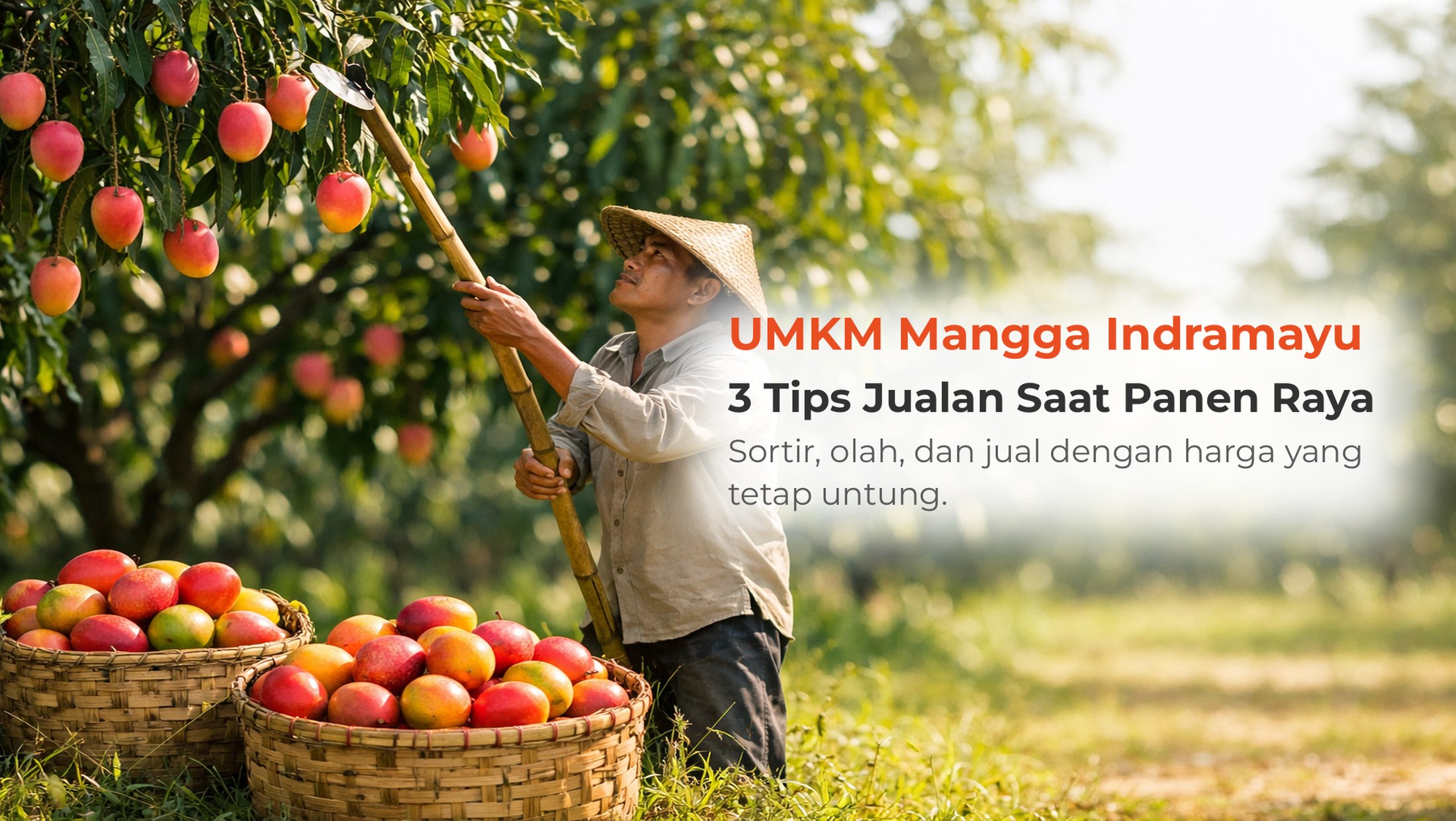
Every year around the middle of the year, the roads along the northern coast of West Java turn into one giant fruit market. Trucks loaded with produce line up, temporary stalls appear at every junction, and farm-gate prices move quickly with supply. Behind that bustle sits one commodity that marks the season: the gedong gincu mango from Indramayu Regency.
Data from Statistics Indonesia (BPS) for July 2026 puts Indramayu mango production at 1,351,779 quintals, or roughly 135,177.9 tonnes. That figure makes it the largest producer in West Java, contributing about 55.9 percent of total output across the Ciayumajakuning area. The nickname Mango City is not a slogan; it reflects the sheer scale of a harvest that has to be absorbed by the market every year.
That scale cuts both ways. On one hand, abundant supply opens opportunities in processing and trading. On the other, when the peak harvest arrives, farm-gate prices can be pressed down because everyone is selling the same thing at the same time. Traders know the pattern well: in season, gedong gincu can sit around Rp20,000 to Rp25,000 per kilogram, while out of season the figure can climb to Rp40,000 or Rp45,000 per kilogram.
For small business owners, that gap is not a reason to give up. It is exactly where business management is tested: how to sort the produce, process what fails the grade, and sell through the right channels so that an abundant harvest does not turn into a loss.
Why the Mango Harvest in Indramayu Tests Every Business
Indramayu Regency grows more than one variety. Besides gedong gincu, which is the export commodity, there is cengkir, usually used for fruit salad and preserves, and gajah, which is large in size. That diversity is an advantage, because each variety has its own market. The problem is that many business owners focus on a single type and a single sales channel, so when peak supply arrives they run out of ways to sell.
Local practice in fruit centres such as Krasak Village and Jatibarang District offers an important lesson. Farmers there pick the fruit with a sodo, a long bamboo pole with a special blade, so the fruit does not fall and bruise. After picking, the fruit is sorted by skin colour, aroma, and ripeness. Fruit that does not meet shipping standards is not thrown away; it is redirected to processing or the local market. The principle is simple: one orchard produces several grades of goods, and each grade has a different sales destination.
Tip 1: Sort and Grade the Fruit Before Setting a Price
The most common mistake during peak harvest is selling every piece of fruit at a single price. In reality, quality within one orchard is never uniform. Some fruit is flawless and ready to ship out of town, some has uneven colour, and some is bruised from falling. If everything is mixed in one basket, buyers will value it at the lowest price.
Concrete steps:
- Split the fruit into three grades: grade A for flawless fruit with even colour and strong aroma, grade B for fruit that is fine to eat but ordinary in appearance, and grade C for bruised or overripe fruit.
- Weigh and record the volume of each grade every day, so you know what share of the harvest is genuinely fit for fresh sale.
- Set a different price for each grade and display it on a board at the stall or in your online catalogue. Buyers trust a seller who shows a clear basis for pricing.
- Keep grade C separate and move it to the processing kitchen immediately, because it spoils quickly if left in a pile.
Careful sorting also saves shipping costs. When you send fruit out of town, one bruised piece can affect the rest of the box and cause the whole shipment to be rejected. With proper grading, you can select only grade A for long-distance delivery, while grade B goes to the local market or is sold directly to consumers.
The habit of recording sorting results pays off over time. After a few seasons you will have real data: which variety most often passes as grade A, which orchard is consistent, and what the average shrinkage is after sorting. That data is what you use later to negotiate prices with large buyers, instead of relying on feelings or guesswork.
Tip 2: Turn Grade B and C Fruit into Value-Added Products
Fruit that fails shipping standards is not worthless. In Indramayu Regency, fruit processing is growing. The 2026 GINCU-AYU innovation programme recorded five processed fruit innovations reaching the final assessment, from crackers and fruit-seed coffee to cascara and fruit-based snacks. One local small business even won a national title with pineapple tarts filled with gedong gincu jam.
Concrete steps:
- Choose one processed product that fits your kitchen capacity and shelf life, such as jam, dodol, crackers, or candied fruit.
- Calculate the cost per pack by including fruit, sugar, packaging, labour, and production shrinkage, not just raw materials.
- Produce small packs for a market test, then record which product sells out fastest within two weeks.
- Obtain distribution permits and halal certification if the product will enter modern retail, because buyers there ask about them before discussing price.
Value addition is most visible at peak season. When fresh fruit prices fall, the raw material cost of processed goods falls too, so margins on finished products actually widen. Conversely, out of season you still have processed stock that can be sold at a stable price. This is the most practical way to break dependence on fresh fruit price swings.
Tip 3: Protect Your Price with Layered Sales Channels
At peak supply, one sales channel is never enough. If every seller competes for buyers in the same market, prices will undercut each other. The answer is not to hold stock until it rots, but to open several sales doors at once, each aimed at a different group of buyers.
Concrete steps:
- Open pre-orders before the harvest. Buyers who order early get guaranteed quality and price, while you get certainty about how much produce will be absorbed.
- Separate the channels: grade A for out-of-town delivery and modern retail buyers, grade B for the local market and fruit stalls, grade C for your own processing kitchen.
- Apply wholesale pricing for buyers who take large volumes and retail pricing for single-unit buyers, so the two do not cannibalise each other.
- Record where each buyer comes from and how much they purchase every day, so you know which channel is most profitable next season.
Do not overlook neighbouring industries. Indramayu Regency is also known for shrimp paste and processed fish from the Karangsong coast, complongan batik, and smallholder salt. Fruit businesses can work with them on local gift packages, for example a hamper containing candied fruit, packed shrimp paste, and batik cloth. This kind of cooperation widens the market without requiring large additional capital.
What you should avoid is selling below cost just to clear stock. Calculate the lowest price that still covers your costs, then offer other forms of value such as neat packaging, delivery service, or a discount for bulk purchases. Buyers appreciate clarity, and consistent pricing builds long-term trust.
FAQ: Common Questions
When does the mango season in Indramayu take place?
The harvest usually runs in stages from the middle of the year and peaks around September to October. Out of season, supply thins and prices rise, which is why processed products become the backbone of sales.
Can grade B and C fruit still be sold at a high price?
Not as fresh fruit. Their value rises once they are processed into jam, dodol, crackers, or candied fruit, because raw material costs are low while finished product prices are more stable.
How do I set a fair selling price?
Start from cost: purchase price, sorting cost, packaging, labour, and shrinkage. Then add a reasonable margin and compare it with local market prices so you stay competitive.
Do I need to record daily sales digitally?
Yes, especially during harvest season when transactions move fast. Digital records help you see which products sell best, which channel is most profitable, and how much stock must be redirected quickly.
Business and Finance Tips for Fruit Traders
The harvest season lasts only a few months, but business costs run all year. That is why financial management has to be prepared before the season arrives, not after the money is gone.
- Separate business money from household money. Open a separate account or digital wallet and set a fixed owner's salary each month. Without this separation, seasonal profit disappears without a trace.
- Work out your cost price before setting a selling price. Break down every cost component, including shrinkage and shipping, so you know the lowest price that is still profitable.
- Set aside a business emergency fund. Weather, pests, and shifts in demand can change your harvest. Keep part of the peak-season profit to cover the quiet months.
- Review your records every week. Four numbers are enough: income, expenses, remaining stock, and receivables. From those you can make the next purchasing decision calmly.
An example cost breakdown per kilogram of fruit sold fresh can be arranged as in the table below. The figures illustrate the cost structure, not a market price benchmark.
| Cost component | Role in the calculation |
|---|---|
| Purchase price from farmers | Main basis of cost price |
| Sorting and labour | Cost of preparing goods |
| Packaging and boxes | Higher for long-distance shipping |
| Freight | Differs by sales channel |
| Shrinkage and damaged fruit | Often forgotten, yet real |
With a simple table like this, you can recalculate prices whenever the purchase price changes. Selling decisions become based on numbers rather than estimates.
Qasir Features for Indramayu Mango MSMEs
Neat record-keeping does not have to be complicated. Several Qasir features can be used directly for both fresh fruit and processed products.
Digital Cashier for Daily Transactions
Record every sale straight from your phone, without a manual cash book. As a result, daily turnover and transaction counts can be checked at any time, even when the stall is busy with buyers.
Stock Management for Fruit and Processed Products
Track remaining stock per product and get a warning when quantities run low. For a fruit business, this helps you decide when to re-sort or redirect leftover fruit to the processing kitchen.
Wholesale Pricing for Bulk Buyers
Set special prices for buyers who take large volumes. You can serve wholesale and retail customers at the same time without recalculating manually on every transaction.
Sales and Profit Reports
Summarise sales, expenses, and profit in a single view. These reports are what you use to judge which sales channel is most profitable in the following season.
Conclusion
An abundant harvest in Indramayu Regency is an opportunity, not a threat, as long as the produce is managed well. Sorting determines price, processing rescues fruit that fails the grade, and layered sales channels keep prices reasonable when supply peaks. All three rest on one thing that is often overlooked: accurate records.
Start with the simplest step. Record every transaction, calculate your cost price honestly, and separate business money from personal money. If you need a guide to recording daily income and expenses, there is a practical guide to recording business income and expenses you can apply right away. To see which products sell best, read how to read your sales data.
If capital is a constraint when you want to expand processing capacity, the 2026 KUR scheme for MSMEs may be worth considering. Meanwhile, for bulk buyers, first learn how to use the wholesale price feature so retail and wholesale prices do not undermine each other.
Manage Your Indramayu Mango Business More Easily with Qasir Features
Qasir brings transaction records, stock, and reports together in one app you can use from your phone. For fruit and processed product businesses, these features are the most frequently used:
- Digital cashier to record daily sales without a manual book.
- Stock management so remaining fruit and processed products are always visible.
- Wholesale pricing to serve bulk buyers at special rates.
- Sales and profit reports as the basis for next season's decisions.
- Cash in and cash out so the flow of business money stays clear.
Download Qasir for free on the Play Store and start recording your first transaction today. Next harvest season will feel far calmer because decisions come from numbers, not estimates.