
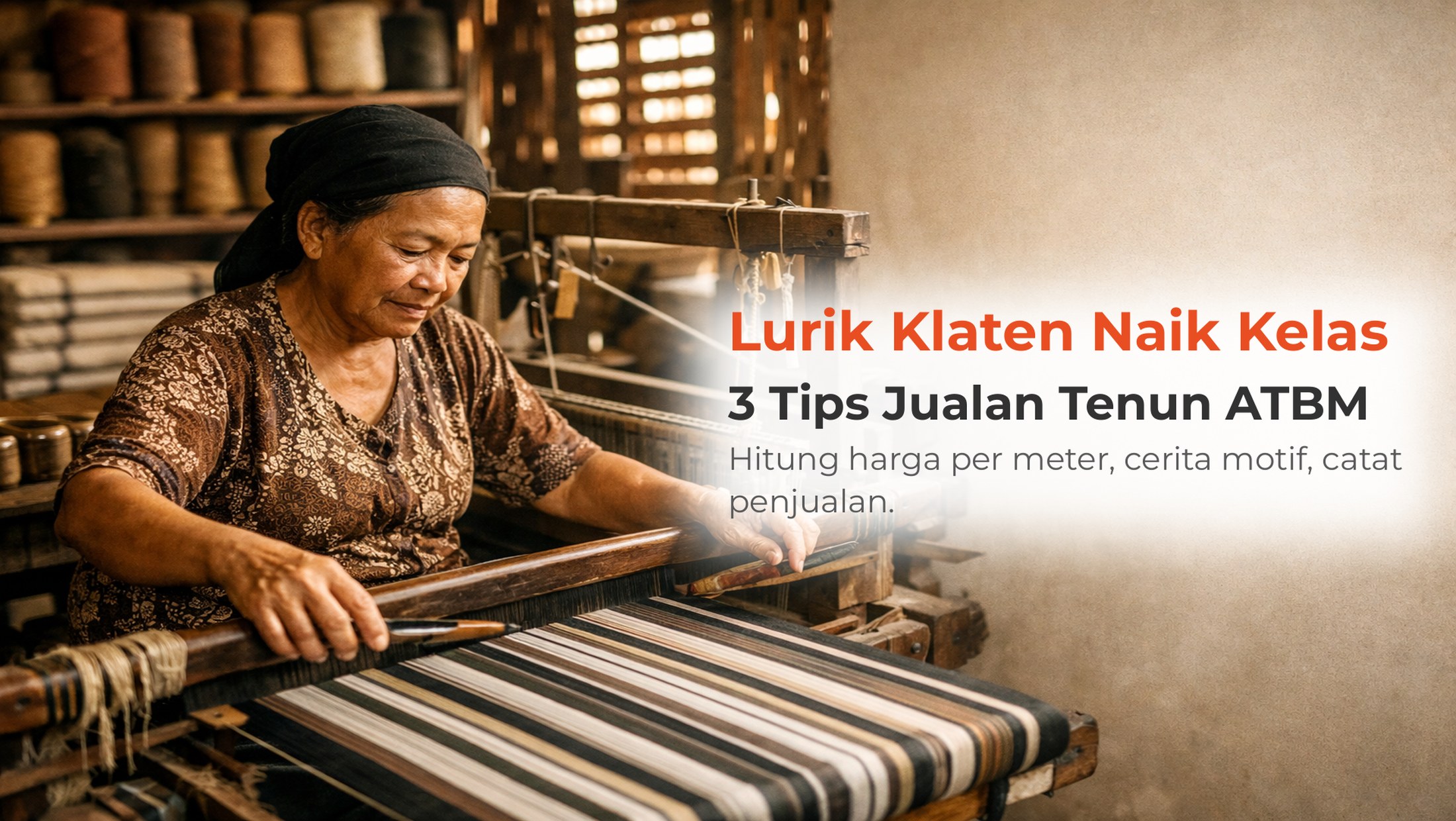
Handwoven lurik cloth from Klaten is back in the spotlight. Not because of a festival or a carnival, but because export demand for fashion and textile products keeps opening up. The Ministry of Trade recorded USD 361.61 million in business matching transactions from January to October 2026, with fashion and textiles among the products foreign buyers look for most. That figure consists of USD 76.38 million in purchase orders and USD 285.23 million in potential transactions from 1,433 businesses.
The news sounds good. But one problem rarely gets discussed: lurik weavers in Klaten keep shrinking in number, and most of those still working are elderly. The centers in Pedan and Cawas still work on handlooms while demand rises. That means owners who manage production, pricing, and sales properly win twice: better prices, and more serious buyers.
This article covers practical ways to run a Klaten lurik business so it is ready not just for the local market, but for institutional orders and overseas buyers.
Lurik Klaten and the Face of the Small Industry Around It
Klaten Regency has a trait that is hard for other regions to copy: almost every product is born from human hands, not large machines. In Pedan and Cawas, people weave lurik from one generation to the next. In Tlingsing Village, Cawas District, around 225 weavers are still active. Some have moved to machine looms, but many stay with ATBM because buyers are actually looking for the texture and the small imperfections that only handweaving gives.
Beyond lurik, Klaten also has painted pottery from Melikan Village in Bayat District, shaped on a slanted wheel, a technique unlike other pottery centers. Coconut sugar and home-made foods supply traditional markets across Central Java. These three industries share the same pattern: local raw materials, skills passed down through generations, but business management that is still largely manual.
That pattern makes businesses here prone to losing money without realizing it. A flood of orders does not mean profit, fabric stock piles up without records, and prices are often set by gut feeling. Yet the product has high selling value.
The Opportunity That Is Opening Up
The Central Java provincial government has stated its commitment to strengthening the traditional weaving industry, including the centers in Klaten. The Ministry of Trade business matching program is also actively connecting businesses with buyers from 33 countries. For textile products, buyers usually ask three things: consistent quality, production capacity, and on-time delivery. All three can only be answered if the business keeps clear production and sales records.
Tip 1: Work Out Your Cost per Meter Before You Negotiate a Price
The most common mistake in a weaving business is selling at a "follow the market" price without knowing the real cost. Lurik weaving carries quite a few cost components: yarn, dye, weaving wages, winding and threading wages, electricity, equipment depreciation, and the cost of failed production.
A simple example. For one 2-meter length of lurik, say yarn and dye cost Rp24,000, weaving wages Rp14,000 (weaving wages in several Central Java centers hover around Rp7,000 per meter), preparation wages Rp6,000, and other costs Rp6,000. Total direct cost is Rp50,000, or Rp25,000 per meter. If it sells for Rp180,000 for two meters, the gross margin is Rp130,000. That sounds large, but marketing costs, return shipping, and slow payment still come out of it.
Concrete steps:
- Record costs per piece of cloth, not per month. One piece is one unit you can compare directly against the selling price.
- Add loom depreciation. A wooden ATBM can last for years, but its parts still need replacing. Set aside around Rp500–Rp1,000 per meter for this.
- Calculate your yield. Not every thread becomes perfect cloth; some comes out flawed and has to be sold as second quality. Build that loss into the price of first-quality cloth.
Once the per-meter figure is clear, negotiating with wholesale buyers becomes far calmer. You know the floor that still leaves a profit, and when to say no. To go deeper into the math, there is a guide to calculating business profit you can use as a starting point.
Tell Retail, Wholesale, and Custom Orders Apart
Another common mistake: using one price for every buyer. A retail buyer at the market takes one piece, an office uniform buyer orders 50 pieces, and an export buyer may ask for 300 meters in a custom motif. These three order types have different cost structures, so different prices make sense.
| Buyer type | Volume | What to factor in |
|---|---|---|
| Market retail | 1–3 pieces | Price per piece, tailoring cost if any, time spent haggling |
| Wholesale / reseller | 10–50 pieces | Volume discount, bulk packaging cost, payment terms |
| Institutional order | 50–300 meters | Motif design cost, sample trials, delivery deadline, quality guarantee |
With a table like this, you can build a tiered price list and stop recalculating every time someone asks. The wholesale price feature in a point-of-sale app can also help, so prices adjust automatically to the quantity purchased.
Tip 2: Build a Product Story You Can Reuse on Every Channel
People who buy woven cloth are not only buying cloth. They are buying a reason to wear it. Lurik motifs have names and meanings: some are worn for traditional ceremonies, some for uniforms, some are chosen deliberately for their calm earth tones.
The trouble is this story often lives only in the weaver's head. The moment the product reaches a marketplace or is offered to an office, the description becomes "premium ATBM handwoven lurik cloth" and stops there. Buyers are left with no emotional reason to choose your product over a cheaper one.
Concrete steps:
- Write a one-page profile: who does the weaving, in which village, how long one piece takes, and what the motif means.
- Photograph the process, not just the result. Pictures of yarn drying in the sun, the loom in use, and hands at work are usually more convincing than a posed catalog.
- Prepare three versions of the description: one for marketplaces (short, clear keywords), one for B2B offers (focused on capacity and quality), and one for social media (story and process).
A consistent story also helps with legal requirements and standards. For institutional and export markets, documents such as a NIB, a certificate of origin, and quality standards are often requested. Preparing the product narrative early makes this process faster, because all the information is already organized in one place.
Tip 3: Sell on Three Channels at Once, but Record Everything in One Place
Weavers whose sales grow are usually not the most active posters, but the tidiest record keepers. They know which products sell best, which channel is most profitable, and which motifs get requested most.
The classic problem: orders arrive from the market, WhatsApp, marketplaces, and office offers. Each goes into a different book, sometimes nowhere at all. In the end warehouse stock does not match the records, and a large order gets turned down because the stock is assumed gone.
Concrete steps:
- Use one product list with simple codes, for example LRK-01 for a striped lurik motif and LRK-02 for a checkered one. The same code is used on every channel.
- Record each transaction as it happens, not when you close the books. A one-day gap often turns into a large discrepancy once orders pile up.
- Keep business money and personal money separate. It sounds trivial, but family weaving businesses most often leak at exactly this point.
- Review sales data every week to see which motifs and sizes run out fastest. This guide to reading sales data can serve as a reference.
Tidy records also open access to financing. Banks always ask for a summary of sales from the past few months before approving working capital credit. Without records, applications often stall even when the business has been running for years. This guide to recording income and expenses is a good first step.
FAQ About the Klaten Lurik Weaving Business
Can small weavers export Klaten lurik cloth directly?
Yes, but in stages. Weavers usually start through a cooperative, an exporter, or a support program such as the business matching run by the Ministry of Trade. What needs to be ready first is consistent quality, production capacity you can commit to, and complete business documents.
How much does handwoven lurik cloth cost per meter?
There is no single figure, because it depends on the type of yarn, how complex the motif is, and the width of the cloth. ATBM cloth made of cotton usually sits in the range of hundreds of thousands of rupiah per piece, while special motifs or natural dyes can go higher. What matters is not the number itself, but that you know your own cost per meter.
How do I compete with factory-made lurik that is cheaper?
Do not fight on price. Position your product as handwoven cloth with a story, limited quantities, and a different quality of fabric. Buyers looking for mass uniforms will choose the factory, but buyers after something distinctive avoid products that are too uniform.
Does a weaving business need a point-of-sale app?
Yes, especially once sales run through more than one channel. A point-of-sale app helps you record transactions, track fabric stock by motif, and see sales reports without recounting everything in a ledger. For a business that is still a one-person operation, the biggest benefit is time.
Business and Financial Tips for Weavers
1. Separate business cash from household cash. Set an owner's salary every month, however small. That way business profit does not get mixed up with daily needs, and you can see whether the business is really growing.
2. Set aside a business emergency fund. A weaving business depends heavily on yarn availability and seasonal orders. Keeping 10–15 percent of net profit each month helps when raw material prices rise or orders dry up.
3. Calculate working capital, not just startup capital. Many weavers stall halfway through a large order because they run out of money to buy yarn before payment comes in. Work out your cash needs for the next 2–3 months before accepting a big order.
4. Review your prices every six months. Yarn prices and weaving wages change. A selling price that is never reviewed will slowly erode your margin without you noticing.
Qasir Features for Klaten Lurik Weaving
A Digital Register for Recording Fabric Sales
The Qasir point-of-sale app records every transaction straight from your phone, including sales by the piece or by the meter. Daily revenue is visible without recapping a ledger at night.
Stock Management by Motif and Size
Fabric stock can be recorded by motif and size, complete with a notification when supplies run low. You know which cloth has to be woven next before the following order arrives.
Sales and Profit Reports
Sales reports are generated automatically by day, by product, and by channel. From there you can see which motif is most profitable, not just the one ordered most often.
Wholesale Pricing and Large Volume Orders
Prices can be set in tiers according to purchase quantity. That suits serving resellers and uniform orders without manual calculation every time an offer comes in.
Conclusion
The market opportunity for Klaten lurik cloth is wide open, especially now that fashion and textiles are among the products buyers hunt for in the business matching program. But that opportunity can only be taken by business owners who know their cost of goods, have a clear product story, and record sales properly.
Start with three simple things: calculate your cost per meter, write the story behind each motif, and record every transaction in one place. None of them requires large capital, but the effect shows once orders start arriving from out of town.
Manage Klaten Lurik Sales More Easily with Qasir
Qasir has features you can put to work right away in a weaving or craft business:
- Digital register — record fabric sales straight from your phone.
- Stock management — monitor supplies by motif and size.
- Sales reports — see your best-selling and most profitable products.
- Cash in and cash out — automatic daily cash flow summaries.
- Wholesale pricing — set tiered prices for resellers and large orders.
- Customer data — keep buyer history so you can offer new motifs.
Download Qasir for free on the Play Store, then start recording your first fabric sale today.
Data sources: Ministry of Trade and coverage of the Pedan weaving center. You can also read selling tips for batik Pekalongan and batik Solo for similar textile industries.