
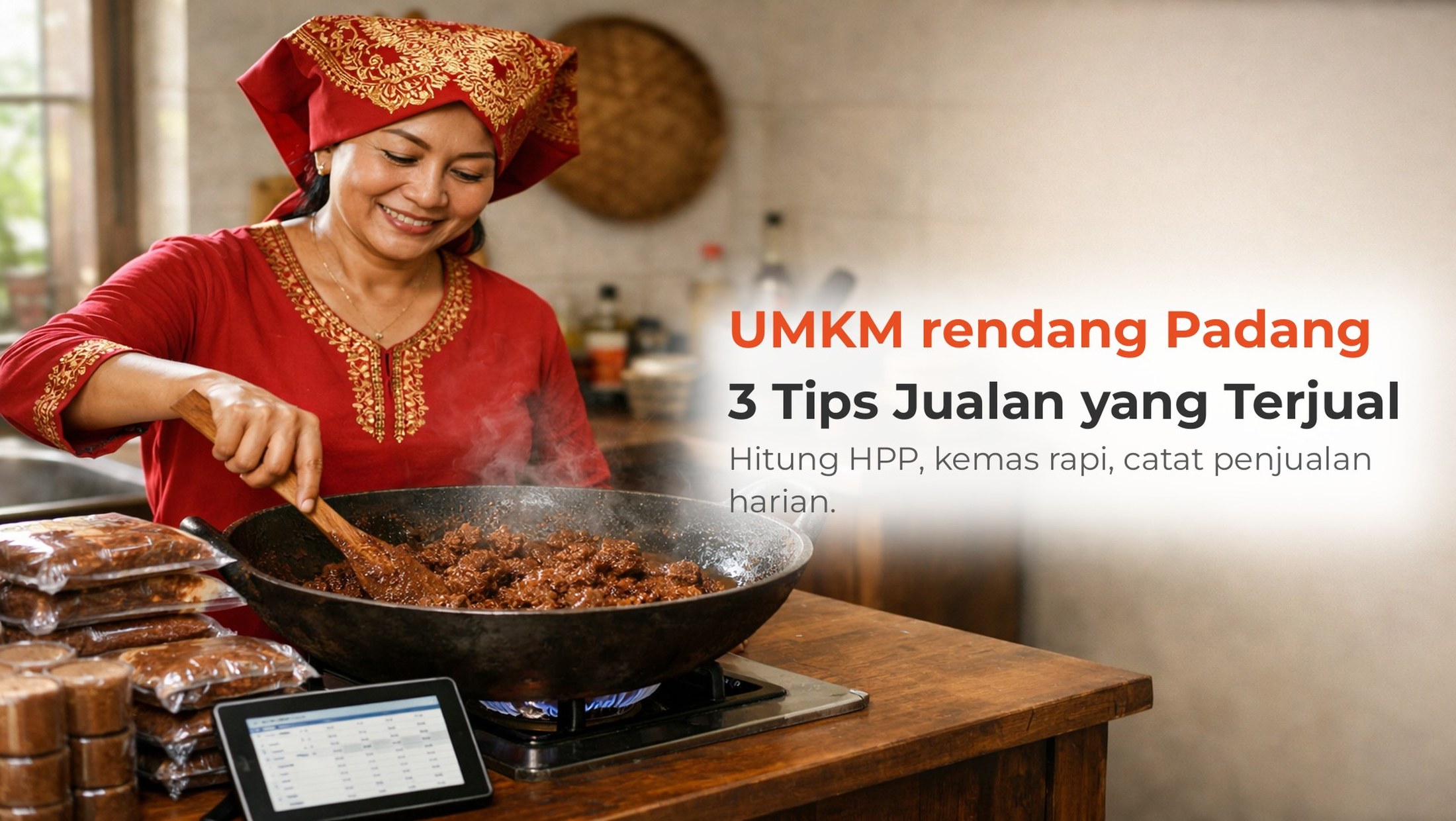
Padang Rendang MSMEs move from a home kitchen to retail-ready packaging, and plenty of tasks get skipped along the way: costing ingredients, recording every sale, picking sales channels, and sorting out permits. Without clean records, a busy business can still lose money in a slow month.
Padang Rendang MSMEs Face a Real Market Test
The Cooperative and MSME Office of Padang City records 47,692 business operators under its supervision. In 2022 the number of MSMEs stood at 39,924, and total MSME turnover rose from Rp746.1 billion in 2023 to Rp952.1 billion in 2024. In 2026 the number of MSME operators is put at around 48 thousand, with retail accounting for 40 percent and the food sector for 33 percent.
On 17 November 2026, the Padang City Government handed out awards to the six best MSMEs of 2026. Final judging was carried out by a jury on 13 November 2026, weighing product quality, business and financial performance, legality, governance, branding, packaging, and readiness for export.
The first culinary winner was Ring Bun Bakery, the second was Niranta Palm Sugar, and the third was Siti Nurbaya Food. In the crafts and fashion category three winners were also named, including a jewellery label and a digital printing business. Prizes were Rp27 million for first place, Rp13 million for second, and Rp10.5 million for third.
The MSME Champion Padang 2026 program started in 2025 with roughly 1,000 MSMEs screened, 480 completing intensive training, 30 taking mentoring through three incubators, 15 reaching the finals, and six receiving awards. The program is funded by the Padang city budget. Full details of the six best MSMEs awarded in 2026 are in the official report.
The Ministry of Cooperatives and MSMEs notes that of roughly 50 million business operators in Indonesia, only around 25 million have so far joined a digital platform. Digitalisation for MSMEs does not stop at moving sales online: it also needs better business governance, proper transaction records, and financial literacy, because those records are what open the door to financing. National digitalisation figures for MSMEs put that in context for Padang operators.
Tip 1: Cost Beef and Coconut Cream Properly
Many food business owners get the costing wrong because they only count the price of beef. A proper cost figure also covers coconut cream, spices, packaging, delivery, cold storage, and the raw material that ends up thrown away during cooking.
Cooking method decides how much gets wasted. The dark colour and deep flavour come from simmering coconut cream with spices over a low flame until it thickens and releases the oil known as kalio, and the final stage produces the dry texture. A low flame with steady stirring prevents scorching and makes sure the dark colour forms through caramelisation of the cream and spices. The cream comes from grated coconut that is strained, and ideally five coconuts are needed for one kilogram of beef. The official gastronomy guide to the rendang cooking method in Padang walks through each stage.
Once the cost per portion is clear, record every outgoing payment in one place so the margin does not quietly disappear in the middle of a busy day. A practical guide to recording income and expenses for a food business offers a simple framework to follow.
Tip 2: Pack and Certify Your Products for Shipping
Packaging is part of the product, not just a wrapper. For beef products, tidy packaging protects the flavour, makes handling easier during transport, and gives bulk buyers a reason to trust that the taste stays consistent.
The Sentra Rendang complex in Padang City, located in Lubuk Buaya village, Koto Tangah district, is an example of a shared facility built for food businesses. It includes a sterilisation room, rooms for primary and secondary packaging, and a production kitchen.
In 2027 the labour and industry office will raise capacity to 20 kg for a single pot, with eight production rooms, bringing total capacity to around 160 kg in one cooking session. Use of the facility carries no charge, only a service charge set by the applicable rules, and the centre stays open for other local food products. Official details on the Sentra Rendang facilities and the capacity upgrade plan appear in the city government report.
On the permit side, processed food products generally need a PIRT licence, while halal certification involves BPJPH. A guide to keeping the distinctive Minang flavour authentic is a useful reference when products travel outside the city.
A correct halal label opens the door to minimarket and modern retail shelves, while airtight packaging extends shelf life. For a product shipped out of town, those two things often decide whether a bulk buyer places a repeat order or only tries once.
Tip 3: Use Digital Channels and Mentorship Programs
Digital channels do not have to start with a large platform. A food business can begin with a simple online catalogue, a social media account, and group orders collected between neighbours. What matters is that every channel feeds into the same set of transaction records.
Niranta, a palm sugar business on Terandam street in Padang, shows how this works in practice. The company was founded in 2015 and produces solid, powdered, and liquid palm sugar using raw material sourced from farmers in Muarasipongi village, South Tapanuli. Mentorship in digital marketing and finance through the SIAPIK app, a website, a Shopee account, and an Instagram profile helped the website record 607 visitors in its first month. A study of the Niranta palm sugar business in Padang describes the digitisation steps in full.
City mentoring programs help as well. In the MSME Champion program, 30 business operators took part in mentoring through three incubators, and 15 reached the finals. For owners who are just starting out, that kind of support saves time because it cuts repeated costing mistakes.
To measure the results, read the sales data every day. A guide to reading sales data and finding the product that sells best helps operators avoid guesswork.
Market recognition also opens the door to financing. A guide to the requirements and steps for applying for a 2026 Indonesian SME loan is useful for operators who already keep tidy transaction records, since complete paperwork and a clear financial track record often decide the outcome.
FAQ: Common Questions
Do rendang stalls in Padang need a PIRT licence and halal certification?
For a processed food product such as rendang, the PIRT licence covers food safety and quality, while halal certification involves BPJPH. The two are separate and follow different procedures.
Many owners start with the PIRT licence and then apply for halal certification once the product begins reaching modern retail. One important note: a cashier app such as Qasir is a recording tool and does not replace official permits. Tidy records still need valid paperwork behind them.
How long can cooked rendang be stored, and how should it be packed?
Cooked rendang keeps for several days in a refrigerator when it is packed properly in an airtight container. For longer storage, freezing is the safest option because freezing stops microbes from growing on the food.
Vacuum or airtight packing extends shelf life and keeps the texture dry. For longer journeys, add ice packs so the product temperature stays stable while it travels. That range matters for a food business because beef is an expensive raw material, so spoilage turns directly into a real loss.
Should costing include raw material that gets thrown away?
Yes, it must. Costing is calculated from the clean cooking yield, not only from the purchase price of the ingredients that went in. Beef, coconut cream, and spices almost always leave a little residue once they are cooked and reduced.
If that cost is left out, the margin per portion looks larger than it really is. The practical method is to weigh the ingredients before cooking and weigh the finished product afterwards. The difference in weight is the waste that has to be counted.
Why does daily sales recording matter for a Padang food business?
Ingredients such as beef carry a high price, so without a correct margin record the profit can disappear quickly. Daily recording also reveals buying patterns and when stock needs to be replenished.
Busy seasons affect sales volume, and without daily figures it is hard to tell which product sells best and which one should be cut. Consistent records also become the basis for planning next week's production.
Business and Finance Tips for Padang Food Entrepreneurs
The following cost components should be reviewed every month so the margin stays healthy.
| Cost component | Role in the calculation |
|---|---|
| Purchase price of beef | The largest cost and the basis of the selling price |
| Coconut cream and spices | Measured by the batch and reduced by the kalio released |
| Packaging and labels | A per unit cost that rises with volume |
| Delivery and cold storage | Must enter the costing of any shipped product |
| Raw material wasted in cooking | The weight difference before and after cooking |
Alongside the cost components, three financial habits help a business stay stable. First, keep business money separate from personal money. Second, set aside funds for the next raw material purchase before spending the profit. Third, record every small outgoing cost such as packaging and local delivery.
The principle of deliberation also applies to business finance. Tungku Tigo Sajarangan is the figurative term for the collective leadership of the Minangkabau people, made up of Niniak Mamak, Alim Ulama, and Cadiak Pandai, built on the values of deliberation, consensus, and mutual help. An academic paper on Tungku Tigo Sajarangan explains this figurative idea in full.
In business, this reads as a habit of sharing roles and deciding together rather than working alone. The practical version is simple: one person lists the ingredient needs, one person checks market prices, and one person records the transactions. Costing mistakes are easier to spot and big decisions no longer depend on a single person.
Qasir Features for Padang Rendang MSMEs
The features worth choosing should follow the activity that happens most often each day. Four of them cover the flow from cooking through to the daily cash count.
Digital Cashier for Daily Rendang Sales
A digital cashier replaces the notebook and the calculator for daily sales records. Each transaction is entered with the product name, quantity, and price, so a sales report forms automatically and does not have to be rebuilt at the end of the day.
For businesses that serve buyers on site, tidy records also make the end of shift cash count easier. Daily sales data becomes the basis for calculating how much raw material to buy tomorrow.
Stock Management for Beef and Coconut Cream
Raw material management helps an operator see the remaining stock without checking the fridge and the storage room one shelf at a time. The amount of beef and coconut cream on hand can be compared directly against the next production run.
The stock history also shows when an ingredient is running low, so the next purchase can be made earlier.
Wholesale Pricing for Bulk Buyers
Wholesale pricing lets an operator set different price levels for large volume purchases. Bulk buyers such as other stalls, catering orders, and retail traders usually buy on a regular cycle, so a dedicated price tier helps both sides.
A worked example appears in the guide to maximising sales with the wholesale price feature, which covers how to build price tiers and promotions for bulk buyers.
Daily Sales and Cash Flow Reports
Daily sales reports and cash flow records bring two sides of the business into one view: how much was sold, and how much money is actually on hand.
The cash count is done when the register closes each day, so any gap between the money in the drawer and the recorded sales is visible straight away. Sales reports on the dashboard show which product contributes the largest share.
Conclusion
Three things decide whether a food business can move up a class: honest costing, packaging and permits that hold up, and tidy transaction records.
Costing based on the clean cooking yield keeps the selling price sensible and stops the margin from being quietly eroded. Tidy packaging and valid permits open the way to a wider market. Complete daily records give the basis for reading data, managing stock, and reaching financing.
This approach matches the direction of the city UMKM program, which assesses product quality, business and financial performance, legality, governance, branding, packaging, and readiness for export.
Manage Your Padang Food Business More Easily with Qasir
Start with small steps: record today's sales, work out the cost per portion, then list the raw material needed for next week.
A digital cashier, raw material stock management, wholesale pricing for bulk buyers, and daily sales and cash flow reports are all available in a single app.
No feature replaces official permits, and records in the app still need to be reconciled against a physical check. Download Qasir free on the Play Store to start recording sales, managing stock, and monitoring the daily cash count of your food business.
Experience from other regions can serve as a reference. Export tips for Asahan terasi SMEs shows how local food products are prepared for overseas markets.
Meanwhile sales tips for Magelang getuk SMEs covers how to tidy up packaging for regional food products.