
On 5 November 2026, Coordinating Minister for People's Empowerment Muhaimin Iskandar received the Indonesian E-Commerce Association at the Kemenko PM Office. He asked e-commerce platforms to open the etalase for the MSMEs they mentor, as National Online Shopping Day 2026 targets Rp40 trillion in transactions. Two days later the Indonesian Retailers Association said the same at National Retail Day 2026 in Bandung: MSMEs need product readiness, production capacity and sound management, not just a platform presence.
A survey from the same period shows 36,8 percent of Indonesian MSMEs already use artificial intelligence, 42,6 percent of them for marketing and content creation. Products ready for the digital etalase will be picked up first.
Kabupaten Pamekasan on Madura Island has the capital to meet that demand. Cooperative, Small and Medium Enterprise, and Manpower Office data show 49.185 MSMEs across 178 villages and 11 wards. Of more than 70 Pamekasan MSME products applied to chain stores like Indomaret and Alfamart, 12 were selected, including keripik tette, abon, banana chips, rengginan, crispy anchovies, and ginger coffee. Full data is at the official BPS Kabupaten Pamekasan site.
This article covers three steps keripik tette producers in Pamekasan can take to enter modern stores and the digital etalase without losing the distinctive flavor buyers seek.
Tip 1: Keep Keripik Tette Pamekasan Quality So It Still Has Buyers
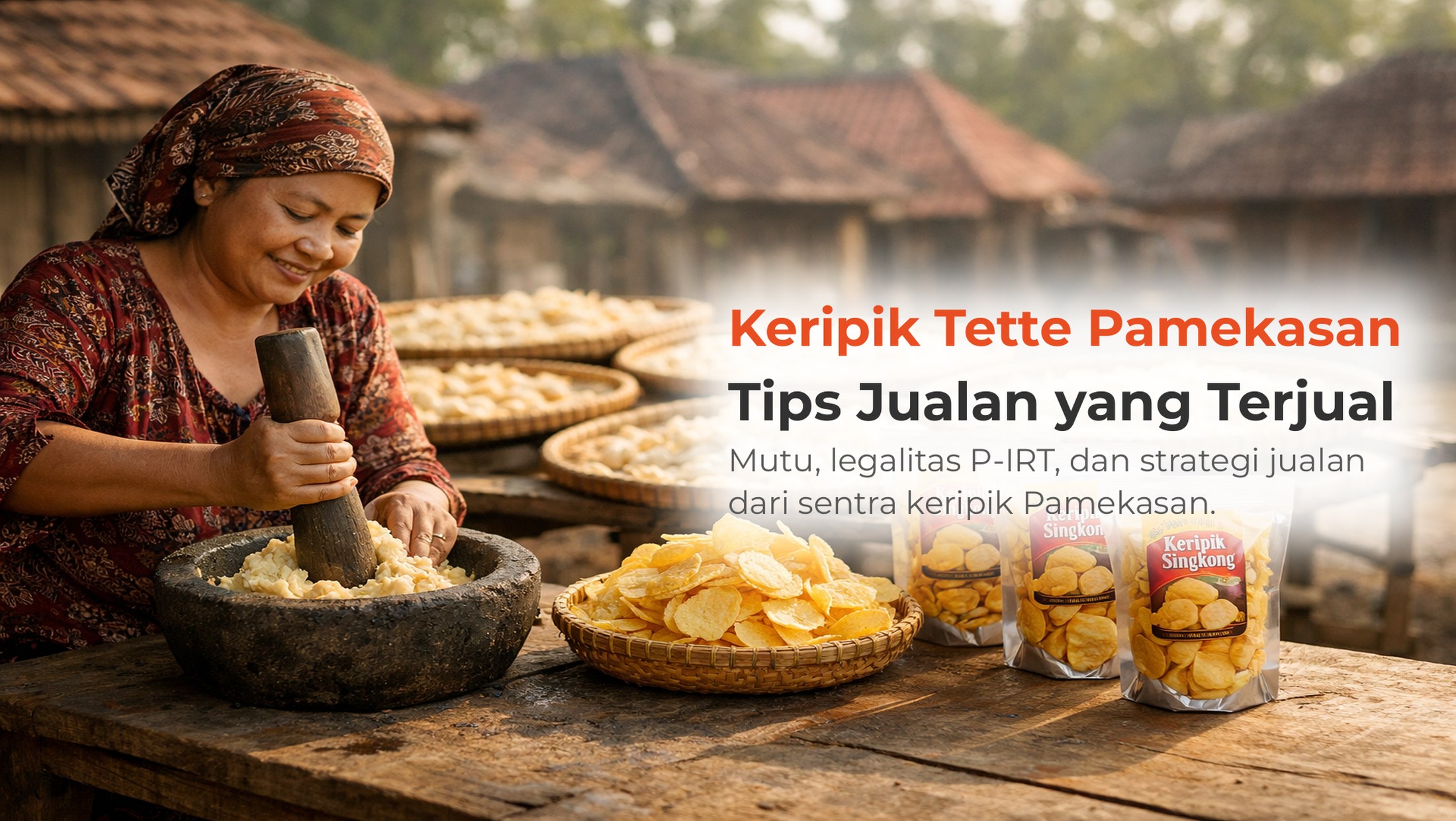
Keripik tette is a Pamekasan specialty made from cassava. In Madurese, tette means hand-pounded, and that process separates it from ordinary cassava chips. The cassava is peeled, washed, then boiled with a little salt until soft. The dough is pounded with a stone mortar until flat, dried in the sun, and fried. This manual process gives keripik tette a taste and texture that differ from machine-made chips.
In Desa Blumbungan, Kecamatan Larangan, Pamekasan, home producers still run that manual process. Pamekasan Regency Agriculture Office data show cassava planting in Desa Taro'an, Kecamatan Tlanakan, reaching 59 hectares with production of 11,74 tons. Research on keripik tette businesses there found the industry contributes 31,72 percent to local family income. Producers say one production day takes six to eight hours for five to six packs.
Quality varies between batches. These practices narrow that gap:
- Set one recipe and one measurementCassava amount, salt measure, boiling time and drying time must be identical for every worker, so batches can be compared.
- Record daily production in the production logKilograms of cassava processed, packs produced, packs left. This is the basis for large orders.
- Separate tools and containersPounding tools and dough containers must not store raw ingredients, so mixing does not lower quality.
- Test shelf life regularlyPackaged cassava and taro chips keep about 7 days. After that they absorb oil and lose crunch.
- Keep a sample from every batchIf a buyer complains, the sample proves where your product came from.
The right technology helps, as long as it does not change the flavor. For cassava and taro chip MSMEs in Desa Pademawu Barat, Pamekasan, a rotating machine nearly doubled production and gave a crisper, less oily texture. Results were more consistent without abandoning the manual process.
| Stage | Traditional Practice | What Must Be Kept |
|---|---|---|
| Preparation | Cassava peeled, washed, boiled with a little salt | Uniform cassava size so boiling time matches |
| Shaping | Dough pounded with a stone mortar | Uniform sheet thickness so drying ends together |
| Drying | Dried under the sun | Clear weather, dried on a woven mat, not on the ground |
| Frying | Fried over medium heat | Oil changed regularly, drained before packing |
| Packing | Packed in a standing pouch | Full label, production date, permit number |
Other producing regions face the same demand. Lombok Barat palm sugar, for instance, has already entered digital storefronts with complete permits and clear packaging. The full story is covered in sales tips for Lombok Barat palm sugar SMEs.
Notice one important point. Consumers buy not only the flavor but the story behind the package. The account of this product being pounded with a stone mortar by a home business in Desa Blumbungan is something mass produced goods cannot copy, and often decides which brand buyers pick.
Tip 2: Handle Legality and Packaging So Entry into Modern Stores Is Safe
Competition to enter modern stores in Pamekasan is tight. Of more than 70 Pamekasan MSME products applied to chain modern stores, only 12 passed selection: keripik tette, abon, banana chips, rengginan, crispy anchovies, and ginger coffee. These numbers show that entry depends not only on taste, but also on documents and packaging.
Documents to prepare:
| Document | Issuer | Purpose |
|---|---|---|
| NIB and basic business licence | OSS | Basic business legality |
| P-IRT number | BPOM | Food distribution permit for home businesses |
| Halal certificate | LPH or BPJPH | Requirement for food products in modern retail |
| Trademark registration | Kanwil Kemenkumham | Protects the product name from imitation |
| Distribution permit number | Badan POM | Document that must be attached to the package |
The order should be: register the NIB first in the OSS system, then apply for the P-IRT permit to BPOM, then process the halal certificate. For trademarks, registration through Kanwil Kemenkumham protects the product name from imitation, which matters because regional names are often used by others without permission.
Research on keripik tette MSMEs in Desa Taro'an, Pamekasan, found four weaknesses repeated across home businesses: unappealing packaging, no sticker label, no NIB licensing, and no digital marketing. The empowerment program fixed these four points. Packaging moved to a standing pouch, a new sticker label was made, NIB licensing was processed, and a social media account was created for digital marketing. The price of raw keripik tette rose from Rp10.000 to Rp12.000 per 100 pieces, while the finished product was priced at Rp5.000 per pack of 30 pieces with new flavor variants. It is now sold not only traditionally but also through social media accounts and Pamekasan souvenir centers.
Better packaging and legality deliver two results at once. The finished product is more presentable for the digital etalase, and the higher price makes the margin more reasonable. The halal label is not just formality. A complete halal registration guide for MSMEs is in our guide to halal certification for Indonesian MSMEs.
Tip 3: Use AI and the Digital Etalase for Wider Sales Reach
Demand for MSME products on the digital etalase is rising. On 5 November 2026, Coordinating Minister for People's Empowerment Muhaimin Iskandar asked e-commerce platforms to open the etalase for the MSMEs they mentor, alongside National Online Shopping Day 2026 and its Rp40 trillion transaction target. Two days later the Indonesian Retailers Association at National Retail Day 2026 in Bandung stressed that MSMEs need product readiness, production capacity and sound management, not just a platform presence.
A survey from the same period shows 36,8 percent of Indonesian MSMEs already use artificial intelligence, 42,6 percent of them for marketing and content creation. Products ready for the digital etalase will be picked up first.
For keripik tette producers in Pamekasan, several things can be done step by step:
- Take product photos with natural lightPlace the chips on a plain surface next to a window and shoot from above. The same photo works for the catalog, the marketplace, and social media, so one session covers three channels.
- Write the process story in the product descriptionTell how the cassava is boiled, pounded, and dried in the sun. A clear origin is information mass produced goods cannot copy, and that is what makes buyers choose.
- Create several flavor variantsResearch in Desa Taro'an showed new flavor variants open wider sales, from traditional selling to social media accounts and souvenir centers.
- Photograph the process for social mediaPounding with a stone mortar and drying under the sun is attractive content needing no production cost.
- Record orders from online channelsSocial media orders often arrive mixed together. Record them per channel so you know which one brings repeat buyers.
| Channel | Who the Buyer Is | Main Need |
|---|---|---|
| Direct selling | Middlemen, market stalls, Pamekasan souvenir shops | Neat packaging and clear pricing |
| Chain modern stores | Everyday consumers at Indomaret and Alfamart | NIB, P-IRT permit, halal certificate, full label |
| Social media | Buyers from outside Madura | Consistent product photos and process story |
| Marketplace | Consumers seeking regional souvenirs | Product weight, reference price, easy to find name |
| Government program etalase | Buyers through the national trade program | Complete legality and a tidy business profile |
FAQ: Questions About UMKM Keripik Tette Pamekasan
What is keripik tette and why is it only found in Pamekasan?
Keripik tette is a Pamekasan specialty snack made from cassava. In Madurese, tette means hand-pounded. The cassava is boiled with a little salt until soft, then pounded with a stone mortar until flat, dried in the sun, and fried. This pounding process is what sets it apart from cassava chips in general.
How long can keripik tette be stored?
For packaged cassava and taro chips, the shelf life is about 7 days. After that they absorb oil and lose crunch.
Can keripik tette from Pamekasan already enter modern stores?
Yes, and it has happened. Of more than 70 Pamekasan MSME products applied to chain modern stores such as Indomaret and Alfamart, 12 passed selection, including keripik tette. The main conditions remain documents: NIB, the P-IRT permit from BPOM, and the halal certificate, plus a fully labelled package.
How much capital is needed to start a keripik tette business?
The answer depends on scale. More important than the capital figure is how many packs you want to produce per day and how long a working process you can go through. The calculation must cover cassava raw materials, frying oil, packaging, and permit costs.
Can this product be sold outside Madura?
Yes, through social media, the marketplace, and the digital etalase. Customers outside Madura look for regional products with neat packaging and clear legality, because local brands are hard to trust without documents.
How do you calculate the profit from selling keripik tette?
Take the selling price minus the total cost per pack: cassava, oil, salt, packaging, and shipping. Do not forget production shrinkage, because not all the boiled cassava becomes chips worth selling. The method is explained in the article on calculating profit correctly.
Business and Finance Tips for Pamekasan Keripik Tette Producers
Separate business cash from household cash from the first day
Many family losses appear because business money goes to household needs. Separate them from the start: one cash book for the business, one for the house. The Cash In and Cash Out records in Qasir show how much truly comes in from keripik tette sales and how much goes out for cassava, oil, packaging, and shipping. The method is in the article on how to start recording business income and expenses.
Calculate the margin per variant before increasing production
Raw and cooked keripik tette have different cost structures. Both must be calculated separately, because one variant can look profitable while the other has a thin margin.
Keep an emergency fund for days without orders
Keripik tette production follows a seasonal pattern. Unclear weather slows drying, and piled up orders need more working capital. An emergency fund collected in good months keeps cash flow stable so you are not forced to sell below cost.
Track which product sells best from sales data
Flavor variants differ in selling power. The sales report feature in Qasir shows which variant sells best and which has a thin margin, so the next production can go to the variants in demand. How to read it is in the article on checking sales data to find the best seller.
Record regular customers so orders do not get lost
Buyers who have tasted keripik tette tend to return, especially when their name is remembered. The customer feature in Qasir stores purchase history, so you know who buys regularly and when to offer new products. The full guide is in the article on why customer data matters for MSMEs.
Conclusion
Demand on the digital etalase for MSME products is rising. On 5 November 2026, the Coordinating Minister for People's Empowerment asked e-commerce platforms to open the etalase for the MSMEs they mentor, alongside National Online Shopping Day 2026 and its Rp40 trillion transaction target. A survey from the same period shows 36,8 percent of MSMEs already using artificial intelligence for business support, and 42,6 percent of them for marketing and content creation.
Kabupaten Pamekasan has a strong base to answer that demand. More than 49.000 MSMEs are spread across 178 villages and 11 wards, twelve products have passed selection for chain modern stores, and the keripik tette process of pounding with a stone mortar in Desa Blumbungan is an authenticity mass production cannot copy.
In short, keripik tette producers in Pamekasan need to do six things:
- Set one recipe and one measurement, then record daily production in the production log
- Prepare the NIB, the P-IRT permit from BPOM, and the halal certificate before selling to modern stores
- Improve packaging with a standing pouch, a complete sticker label, and a registered brand name
- Use AI for product photos and the process story, then open social media and marketplace channels
- Separate business cash from household cash, and calculate the margin per variant before raising production
- Track the best selling variants and keep customer records so orders do not get lost
All those steps need one thing: tidy records. Those records let you calculate profit and maintain quality batch after batch.
Manage Keripik Tette Sales in Pamekasan More Easily with Qasir Features
Managing a keripik tette business has many parts to record: cassava used, frying oil, packaging, prices for bulk buyers, and customer records. All of that runs from one digital cash register app, without separate notebooks.
Digital cash register for transactions at the stall and the bazar
When selling directly to buyers or taking orders on the spot, transactions are often written down or kept in memory. A digital cash register app records every sale automatically, with a receipt for the customer.
Stock management for cassava, oil, and packaging
The stock management feature reduces the risk of running out of raw materials unnoticed, and flags products that have sat on the shelf too long. This matters because the shelf life of keripik tette is about 7 days.
Product variants for raw, cooked, and various sizes
Keripik tette can be sold raw or cooked, in 250 gram, 500 gram, up to 1 kilogram packages. The product variation feature keeps all those options in one item, so the cashier never picks the wrong variant.
Wholesale prices for buyers who order in bulk
Middlemen, souvenir shops and modern stores buy in bulk at lower unit prices. In Qasir, wholesale prices sit directly on the product, so the selling team does not recalculate them per order.
Sales and profit reports to see which variants are profitable
With sales and profit reports, you can see which variant sells best and its margin, so the next production can go to the variants in demand.
Customer data to keep buyers who have already shopped
Keripik tette buyers who have tasted your product tend to return. The customer feature in Qasir stores purchase history, so you know which products sell often and when to offer a new variant.
Download Qasir free on the Play Store or App Store, and tidy up your keripik tette sales records today.