
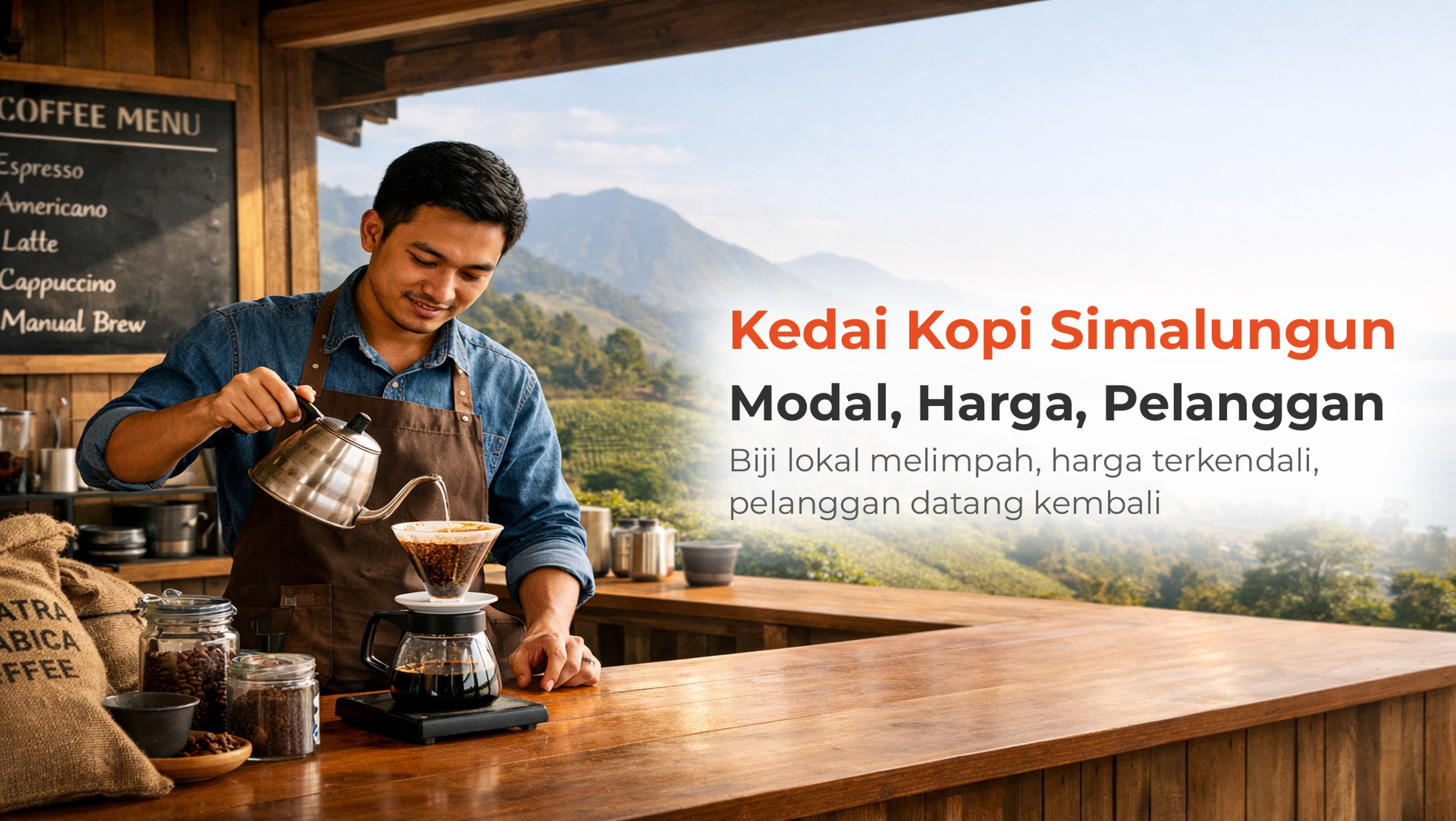
Picture a small cafe in Pematang Raya: mornings filled with farmers coming down from the plantation, afternoons full of young people looking for a place to sip coffee. Behind those busy tables sits one advantage shop owners here rarely notice: the raw beans grow in their own backyard. Simalungun Regency records 17,445 arabica farming households spread across 17 districts, and the region's robusta production reached 1,810 tons in 2023, about 17.4 percent of all North Sumatra robusta output. Those numbers mean local supply sits close by, so a cafe can keep ingredient costs down without sacrificing quality.
This article covers tips for opening and running a coffee shop in Simalungun Regency: from initial capital calculations and menu pricing to keeping customers coming back. Every figure is drawn from official sources and recent reporting, so you can adapt each step to local conditions.
Simalungun Coffee and Warkop Life around Lake Toba
Before talking strategy, know the region's main strength first. Simalungun coffee grows in highlands around 900-1,400 meters above sea level, close to the fertile soils of the Lake Toba area. The most cultivated varieties are Ateng and Sigararutang, with two common post-harvest processes: full wash and semi wash. The cup profile is distinctive, with a strong yet refreshing acidity that pairs well with fruit, for example in the increasingly popular iced coffee lemon.
That distinction is more than a story. Two regional products, Arabika Sumatera Simalungun and Robusta Simalungun, are registered as geographical indications at the Directorate General of Intellectual Property, standing alongside names as big as Gayo and Toraja. In October 2026, the Simalungun administration with Bank Indonesia closed Karya Hita Festival 2026 with a business matching agenda to open export routes. Good news keeps arriving: at the North Sumatra craft expo in November 2026, a local coffee entrepreneur was shipping hundreds of kilograms of beans per month to Malaysia. If you want to see how another region lifts its local beans, read the Kerinci coffee shop tips built around Kayu Aro arabica.
But a growing market does not automatically fill your seats. Warkop in Tiga Dolok, Raya, or Pamatang Sidamanik still compete with trendy cafes while rent and wages creep upward. Fortunately, the coffee-drinking tradition in Simalungun runs deep, and supporting sectors are alive too: the legendary Bah Butong tea estate in Sidamanik, forest honey, and ulos weaving that keeps tourist traffic flowing. The customers are there; what remains is how you attract and keep them. Big-city experience from Surabaya coffee shops shows that warkop can hold their ground as long as the strategy is right.
Tip 1: Calculate Your Initial Capital Before Opening
The most expensive beginner mistake is renting an expensive coffee shop location before knowing how much money is actually needed. For a modest warkop in Simalungun, you can start at a household scale and level up once revenue stabilizes. Here is a rough picture of the cost items to prepare.
| Cost Item | Rough Figure | Note |
|---|---|---|
| Monthly rent | Rp1-3 million | Cheaper outside the town center; make sure parking exists |
| Light renovation + furniture | Rp5-12 million | Wooden tables, chairs, warm lighting |
| Brewing equipment | Rp3-7 million | Manual brew set, grinder, kettle, glasses, scale |
| Initial stock | Rp2-4 million | Beans, milk, sugar, syrup, snacks |
| Two months of operating cash | Rp4-6 million | Staff wages, electricity, emergency reserve |
These figures are only benchmarks; actual costs depend on your location and concept. The key is keeping at least two months of operating cash, because many new cafes take time to become known locally. Separate business money from personal money from day one, so you know whether the business truly profits or cash merely circles around. If you want to compare how to calculate capital for other ventures, see our guide to recording income and expenses.
Tip 2: Price Your Menu by Leveraging Local Beans
The competitive edge of a shop in this region is access to fresh beans without a long distributor chain. In 2026, green bean prices for Simalungun arabica sit around Rp130,000-140,000 per kilogram for semi wash and Rp150,000-155,000 per kilogram for full wash, while robusta trades near Rp78,000 per kilogram. At the farmer level, prices even touched Rp61,000-62,000 per kilogram in April 2026.
Use that position. Buy directly from farmer groups in Silimakuta, Raya, or Dolok Pardamean to trim costs, then offer signature brews that outside cafes cannot copy. As a benchmark, one kilogram of beans yields roughly 60-70 cups, so the bean cost per cup is only a few thousand rupiah. Selling prices at local warkop usually sit far below chain cafes, and that is not a weakness as long as you calculate the margin per cup with discipline. Our recommendation: write a standard recipe per drink, compute the cost per cup, then set a price that leaves room for promotions without wrecking the margin.
Tip 3: Keep Customers through Community Strength
In a regency town, regulars come not just for taste but because they feel recognized. A few simple habits work well for Simalungun coffee shop owners. First, use the quiet hours between two and four in the afternoon for snack-and-warm-drink bundles, a favorite window for people returning from the plantation or the market. Second, build the habit of remembering customers: their usual order, when they tend to visit, and the occasional small bonus.
Third, approach the communities already around you. In Sait Buttu village, for example, Bank Indonesia integrates coffee farmers, honey collectors, and a tourism awareness group into one ecosystem, and your cafe can be a stop for visitor groups. Around the Sidamanik tea estate, cafes that carry the natural scenery are hunted down by visitors. Displaying ulos weaving or forest honey from local makers at the counter also roots your shop in the region instead of feeling like a generic hangout.
Finally, record who your customers are. You do not need an expensive app at the start; a notebook or simple dataset is enough to guide your promotions. Our article on why customer data matters for small businesses explains how simple data turns one-time buyers into regulars.
FAQ
1. How much initial capital does a coffee shop in Simalungun need?
For a household-scale warkop, prepare around Rp15-30 million covering rent, equipment, stock, and two months of operating reserves. Starting small is safer than investing big at once.
2. What makes Simalungun coffee different?
Arabica from this region is known for a strong yet refreshing acidity, with Ateng and Sigararutang as popular varieties. Two of its products are even registered as national geographical indications.
3. Where can I get a local bean supply?
Farmer groups in leading districts such as Silimakuta, Raya, and Dolok Pardamean accept direct purchases. Farm-gate prices reached Rp61,000 per kilogram in April 2026, so compare several suppliers first.
4. How do I compete with trendy coffee chains?
Do not copy them. Offer local character, friendly prices, and an atmosphere that makes customers stay. A warkop's strength is closeness to its customers, not giant discounts.
Business and Finance Tips
Running a cafe means managing two things at once: the quality of each cup and the financial health of the business. The following principles work even without an accounting background.
- Rotate cash with the harvest season. Bean prices move with seasons and demand; during peak harvest, supply is larger and prices lower, so use the moment to stock beans that keep for months.
- Separate business and personal cash. Mixing the two is the most common reason a quiet business still leaves an empty wallet. Keep one account or wallet for the business alone.
- Set aside an emergency fund. Reserve at least 10 percent of monthly profit for equipment repairs or low-revenue periods, such as the rainy season when visitor traffic drops.
- Review reports every week. Seeing best-selling products and quiet hours helps you decide promotions on evidence, not guesswork.
Qasir Features for Simalungun Coffee Shops
After the tips above, this section explains how a digital POS app can support your shop's daily operations. Every feature below is an official feature available in the Qasir app.
Digital Cashier for Daily Transactions
The Qasir digital cashier records every sale straight on your phone without manual receipts. For a shop serving dozens of orders a day, these automatic records keep daily revenue from vanishing just because someone forgot to write it down.
Stock Management for Coffee Ingredients
The stock feature helps you track remaining beans, milk, sugar, and snacks down to usage level. You will know when to reorder before supplies run out in the middle of a busy weekend. Learn how in our guide to accessing the Qasir dashboard from the mobile app.
Sales Reports to Spot Best Sellers
Sales reports turn daily data into an easy-to-read summary. From there you can see which menu items sell best at peak hours, then adjust stock and promotion plans.
Cash In and Cash Out Recap
The cash in and cash out feature records every income and expense, including raw material purchases. This record is useful for weekly financial reviews or when preparing reports for a business loan application.
Conclusion
Warkop in Simalungun Regency hold an asset few regions can match: quality beans at close-supplier prices, plus a coffee culture already woven into daily life. The key comes down to three things, disciplined capital calculation, pricing that exploits the local bean advantage, and care for customers that brings them back. Growing production figures and regional support programs such as the export business matching point in a positive direction, but the final result still depends on how you run the shop day to day.
Run Your Coffee Shop More Easily with Qasir Features
To support the steps above, here are Qasir features relevant to coffee shop operations.
- Digital Cashier records every transaction on your phone, so daily revenue never disappears from forgotten notes.
- Stock Management tracks remaining beans and other supplies so you never run out during rush hour.
- Sales Reports show best-selling menu items and peak hours in an automatically built summary.
- Cash In and Cash Out keeps finances tidy for weekly reviews or loan applications.
- Non-Cash Payments let customers pay digitally, faster queues without fumbling for change.
Download Qasir for free on Google Play, then start recording your shop's transactions today.