
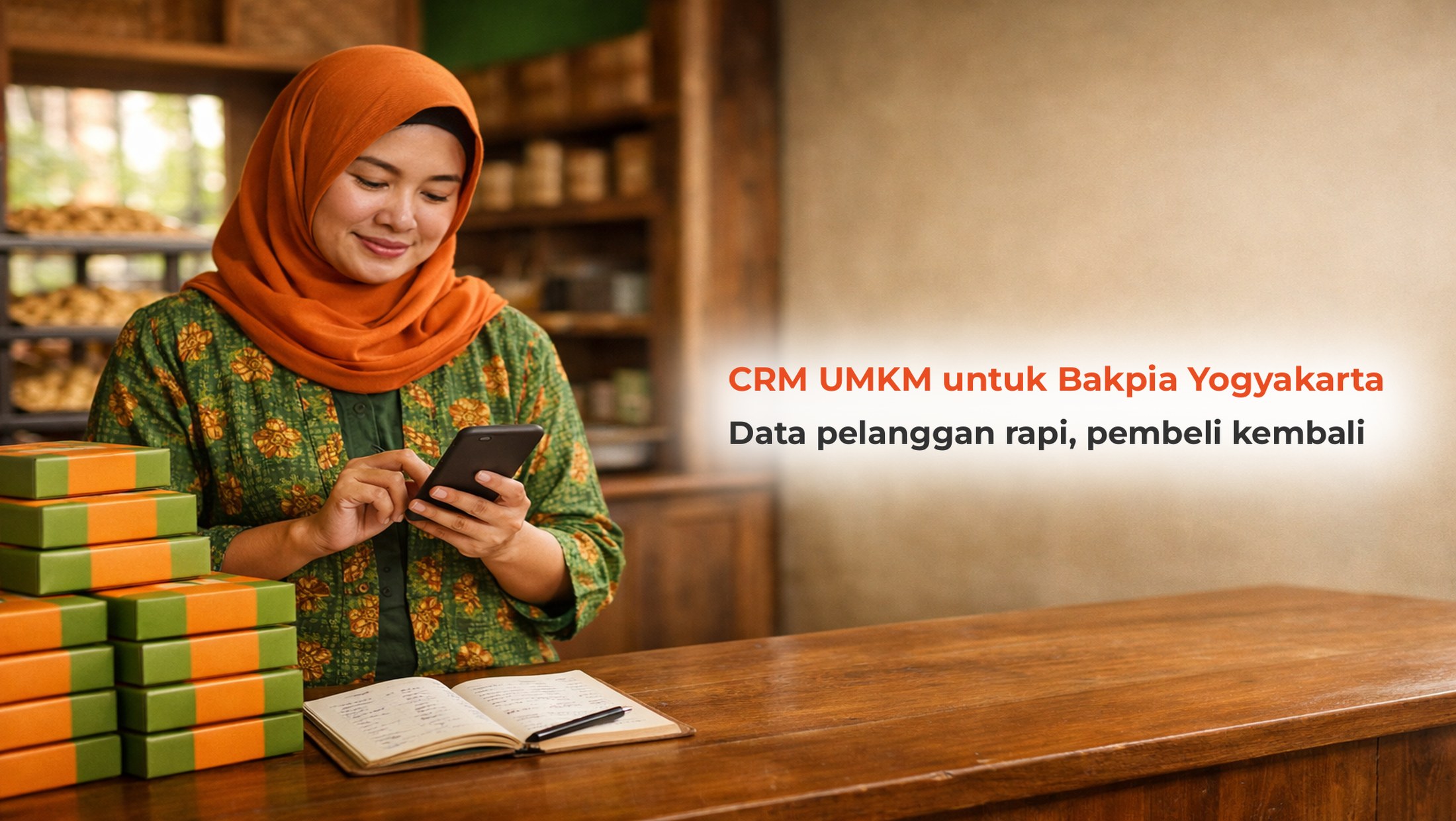
Customer CRM is a simple way to record who your shop's customers are, what they have bought before, and when it is best to contact them again. For makers of bakpia in Yogyakarta, that means knowing who buys souvenirs every school holiday, who orders boxes to ship out of town, and who suddenly stops coming in. It takes no big budget and no IT person; it takes a list you actually keep.
Short answer: you do not need expensive software to start. The Qasir cashier app already includes the Customer Feature, which stores names, phone numbers, emails, birth dates, addresses, and order notes, plus a Customer Report that shows every person's total visits and purchase history. That data is what powers points programs, member discounts, and win-back promotions.
A bakpia shop lives on repetition. The same faces return every holiday season: the office administrator ordering dozens of boxes, the family buying gifts before travelling home, and the reseller who only calls when the tourist season peaks. None of them are strangers, yet most shops greet them as if they were. Writing down a name and a phone number takes a few seconds at the counter, and that small record is what lets you greet regulars by name, tell them when a new flavour lands, and invite them back before a competitor does.
Why Customer CRM Matters for Yogyakarta Bakpia SMEs
Bakpia competition in Yogyakarta is extremely tight. Records from Ngampilan village note that 120 SMEs and business owners work in the bakpia trade every day in the Pathok centre of Yogyakarta City. The brands are all different, the flavours and prices are alike, and the outlets stand side by side along Jalan KS Tubun.
On the other hand, buyers arrive in waves. BPS for DIY recorded 3.52 million domestic tourist trips to the province in July 2025, up 44.68 percent on July 2024. A shop that only writes down daily revenue never learns who bought, where they came from, or whether the same people come back next year.
Customer CRM answers all three questions at once: who the loyal customers are, what they buy, and when they need to hear from you again. Everything can run on the same phone you already use for transactions, with no laptop and no extra application.
The best time to start is now, before the holiday season comes around again. Customers recorded in December will reappear at the next school holiday and year end, and that is when the contact list starts doing its work. Postponing until the shop moves buildings, or until notes are scattered across several people's notebooks, only makes the data harder to organise.
What makes this data different from an ordinary notebook is the ability to group it. You can separate daily souvenir buyers, customers who order for office events, and out-of-town buyers who appear only during long holidays. Each group needs a different way of communicating, and without grouping you can only send one identical message to everybody.
The key is not the most advanced feature but a small discipline practiced every day: every buyer who takes many boxes or asks for out-of-town shipping has their name and phone number recorded. A year later, that list becomes the most valuable asset in your shop, far more valuable than revenue notes that do not mention a single name.
Comparing Ways to Record Customers in a Bakpia Shop
| Aspect | Pen and paper | Spreadsheet on phone | Qasir cashier app |
|---|---|---|---|
| Customer data | Names written carelessly, often illegible later | Manual columns, prone to duplicates and typos | Customer Feature: name, phone, email, birth date, notes |
| Purchase history | None, only the daily revenue total | Must be copied one by one | Customer Report: total visits and transaction history |
| Finding an old buyer | Flipping page after page of the book | Manual filtering inside one file | Search by name or number on the transaction screen |
| Win-back promo | Impossible, you just wait for them to come | Type them out one by one on WhatsApp | Contact list ready to use, receipts can be emailed |
| When the phone is lost | The book is lost too | The file is lost too | Stored in the account, openable on another device |
The table shows one thing: an SME's problem is not a lack of data, but data that is never read back. You know today's revenue, yet you do not know that last month's eight biggest buyers never returned at all this month.
So far I am very satisfied using Qasir. The app is practical, the display is easy to understand, and it really helps in recording sales and monitoring transactions. Hopefully it keeps gaining more interesting features going forward.
The lesson from Yogyakarta jamu SMEs applies to bakpia as well: souvenir buyers are repeat buyers, but not daily ones. What separates a shop that lives off repeat buyers is its ability to remember customers, not its ability to wait.
4 Practical Steps to Start a Customer CRM in a Yogyakarta Bakpia Shop
These four steps can be finished in a single workday, even by one person with no dedicated team.
- Turn on the Customer Feature. Start from the Qasir app settings, then ask the cashier to fill in names and phone numbers for bulk purchases, event orders, and shipments out of town. The guide is in the Customer Feature article at bantuan.qasir.id.
- Tidy the data you already have. Use the import contacts menu from your phone book, then delete duplicate numbers and numbers that are no longer active. Dirty data produces promotions that miss their target.
- Set one rule. For example: every order above five boxes must carry a customer name. One rule applied consistently is more useful than ten rules written on the shop wall.
- Read the Customer Report at the start of every month. Mark the top 10 buyers, then note who has not returned for three months. Contact them with a simple message, not a mass blast.
The fourth step is the heart of a real customer CRM. Without regular reading, customer data is merely an archive that piles up; with regular reading, it turns into a to-do list you can act on this very week.
For a more complete setup, also see how to make the most of the Customer Feature and why buyer data decides the next purchase.
Buyer data is also useful when complaints arrive. From the contact record, you can reach out to buyers whose orders were late, apologize and fix the process, then measure their satisfaction with a simple customer survey. For more structured handling, follow this guide to handling customer complaints so that one complaint never turns into a buyer lost forever.
FAQ: Common Questions About Customer CRM
How is a customer CRM different from a paper notebook?
A paper notebook only stores names and addresses. A customer CRM stores that data alongside purchase history, total visits, and special notes, so you can search, sort, and follow up on it without opening page after page.
Does a small bakpia shop need a CRM too?
It does, precisely because the shop is small. One buyer who returns three times a year costs less than having to attract new buyers through endless promotion. For a small shop, a CRM starts with tidy buyer data, not with paid software.
How much does it cost to get started?
The Customer Feature, Customer Report, Loyalty Points, and Membership Discount are already part of the Qasir cashier app. To match the service package to your shop's needs, ask the Customer Happiness team directly through Live Chat in the app or on the Qasir additional features page.
Is buyer data safe stored in the app?
Data is stored in your shop account and can be opened from authorised devices. Use Employee Authorisation to limit who may view buyer data, and never share the cashier PIN with outsiders.
What if a buyer does not want to be contacted?
Ask for permission when you record the number, explain the benefit such as news of new variants or member promotions, and respect a request not to be contacted. A good CRM protects the relationship instead of adding spam for them.
Business and Finance Tips for Bakpia Entrepreneurs in Yogyakarta
- Separate business money from personal money. Record every cash in and cash out through the Cash Recap, including ingredient purchases and production wages. Without this separation, bakpia profit always looks bigger than it really is.
- Calculate the cost of rewards before promising points. Souvenir product margins are thin. Decide first what percentage of profit you are willing to give up for a points program, so the promotion does not eat into working capital.
- Prioritise the top ten buyers. Finding new buyers is far more expensive than keeping existing ones. One personal message to a regular buyer usually pays off more than a big campaign aimed at strangers.
- Review the numbers at the start of every month. Check ingredient stock, the price of flour and mung beans, and receivables from large orders. A CRM is only useful when its data is used to make decisions, not merely stored.
The principle is simple: customers are an asset you can record. As long as that asset lives only in one person's head, your shop is fragile the moment that person takes a holiday or quits.
Qasir Features for Customer CRM in a Yogyakarta Bakpia Shop
Customer Feature to Store Buyer Data
This feature stores names, emails, phone numbers, photos, birth dates, addresses, and order notes, plus contact import from your phone list. The benefit is immediate: every bulk box buyer and every event order is recorded neatly with no extra notebook.
Customer Report to Recognise Repeat Buyers
This report shows total visits and transaction history for each buyer, including notes on credit or instalments. The benefit is that you can build a list of the top ten buyers and follow up with them before they move to another shop.
Loyalty Points to Encourage Repeat Purchases
Every transaction collects points that customers can exchange for gifts or discounts. The benefit is that souvenir buyers have a concrete reason to return to your shop instead of trying a new one on Jalan KS Tubun. Details are in the Qasir Loyalty Points guide.
Membership Discount for Special Buyers
A special discount can be given to selected customers without lowering your general selling price. The benefit is that you can reward loyal shoppers while protecting the margin from one-time buyers.
Conclusion
A customer CRM is not a new application you have to buy; it is the habit of recording buyers properly and then reading that record regularly. For Yogyakarta bakpia SMEs competing in a centre full of hundreds of similar business owners, the ability to remember buyers is the cheapest and most durable difference there is.
Start with the four steps above: turn on the Customer Feature, tidy up old data, set one rule, and read the Customer Report at the start of every month. Within two months you will have a buyer list far more useful than any daily revenue note.
Contact Qasir's Customer Happiness Team to Set Up Buyer Data
Qasir's Customer Happiness team is ready to help set up the following so that your shop's buyer data is usable from day one:
- Customer Feature to store and import buyer data.
- Customer Report to see visits and purchase history.
- Loyalty Points to give customers a reason to come back.
- Membership Discount for loyal repeat shoppers.
- Employee Authorisation so only authorised people can view buyer data.
Ask directly through Live Chat in the Qasir app by following the guide to contacting the Qasir team, send a message on WhatsApp +628****0218, or email hello@qasir.id. You can also open qasir.id to get to know the Qasir ecosystem better.
Ready to record your first buyer? Download the Qasir app on the Play Store, turn on the Customer Feature, and start with one buyer name today.