
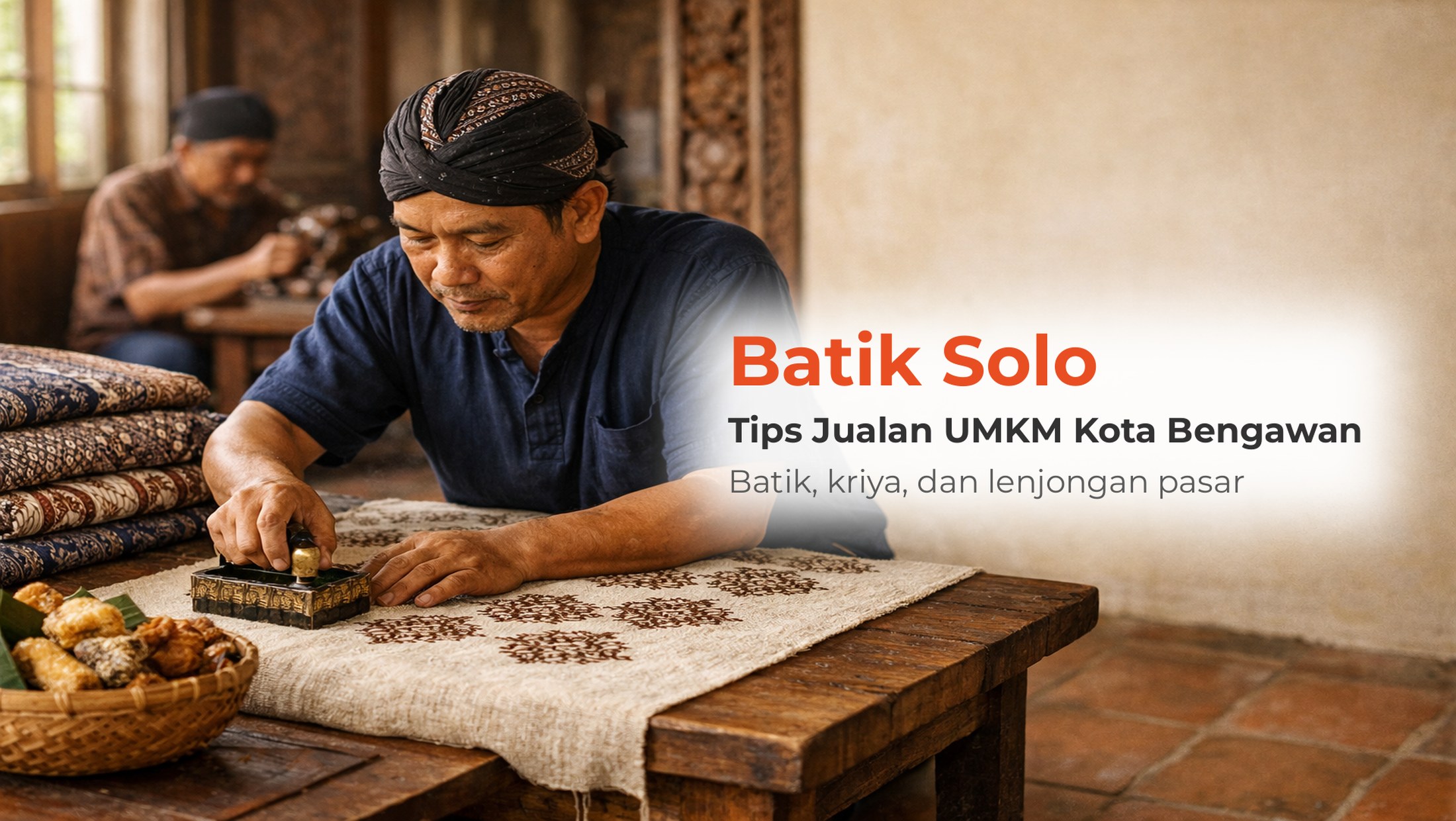
Solo Batik SMEs: Sales Tips for Craft and Snacks
On 5 November 2026, the Surakarta SME association delivered 10 demands to the second commission of the Solo Regional House of Representatives. Two stood out: local solo batik products becoming a main menu for government procurement, and debt relief for KUR loans under Rp100 million. Report on the association hearing
Those demands arrived while the batik market in Surakarta was moving quickly. At Dekranasda Fest Surakarta on 2 November 2026, Venessa Winastesia, chair of Dekranasda for Surakarta, said Surakarta has potential in batik as well as wood and rattan crafts. Artisans were urged to keep innovating. Report on Dekranasda Fest Surakarta
On 6 November 2026, Deputy Minister of Trade Dyah Roro Esti was reviewing the export potential of batik from Solo and Sukoharjo. Batik Keris has shipped to Myanmar and Singapore before, and plans to continue. ANTARA coverage of the batik export review
Behind that market sits a large base of small businesses. The Cooperatives, SMEs and Industry Office of Surakarta records 18.623 SME units, while figures dated 31 December 2025 list 18.143 SMEs. Official portal of the Surakarta cooperatives and industry office
The sector mix shows where demand sits. In 2024 there were 6.604 culinary businesses, 1.838 fashion businesses, 318 craft businesses, and 9.383 in other categories. By scale, 18.039 are micro, 98 small, and 6 medium. Summary of SMEs in the city of Surakarta
The manufacturing sector in Surakarta backs this up. BPS Kota Surakarta Dalam Angka 2025 lists 120 large and medium manufacturing industries: 46 in Jebres, 29 in Banjarsari, 27 in Laweyan, 9 in Pasar Kliwon, and 9 in Serengan. BPS Kota Surakarta Dalam Angka 2025
At the national level, APPBI through the Ministry of Industry records a drop of about 20 percent in Indonesian batik artisans, from 131 thousand in 2019 to 105 thousand in 2023. Regenerating the artisan base is a discussion that keeps returning. Notes from National Batik Day 2026
On digital sales, a 2026 BRIDA study of 70 SMEs across seven traditional markets in Surakarta shows a striking gap. SMEs whose products were exposed to digital content raised daily turnover from Rp450.000 to Rp1.200.000, up 166,7 percent. BRIDA portal for the city of Surakarta
SMEs without that exposure only moved from Rp440.000 to Rp465.000, up 5,7 percent. That gap suggests careful display, tidy product photos, and reliable stock records matter as much as production does.
Tip 1: Calculate Cost per Piece for Batik Kasur Instead of Guessing
Many batik kasur sellers price by estimation: this much for the fabric, that much for the cap, the rest as margin. That makes real profit hard to see, especially when material costs rise. Working out cost per piece gives a base figure before any price is set.
Five cost components matter most for batik kasur: fabric, cap, dye, gum, and packaging. For a cap piece, the cap cost is spread across the pieces printed. For a hand-drawn piece, time and skill take a larger share. For a printed piece, dye and machine time stand out.
Recording each component separately also helps when a large order comes in. Cutting, stitching, and packaging can be timed apart, so the slowest step becomes clear.
A simple layout like this one gives you a starting point, and you fill it in from your own production records:
| Component | How to calculate it |
|---|---|
| Fabric | length per piece times price per metre |
| Cap | cap cost divided by pieces printed |
| Dye | dye cost divided by finished pieces |
| Gum | gum used times price per unit |
| Packaging | packaging cost per order divided by pieces |
Once the cost per piece is clear, prices can be set in tiers: retail for a single buyer, a reseller rate for repeat orders, and a wholesale rate for large orders. For wholesale sales, the wholesale price feature in Qasir helps each customer see the right price for their order.
The same costing principle applies in other batik centres. How production cost is worked out in Pekalongan is explained in the article on batik SMEs in Pekalongan. For Solo, the extra components are local materials, the kasur stitching, and packaging shared with customers.
Cost per piece needs reviewing regularly. Fabric and dye prices move, and so do cap and packaging costs. When the figure is refreshed every few weeks, the price you charge keeps pace with the current market.
One more figure is worth tracking: how long a piece takes from fabric to ready to ship. That number shows where the process can be shortened, whether in cutting, cap making, or stitching.
Material prices should also be recorded per supplier rather than as one blended figure. Fabric, dye, and gum come from different sources under different purchase arrangements, so a single average can pull your cost per piece away from reality.
Tip 2: Keep the Quality and Completeness of Every Batik Kasur
The technique behind the batik shapes its value. Cap batik presses the pattern with a block, hand-drawn batik is worked one piece at a time, and printed batik is done by machine. For batik kasur, cap and hand-drawn pieces generally sit above printed ones because they take more time and skill.
Batik kasur centres in Surakarta are spread across Kampung Batik Laweyan, Kampung Batik Kauman, and Pasar Klewer. Pasar Klewer alone records more than 1.400 traders and more than 2.000 stalls, so buyers from out of town can easily compare one product against another.
Buyers from other cities often ask the same three things: whether the motif can be repeated, how long the work takes, and how to care for it. Answers to those questions are best ready before they are asked, written on the product page or displayed in the shop.
Because many shops offer similar names, complete information becomes the difference. A product label should carry the name, fabric type, motif, size, maker, care instructions, and production date. Complete details let buyers choose without asking many questions.
On permits, home-scale businesses generally work under a P-IRT licence, while a registered company needs an NIB and other licences depending on its size. For foods such as serabi Notosuman, halal certification adds its own requirements, and our guide on halal certification for SMEs covers the schedule.
Examples of permit and label handling for other home-scale businesses appear in the article on jamu SMEs in Yogyakarta. The principle is the same: trading permits and label details should be ready before the product reaches the market.
Quality also depends on who does the work. For motifs created by a senior artisan, the artisan name can be listed on the label or the display. Buyers who look for uniqueness tend to compare the motif and the stitching rather than the price per piece.
Other craft industries in Surakarta meet a similar test. IKM Srikayu, for example, works with wood and rattan for decoration needs, and you can learn about holding product quality from Tette cracker SMEs in Pamekasan, which covers packaging and product completeness.
Signature foods from Surakarta follow the same approach. Serabi Notosuman has been recognised as intangible cultural heritage since 2021, made across four generations since 1923, and runs as an open kitchen at Jalan M. Yamin Number 28 at around Rp3.000 to Rp5.000 per piece. The legendary Surakarta foods tourists seek
Consistent product photography is part of that completeness too. Take one photo of the motif on a clean background and one of the stitching detail, then keep them as a reference when the product is shipped to a buyer.
For customers who order in bulk, a record of their usual quantities helps you prepare materials on time, so no order gets delayed because stock has not arrived.
Lenjongan, a market snack from Surakarta made with getuk, tiwul, sawut, cenil, klepon, and black glutinous rice, topped with grated coconut and liquid palm sugar, sells for around Rp5.000 to Rp10.000. Recommended signature foods of Surakarta
Tip 3: Sell Online and Reach Buyers Outside Solo
The principle is simple: a product described fully is easier to buy for someone who has never visited the shop. Photos of the motif, size, and material, plus a neatly arranged price list, give a clear picture before any question is asked.
The 2026 BRIDA study of 70 SMEs across seven traditional markets in Surakarta shows a consistent pattern. SMEs exposed through digital content raised daily turnover from Rp450.000 to Rp1.200.000, up 166,7 percent, while those not exposed moved only from Rp440.000 to Rp465.000, up 5,7 percent.
The display needs attention too, so the products that sell best stay visible. Moving slower items to a less prominent spot keeps the display tidy and leaves room for newly finished work.
Social media is used to build consistency. Uploading motif photos, telling the story of the batik-making process, and sharing stock information let buyers know whether the item they want is available.
Live streaming can show the batik-making process from start to finish. A live streaming session builds trust, because buyers watch the pattern being formed rather than seeing only a finished photo.
An online catalogue is the easiest tool to keep current. New products, wholesale prices, and stock conditions can be changed directly, with no need to reprint a price list as a physical shop would.
Shipping to other cities also demands packaging that survives the journey. A piece folded carelessly loses its appeal in the buyer's hands even when the motif is good. Folding, a product card, and protection from moisture belong on the checklist before a parcel goes out.
Markets beyond Surakarta open through a different route. Dekranasda supports new SME owners, while established businesses share experience through association networks. Each year there are 5 to 6 chances to join major exhibitions, including Inacraft with its open call and product curation.
Customer records are a form of capital you cannot see on the shelf. A past buyer whose name is recorded is easier to reach again. The value of customer data is covered in the article on why customer data matters for SMEs.
Products from other regions can serve as packaging references. Dodol SMEs in Garut explain how to package a product so it still arrives in good condition when shipped out of the region.
Not every type of content performs the same way. A full motif photo and the story of the making process usually attract more interest than a plain update, so it helps to note how each post performs.
FAQ: Common Questions from Solo Batik Business Owners
Do cap, hand-drawn, and printed batik sell for the same price?
Not always. Cap and hand-drawn batik generally sit above printed batik in price because the work takes more time and more skill. For buyers who value a unique motif, cap and hand-drawn pieces tend to be worth more.
How much capital do I need to start selling batik in Solo?
There is no single figure that applies to everyone. Micro-scale businesses make up most SMEs in Surakarta, so a realistic starting capital is one you can carry from daily sales. Funding sources vary too, including working capital available directly in the Qasir app.
Can batik products from Solo be sold abroad?
Yes, and the route is becoming clearer. Deputy Minister of Trade Dyah Roro Esti is reviewing the export potential of batik from Solo and Sukoharjo, while Batik Keris has shipped to Myanmar and Singapore before. Export readiness depends on clear specifications, sound packaging, and complete permits.
Where can I find funding when cash is tight?
There are several routes worth considering. The Surakarta SME association itself has called for relief on KUR loans under Rp100 million, and Qasir offers working capital funding directly in the app for owners who need to move faster.
Before adding new product lines, check the cash record. Start by writing down every transaction on the same day, then keep business money apart from household money. The article on how to start recording income and expenses shows a simple way to build that habit.
A clean cash record also makes your cost figures easier to check. When the numbers in the book differ from the money in hand, the cause is usually a transaction that was never written down on the day it happened.
Record when payment falls due as well. For wholesale buyers, a written deadline agreed at the start makes the cash flow easier to plan than chasing payment after the goods have been sent.
Business and Finance Tips for Solo Batik SMEs
Separate business cash from personal cash
Many small businesses stop not because the product is unattractive but because the money is mixed. Separate it from the start: one record for business income, one for business spending, and do not use business funds for household needs.
An emergency fund also helps when a large buyer orders in bulk with a short deadline. Without a buffer, one large order can leave cash unusually thin.
Prepare an emergency fund before adding variants
More product variants mean more material on the shelf. Set aside an emergency fund for material purchases, packaging, and shipping before opening a new line.
Buying material in bulk from the same supplier usually brings a better price, but only when the volume is guaranteed. If order quantities keep shifting, a promised special price can end up costing more than it saves.
Set prices by tier from the start
Retail, reseller, and wholesale prices are best decided before the product goes live. That way every customer gets the right price and the margin does not shift with every new request.
At the end of each month, review three numbers: total turnover, total cost per piece, and the number of customers who came back. The gap between them shows which part to work on first, whether production, pricing, or promotion.
Before adding a new variant, look again at the cash record and the customer list. Together they show whether there is still unmet demand, or whether the market has settled around current products.
Record your customers and bring them back
A returning buyer is an asset you do not have to pay for again. Keep the name, phone number, and what they bought last time, then get in touch when a new motif appears or a bulk order is needed.
A few reference points that help you judge how ready the business is:
| Aspect | Reference figure |
|---|---|
| Number of SMEs in Surakarta | 18.623 units |
| Micro-scale businesses | 18.039 of 18.143 SMEs |
| Turnover with digital content | Rp450.000 to Rp1.200.000 per day |
| Turnover without digital content | Rp440.000 to Rp465.000 per day |
| KUR debt proposed for relief | under Rp100 million |
Qasir Features for Solo Batik Shops
Raw Material Management
Records the fabric, dye, gum, and packaging you still have left. For a batik kasur shop, that tells you what to buy before the next order comes in.
Wholesale Price Feature
Sets different price levels for retail, reseller, and bulk orders. A batik seller can serve two kinds of buyer under the same rule without recalculating each time.
Cash Summary
Shows income and outgoing payments in a single view. A batik shop owner in Surakarta can see the day's cash position without adding up the records one by one.
Customer Data
Stores customer details and purchase history. For a batik business, that makes it easier to contact earlier buyers when a new motif or a large order comes along.
Conclusion
Examples from other batik centres can help. Batik SMEs in Pekalongan explain how production cost is calculated in a centre with a different production rhythm, and parts of that approach can be applied in Surakarta.
Batik SMEs in Surakarta have a real opening, but it needs careful management. Calculating cost per piece, protecting product quality and completeness, and opening digital sales are all steps that can begin with a small budget today.
Surakarta is known as a batik city, and that name was built over decades by artisans working from home and from the workshops. Today's business owners inherit that name, along with the chance to show their work to a market far wider than the local shop.
The SME market in Surakarta is growing, from 18.623 recorded business units, to the 70 SMEs across seven traditional markets studied by BRIDA, to the export opportunities now being reviewed. Business owners who record, calculate, and present their work well have a better chance of joining that growth.
Manage Solo Batik Sales More Easily with Qasir
Qasir features worth using every day in a batik shop in Surakarta:
- Raw Material Management to see what is left of fabric, dye, gum, and packaging before the next purchase.
- Wholesale Price Feature to set retail, reseller, and bulk price levels in one go.
- Cash Summary to review incoming and outgoing money without adding it up again.
- Customer Data to keep purchase history and reach earlier buyers again.
- Sales Reports on the Dashboard to follow daily turnover without opening each record.
- Loyalty Points to reward customers who keep coming back.
All of these sit in one app that a market team and an online team can use together. If questions remain, there is a guide to contacting the Qasir team through live chat in the app.
Download Qasir for free on the Play Store or the App Store, then start with something simple: record the cost of one piece, photograph one product, and save one customer name. Small steps done consistently matter more than one large step.