
On 6 November 2026, Deputy Finance Minister Luky Alfirman opened ROEANG KITA 2026, the UMKM Festival and Trade Expo at Summarecon Mall Bandung, with 240 MSME participants from West Java, 40 Trade Expo participants, and 20 institutional booths. The message was clear: MSME development must not stop at increasing the number of business owners, but also cover product quality, wider marketing networks, and easier access to financing.
A day earlier, KUR (Kredit Usaha Rakyat), the government micro-business credit scheme, had disbursed Rp264 trillion, 91 percent of its Rp290 trillion target, to some 4 million debtors. The Ministry of Finance recorded production-sector KUR at 65 percent, with Java, Bali, and Nusa Tenggara near 61 percent. In other words, financing for real business is already available, and areas that produce local products have the same chance to enter this chain.
Sumedang Regency sits in that landscape, good news for Sumedang Tofu SMEs: the market is open, and only product readiness and registration remain. The Regency's 2026 Work Plan records 66.003 MSME units in 2024, up from 64.245 in 2023, with 1.758 joining training. Full data: Sumedang Open Data and the BPS Sumedang website.
Sumedang is known as the City of Tofu, a legacy begun in 1917, when Ong Kino, a pastor from Anxi, Quanzhou, made tofu for his family and sold it to neighbours. A century later, buyers still hunt fried tofu with crunchy golden-brown kerupuk, and Sumedang is a mark of quality.
Sumedang's tofu business covers several products: fried tofu, fresh tofu, and the bongsang, a woven bamboo holder. Opak is a crispy rice cracker from Cikurubuk and Citaleus in Buahdua. Batik Kasumedangan carries motifs from local history, including Kuda Renggong, a Sumedang performing art. Records also mention sampeu wedang, a Rancakalong coffee-like specialty.
Sumedang specialties also spread across several industries that complement one another. Here is a brief map of the products and their places of origin.
| Product | Place of origin | Characteristics |
|---|---|---|
| Fried and fresh tofu | Ganeas and Cikoneng | Crunchy kerupuk, known since 1917 |
| Woven bamboo bongsang | Cikonengkulon, Ganeas | Bamboo holder for tahu Sumedang |
| Opak and kolontong | Cikurubuk and Citaleus, Buahdua | Crispy rice crackers |
| Batik Kasumedangan | Cimasuk, Pamulihan | Kuda Renggong and Mahkota Binokasih motifs |
| Sampeu wedang | Rancakalong | Signature coffee drink |
The link is simple: nearly all start as home production, then grow into branded products sold far beyond the regency. This article covers three steps to raise sales without changing the taste that wins customers.
Tip 1: Keep Sumedang Tofu Quality and Flavour
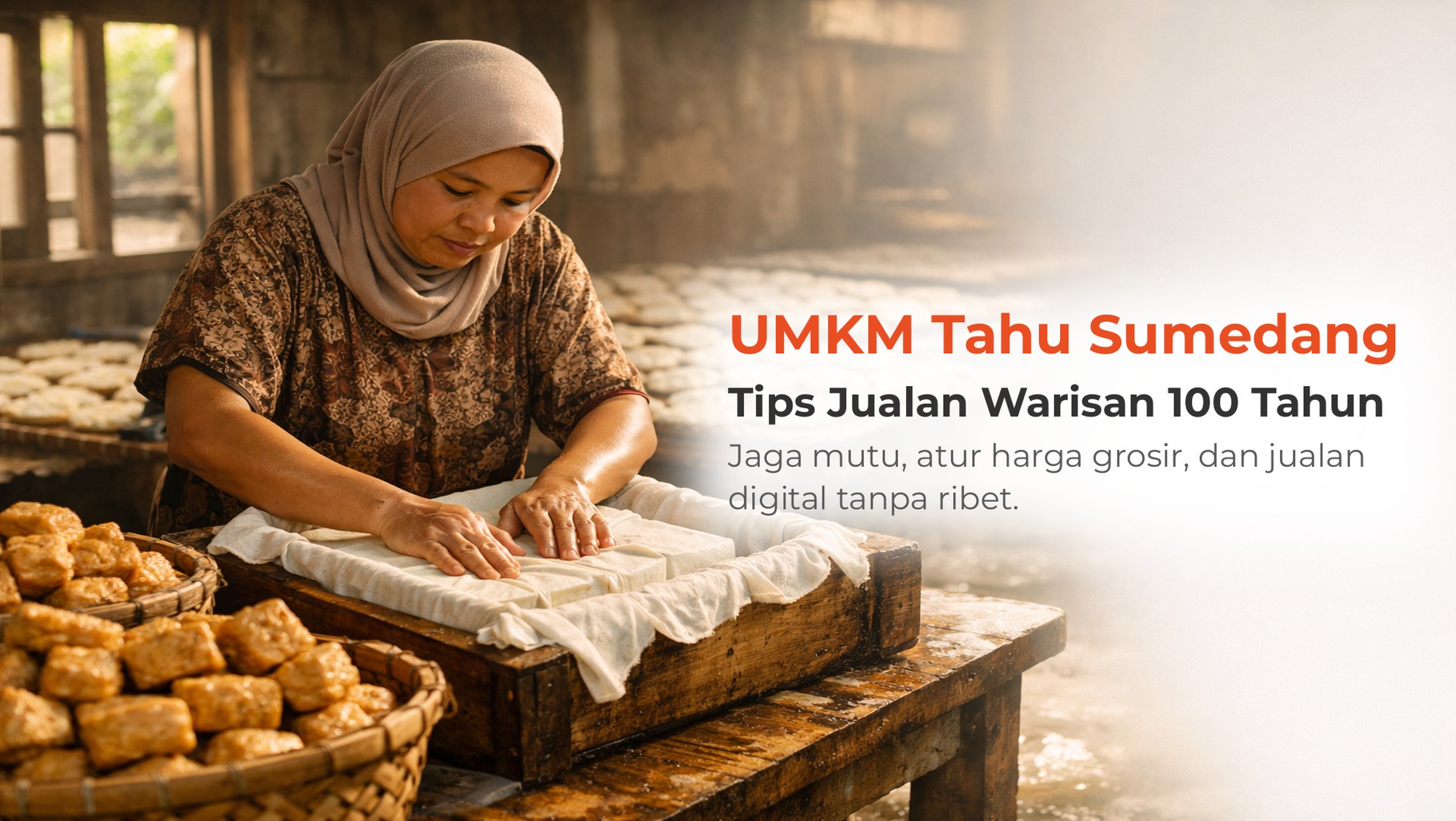
For fried tofu, the difference between a quality product and an ordinary one lies in the details of processing: good soybeans are soaked, ground, strained, then pressed until the texture is right. Processing matters: tofu is dipped in hot oil until a thin, even kerupuk layer forms outside while the inside stays soft and moist. Some sellers still press by hand with cloth and wood; how the water is squeezed out decides how much liquid remains.
The bongsang is where tradition meets business: the bamboo holder for tahu Sumedang is made by separate artisans in Cikonengkulon, Ganeas, and the two support each other. One artisan says bongsang makers keep multiplying, with new makers appearing in Cisarua and Rancakalong. Around 30 artisans in the Bongsang Jembar Sawargi MSME group each make three to four kontek a week, one holding 100 bongsang, giving the trade steady income.
Bongsang quality matters as much as tofu quality. Weaving too tight makes tofu go soggy quickly; weaving too loose fails to protect it in transport. Experienced makers adjust sizes to each buyer's request, including delivery outside the area.
Choose soybeans with clear origin
Raw materials decide over half the flavour. Buy soybeans from traceable suppliers, noting each purchase's date, quantity, and price. When prices rise, those notes show how many portions need a price rise without raising every product.
Record daily batches and ingredients
A tofu business always has two kinds of materials, those bought in and those made in-house, and the records for each are kept apart. One kilogram of soybeans yields a calculable volume of fried tofu. If daily output swings sharply, the cause is usually in the ingredient notes, not the market.
Many tofu businesses in Sumedang keep simple notes in a notebook or on loose sheets. Manual records help if written daily, not summarised at month end. One page a day reveals the pattern: the busiest days, days stock sits unsold, and the hour bongsang stock runs low. For the wider picture of MSME conditions in Indonesia, read the 2026 MSME case study.
Tip 2: Handle Licensing and Packaging
Fried tofu is a food product that must meet permit rules. For home production, a local P-IRT permit is the minimum before wide sale. Halal certification then becomes a question modern retail and export buyers will ask. A product that passes these checks is easier to list on shelves and more trusted.
Packaging decides something else: how long the product keeps and how it looks at first glance. Fried tahu Sumedang has a short shelf life because its texture still holds water. Sealed packaging with clear labels keeps it crunchy and states the production date and permit number.
Many local products also add an identity story to the packaging. For home industries such as tofu, that means one thing: a product whose origin is identifiable is easier to trust. A label naming Sumedang is not decoration. It is a marker of clear origin, showing the product is not anonymous mass production.
Match packaging to the buyer
Not every buyer needs the same format. Small food stalls and traditional markets suit lightweight single-unit packaging. Souvenir shops and buyers taking products home need tighter, more durable packaging. Customers ordering for events need neat packaging that is easy to arrange.
Make a list of product variants with sizes, unit prices, and wholesale prices. Clear variants keep cashiers from picking the wrong item and stock records accurate, since each size has its own quantity. Applying wholesale prices for bulk buyers is covered in the wholesale price guide.
Secure P-IRT and halal certification
This step is often postponed as a formality, even though it is where many businesses stop before reaching modern stores. A sensible order of preparation follows.
| Step | What to prepare | Its purpose |
|---|---|---|
| Business legality | NIB and permits by scale | Basis for accounts and packaging |
| Food permit | P-IRT permit for home production | Meets food-product sale requirements |
| Halal certification | Ingredient list and production process | Opens modern retail and export markets |
| Packaging | Label, production date, permit number, contact | Maintains quality and trust |
The snack sector gives a traceable example. Opak and kolontong from Sumedang villages are widely known, and research on the Cikurubuk opak business shows owners with a logo, a banner, and simple financial reports are easier to trust than those without. Complete licensing preparation gives small businesses the same chance to reach modern shelves.
Every region keeps its products authentic in its own way. In Sumedang, tofu makers are used to buyers who ask where the product comes from. The same applies elsewhere, such as how keripik tette businesses in Pamekasan maintain quality and legality, as explained in the Pamekasan keripik tette guide.
A business that needs fast turnover can start with the channels that already work, then gradually be assessed as ready for retail. The process is stepwise, not one large step that must be completed before any sales happen at all.
Tip 3: Use AI and a Digital Shelf
Early November 2026 brought good news for owners ready to move up. On 5 November 2026, Coordinating Minister for Community Empowerment Muhaimin Iskandar received a delegation from the Indonesian E-commerce Association and asked online platforms to open their digital shelves to the MSME products they support, alongside National Online Shopping Day, targeting Rp40 trillion in transactions. The message is simple: a well-prepared product sells faster once listed.
Adoption data supports this. A survey from the same period shows 36.8 percent of MSMEs in Indonesia already use artificial intelligence, and 42.6 percent use it for marketing and content creation. Product photos and sales descriptions can now be helped by technology, without expensive designers.
For tahu Sumedang products, the first task on the digital shelf is not a long description but honest, clear photos: fried tofu with crunchy kerupuk on a bongsang, packaging naming the region, a readable production date. Visible details build buyer confidence before ordering.
After the photos, complete what buyers ask most: net weight, composition, production date, storage instructions, and permit number. For a short shelf life such as fried tofu, the production date becomes the main marker. Buyers who can tell old stock from new order more often, and you avoid throwaway goods.
Use sales data to plan production
Many tofu owners realise after a month that their best seller is the variant they did not expect. Daily sales data shows patterns the cash book hides: what time buyers arrive most, which variant runs out fast, which day stock sits unsold. Once visible, production can follow the variants buyers look for.
Keep customers who already bought
Buyers of fried tahu Sumedang who have tasted your product have a good chance of returning, especially when taste and quality stay consistent. Often the opposite happens: the customer wants to buy again, but you cannot remember which product they bought, or they do not know how to reorder. Storing customer data and purchase history closes that gap cheaply.
The principle is the same one used by business owners elsewhere who have been trading for longer. Registered customers are easier to offer special deals to, and you learn what people look for most. The approach works for any product, not only food, so what Qasir offers can be used without changing work habits. Storing customer data so buyers return is covered in the customer data guide.
FAQ: Questions About Tofu Sumedang MSMEs
Can tofu Sumedang be sold without a permit?
No. Food products including fried tofu need a P-IRT permit for home production, an NIB, and business permits matching the scale. Without them the product risks being pulled from sale and cannot enter modern stores.
How long can fried tahu Sumedang be stored?
Its crunchiness comes from tofu still containing water, so shelf life is short. Sealed packaging, cool storage, and a production date on the package are mandatory. Selling the same day is the safest choice for keeping quality.
Is the bongsang mandatory for tahu Sumedang?
The woven bamboo bongsang is not obligatory, but it has become a differentiator buyers recognise. Bamboo packaging holds heat and keeps the tofu's shape, so the product stays neat in transit. As for taste, the bongsang or any other packaging changes nothing, only the look and durability.
How much starting capital to sell tofu?
Capital needs depend on the scale. Home production can begin with one pressing set, a pot, a wok, and simple packaging, then grow as buyers increase. The permit, labelled packaging, and income and expense records come first, because these three decide whether the business survives. Cost of goods and break-even point are covered in the calculating profit guide.
Business and Finance Tips for Tofu Owners
Separate business money from personal money
The most common mistake in a home food business is mixing sales money with household needs. Once mixed, it is hard to tell whether the business is truly profitable or the money is covering a shortfall. Separate them from the start, ideally through a separate account, so you can see what really remains.
Set price from ingredient costs
Before setting a price, calculate the ingredient cost per package: soybeans, frying oil, bongsang or other packaging, extra ingredients, and labour costs. Then add a reasonable margin. This prevents profit from shrinking when soybean prices rise, and shows which cost is most sensitive.
Prepare an emergency fund
A food business depending on a single supplier can stop within days if something goes wrong. Keep an emergency fund covering one production cycle. The fund is not for expansion, but a safety net when a downtrend appears or ingredient prices climb.
Apply for the right financing
Government financing programmes for small and medium enterprises add capital to increase production capacity or buy better equipment. Government credit disbursement reached Rp264 trillion in October 2026 with around 4 million debtors, and the production-sector share keeps rising. Owners with tidy sales records are easier to trust than those with empty ones.
Conclusion
Sumedang has capital not every region has: a known name, a taste that cannot simply be imitated, and artisans who support each other, from tofu makers to bongsang makers to bamboo weavers. Government records show Sumedang Regency with 66.003 MSMEs in 2024, 1.758 of them joining training. The market and resources are there; what separates a business that survives from one that stops is how neatly it runs.
The three steps above can be carried out without large costs. Maintain quality and taste, handle permits and packaging, then use the digital shelf with recorded sales data. The order matters: a reputation built on consistent taste costs more than a one-off discount.
Manage Sumedang Tofu Sales with Qasir
Selling tofu is not complicated, but many details must be remembered daily: raw materials used, variants sold, prices for bulk buyers, and customers who have bought before. All of that can be handled from one digital cash register app.
Digital cash register for stalls and bazaars
When selling directly or taking orders on the spot, transactions are often written in a notebook or kept in memory. A digital cash register app records every sale automatically, with a receipt for the customer.
Stock management for soybeans, oil, bongsang
Stock management reduces the risk of running out of raw materials unnoticed and shows which products sit unsold too long. It matters for tofu because shelf life is short and the product cannot be stored long.
Product variants for tofu and package sizes
A tofu business usually has several product types: fried tofu, fresh tofu, tahu bandeng, and various packaging sizes. The product variation feature stores all of those options in one item, so cashiers do not pick the wrong variant.
Wholesale prices for bulk buyers
Food stalls, souvenir shops, and modern stores usually buy in large quantities at a lower price per unit. In Qasir, wholesale prices can be set directly on the product, so the selling team need not recalculate prices for every large order.
Sales and profit reports for profitable variants
With sales and profit reports, you see which variant sells best and how much margin each has, so the next production run can follow the variants buyers look for.
Customer data to keep buyers coming back
Buyers who have tasted your fried tahu Sumedang tend to return. The customer feature in Qasir stores purchase history, so you know which product sells often and when to offer a new variant.
Cash in and cash out recap daily
A food business almost always has expenses outside ingredients, such as delivery and packaging. Tidy cash in and cash out records let you see what really remains each day, not only what came in. Starting tidy records is covered in the income and expenses guide.
For the full picture, choosing the best-selling product from sales data is covered in the sales data guide.
Download Qasir free on the Play Store or App Store, and start tidying up your tahu Sumedang sales records today.