
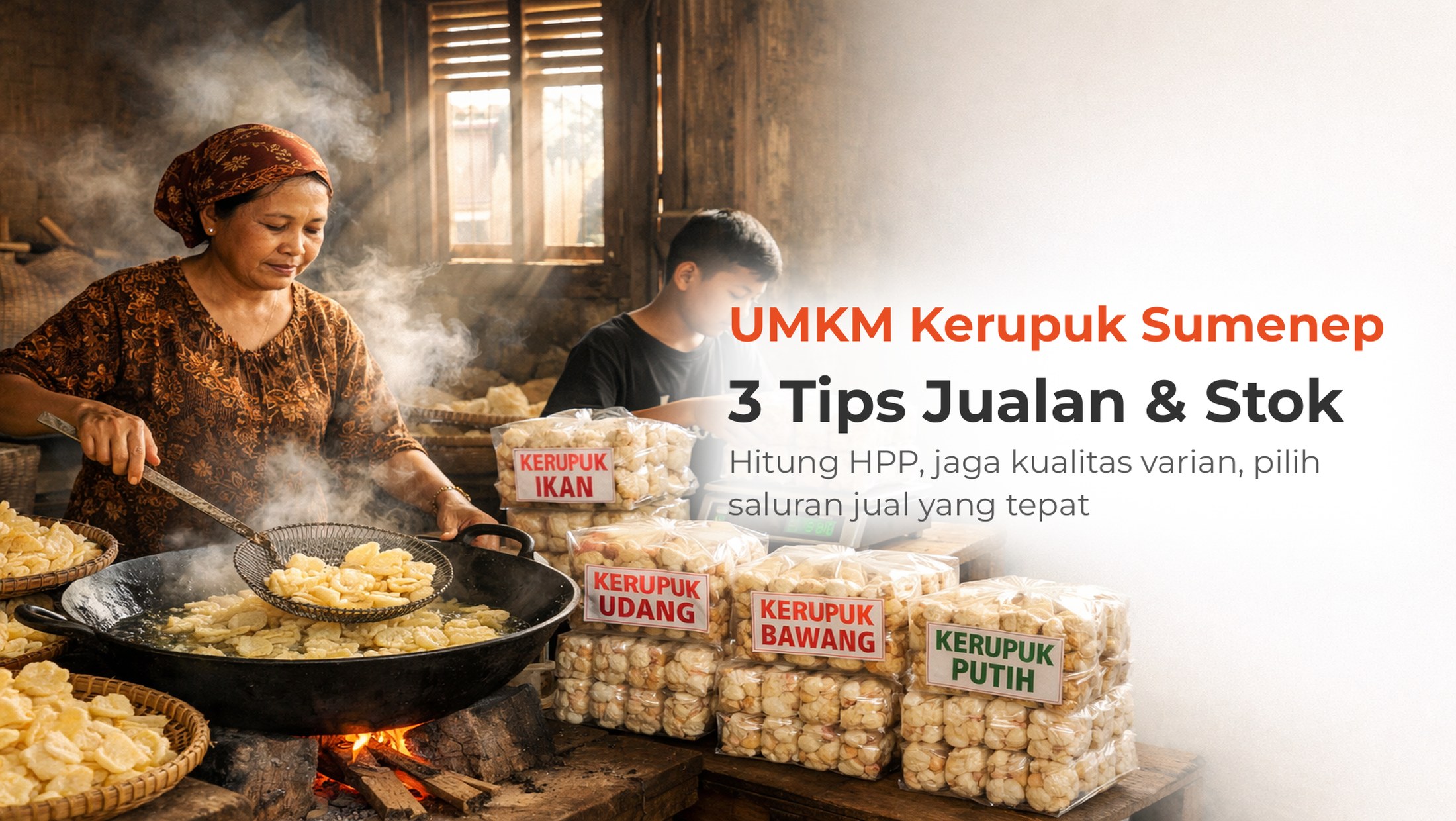
Sumenep Kerupuk SMEs trade in a regency where salt ponds, seaweed farms, and home kitchens share the same coast. Competition is tightening: more sellers reach the morning market from outside the district, and buyers compare the price per pack first. Three levers still work — knowing the real cost of one pack, keeping the product good enough to bring buyers back, and widening the places where you sell. This guide covers all three, then closes with the Qasir features that keep the records for you.
Sumenep Kerupuk SMEs Face Stiff Competition
The salt side of the local economy is expanding. The regency recorded 25,285 tons of farmer salt in the 2026 salt season, based on field extension reports up to August 2026, as ANTARA News reported. The regency development agency is preparing a salt downstreaming agenda for the 2027 RKPD with value-added products from premium consumption salt to spa salt, worked out with Bappenas on 3 and 4 September 2026. The East Java legislature backed the decision to stop importing salt for consumption, a policy that pushes local farmers to raise quality and protects growers who supply processors, as Kominfo Jatim reports. Research and innovation in Madura runs the same direction, with salt innovation villages from upstream to downstream and a technopark concept linking government, industry, and universities, as the Ministry of Marine Affairs and Fisheries reports.
On the food side the pressure is closer to home. Vendors selling the snack in bulk sit at Pasar Saronggi every morning and at Pasar Bluto on Saturdays and Tuesdays. They sell bundles of 12 plastic packs that wholesalers banderol at Rp8,000 to Rp9,000 and market stalls pass on at around Rp12,000. That leaves a thin spread, so the operators who last are the ones who know exactly what one pack costs them. Regency officials frame it the same way: local management, from production planning through processing, finance, and marketing, is what needs strengthening for island businesses, and the regency's SME office pushes operators to level up through legality, quality, marketing, and market access.
Tip 1: Work Out Kerupuk Costing per Pack and per Kilogram
Every stall owner knows the selling price. Far fewer know what one packet costs to produce, and that number decides whether a busy day actually made money. The unit looks simple on the surface, a plastic packet of a few hundred grams, but the real cost sits in the raw material, the oil, the seasoning, the packaging, and the packs that break in transport. Write the cost down per batch first, then divide by the number of packets that batch produced.
Where Bulk Kerupuk Is Bought and Sold at Pasar Saronggi
The daily market sets the reference price. At Pasar Saronggi, wholesale traders bander one renteng of 12 plastic packets at Rp8,000 to Rp9,000, and market sellers pass the same renteng on at roughly Rp12,000, so the spread is Rp3,000 to Rp4,000 per renteng before packaging and transport are counted. Note that the two markets run on different days: vendors sell at Pasar Saronggi every morning, and at Pasar Bluto on Saturdays and Tuesdays, so both prices belong in the same notebook. A clear method for testing whether a busy selling day is actually profitable is in the guide to calculating profit when sales are busy.
| Aspect | Wholesale seller | Retail market seller | Note |
|---|---|---|---|
| Buy price per renteng of 12 plastic packs | Rp8,000 to Rp9,000 | Same wholesale price, paid to the trader | Set by the trader, not by the stall |
| Retail selling price | Not sold one pack at a time | Around Rp12,000 per renteng | The number the customer actually pays |
| Spread per renteng | Margin comes from volume | Around Rp3,000 to Rp4,000 | Before packaging, transport, and unsold packs |
| Raw materials to record | What the trader buys by the sack | Raw material per variant, cooking oil, seasoning, plastic packets | Write one cost line per batch |
| Role of packaging and labels | Plain plastic, price banderoled on the bundle | Clean packing plus a readable label | The label is what brings a buyer back |
Working Out the Cost per Pack, from Raw Materials to Packaging
Start at the raw material stage. The variants that move fastest are fish, shrimp, onion, and white, and coastal groups work with seaweed-based versions, so each recipe has its own input cost and yield per batch. Add cooking oil, seasoning, fuel, then plastic packets and any printed label, and only then count what remains after the oil drains and a few packets are damaged. Divide that total by the packets that survived and you have the cost per pack. Run the same sheet per kilogram as well, because a wholesale buyer compares price per kilogram while a market customer compares price per pack.
Tip 2: Pack Variants Well and Keep Quality so Customers Return
A stall survives on the second purchase, not the first. Customers who find the same flavour, texture, and clean packing at the next visit come back the week after. The recipe, frying time, drying method, and packet size must be identical from batch to batch, and changes written down, not remembered.
The Kerupuk Variants Buyers Look For Most at Daily Markets
Four variants dominate the daily market: fish, shrimp, onion, and plain white. They must be in stock together and priced so comparison is easy. Alongside them sit seaweed products from coastal producer groups coached by the fishery office since 2021: seaweed kembang goyang, rengginang, shredded fish with a seaweed flour skin, gambir, ulat sutra, and kerupuk amplang, as the regency media center reports. Two lines already run at scale: seaweed kembang goyang at 300 kg a month and seaweed crackers at 75 kg a month.
Neat Packaging and Labels That Bring Buyers Back
Packaging protects the product and tells the buyer what they are getting. The plain plastic packet with a banderol price is what most bundles travel in, and it works for the cheapest option. For everyone else, a clean packet with a readable label — variant name, weight, production date — turns an anonymous snack into a product someone can recommend. The same rule applies online, where a photo of the packed product and a clear label do most of the selling before the customer asks a question.
Tip 3: Sell at Daily Markets, District Events, and Online Channels
One channel is a gamble on weather and foot traffic. Three channels turn the same production into three chances to sell, each asking for a slightly different version of the product.
Daily Market Schedules and District Events in Sumenep
The daily market is the anchor. Pasar Saronggi runs every morning, Pasar Bluto on Saturdays and Tuesdays, and both are worth more than an average day because buyers come from outside to stock up. That makes the production schedule the real decision: a batch must be fried, cooled, packed, and delivered before the stall opens, and a stall arriving with the right variant at the right hour outsells one arriving late with more stock. The regency government adds a second channel by compiling a 2026 event calendar for every district, a space to promote local MSME products, culture, tourism, and food. Reserve a table, bring the labelled packs, and let people taste before they buy.
Selling Outside Sumenep Through Online Channels
The coastal producer groups already sell beyond the regency. Their seaweed products are in demand inside Sumenep and have been marketed to Jakarta and Kalimantan, proving outside buyers take the product when packaging and logistics hold up. Online selling works the same way: photograph the actual packed product, state the weight and variant, and keep the price list in one place so a repeat order does not need a phone call. The distance is not the obstacle, the record keeping is. A similar playbook for a neighbouring region is in the Pamekasan keripik tette sales guide, and another regional food business in the Indramayu mango guide.
FAQ: Frequently Asked Questions
Is Sumenep Kerupuk Halal and Ready to Sell?
Agribusiness research at UTM Trunodjoyo studied seaweed processors under the One Subdistrict One Product Halal concept, and the customer satisfaction index reached 90.60 percent for seaweed crackers, ahead of seaweed kembang goyang at 87.29 percent and ulat sutra at 84.08 percent. The regency's SME office keeps coaching operators on business legality and product quality through fishery extension officers active since 2021. An app record never replaces an official permit, so check what your product still needs before approaching a modern shelf.
How Much Starting Capital Does a Kerupuk Business in Sumenep Need?
A trader buying by the renteng at Rp8,000 to Rp9,000 and selling at Rp12,000 needs roughly Rp100,000 to Rp200,000 for a few bundles and a stall fee. A producer adds raw material, cooking oil, seasoning, and packaging; coached coastal groups reach 75 kg a month of seaweed crackers and 300 kg of seaweed kembang goyang, showing the scale a production start-up can reach.
How Do You Calculate Profit from Selling Kerupuk in Bulk?
Subtract the wholesale buy price of Rp8,000 to Rp9,000 per renteng from the retail sell price of around Rp12,000 to get a gross spread of Rp3,000 to Rp4,000, then deduct packaging, transport, and unsold packs to find the net per renteng, per pack, or per kilogram. A practical way to track that data automatically is in the guide to sales data for profit.
Can Kerupuk and Seaweed Products from Sumenep Enter Modern Retail?
The regency's SME office pushes business legality, product quality, marketing, and market access, and research at UTM Trunodjoyo places UD Moffin in SWOT Quadrant I with IFAS 3.64 and EFAS 3.22, showing internal and external strengths. Entry still depends on consistent documentation, halal certification where required, and production volumes that meet a buyer's minimum order.
Business and Finance Tips for Sumenep Kerupuk Owners
Good habits on the money side keep the stall open when the market is quiet. Keep three separate wallets: one for household spending, one for production costs, and one for reinvestment. Calculate the margin on each variant separately because the fish, shrimp, onion, and white versions use different amounts of raw material and oil. Set aside a small emergency fund from every market day so a broken fryer or a rain week does not force a loan. Check the daily sales recap against the cash in the drawer before you close, and review the customer list once a week to see who buys what and how often, as the guide on customer data explains. Use the cash recap feature to spot gaps the same evening, as the cash recap guide shows. Another region runs the same daily discipline on a different product, and Sleman laundry POS sales tips shows how a shop keeps its books tidy.
Qasir Features for Sumenep Kerupuk SMEs
Everything above comes back to one requirement: records you can check without guessing. Qasir is a digital cash register app, and the features below cover the parts of the day a kerupuk business runs on, from the raw material shelf to the customer's receipt.
Manage Raw Materials for Kerupuk Recipes and Seasoning
The raw material and recipe feature stores what goes into each batch, from raw material and seasoning to plastic packets. It shows how much of each ingredient a recipe consumed and what one batch produced. The benefit for a kerupuk maker is a cost per pack from your own numbers, not memory.
Wholesale Prices for Bulk Buyers
The wholesale price feature keeps a separate price level for bulk buyers on the same product record. Market traders buying a renteng and shops ordering twenty packets get the right price without manual recalculation. A worked example appears in the guide to maximising sales with the wholesale price feature.
Daily Sales Reports and Cash Recap
Daily sales reports show how much was sold and which variant moved, and the cash recap compares drawer money with recorded sales at close. The benefit is a gap that shows up the same evening, not at month end, which makes the margin in Tip 1 trustworthy.
Send Digital Receipts to Customers
The digital receipt feature sends the receipt to the customer after the sale, on their phone. A market buyer with the variant name and price in hand can return for the same thing next week, and you keep a record without writing it twice.
sangat membantu, apalagi untuk update stock, harga dll. laporan juga cepat laporan harian penjualan dll. cs juga ramah dan cepat pelayananan
Monji, Qasir user on Play Store
Conclusion
The three levers — accurate costing, consistent quality, and multiple sales channels — work together. Knowing the true cost per pack protects the margin. Keeping the product and packing identical batch after batch builds the repeat buyer. Showing up at the morning market, at the district event, and on an online shop multiplies the chances to sell. When records proving all three sit in one app, the owner spends less time on paperwork, more on production.
Manage Your Sumenep Kerupuk Business with Qasir Features
- Raw material and recipe tracking — know the exact cost per pack for every variant.
- Wholesale price levels — serve renteng buyers and small shop orders without manual recalculation.
- Daily sales reports and cash recap — spot gaps the same evening, not at month end.
- Digital receipts — give the buyer a record that brings them back next market day.
- Customer data — see who buys what and how often, then target promotions.