
693 million consumers. That is the regional market now formally connected through the ASEAN Digital Economy Framework Agreement (DEFA), which has been signed by all ASEAN member states. As reported by Kompas on November 16, 2026, Indonesian MSMEs have a real opportunity to reach this market: DEFA drives the digitalization of trade documents, customs simplification, and the ASEAN Single Window, while the e-Conomy SEA 2026 report projects Indonesia's digital economy GMV to reach USD 446 billion by 2035.
The same week, the North Maluku office of the Ministry of Law and Human Rights strengthened its GI Tourism 2026 program, promoting geographically indicated products — Pala Ternate, Pala Dukono, Cengkeh Moloku Kie Raha, and Kelapa Bido — toward international markets, as covered by Antara. Ternate itself is known as the zero point of the world's Spice Route.
For Ternate clove farmers and small business owners, these two headlines signal open doors. North Maluku's economy is broader than spices: nutmeg, coconut and copra, capture fisheries such as tuna and skipjack, and seaweed all thrive alongside the clove trade. The clove belt itself runs through Ternate, Tidore Islands, North Halmahera (Galela and Tobelo), and Central Halmahera (Weda), and regional plantation plans include rejuvenating 1,000 hectares plus expanding 500 hectares more, with a production target up by 1,000 tons. More volume will need professional buyers, proper storage, and reliable channels in the coming years.
Yet around 95% of North Maluku MSMEs are still micro-enterprises, concentrated in Ternate City and South Halmahera. They face limited financing, high inter-island distribution costs, minimal cold storage, and incomplete product certification. Below, we break the journey into three practical tips, followed by finance habits, tool recommendations, and answers to the most common questions — a working roadmap to sell Ternate clove more professionally, from upstream quality control to export channels.
3 Tips for Selling Ternate Clove
Selling spice to the world is not only about having a good harvest. Buyers — domestic collectors, exporters, and overseas importers — pay for consistency: consistent quality, consistent supply, and consistent paperwork. These three tips focus on what a small business can start doing this season.
Tip 1: Guard Quality Upstream, from Harvest to Drying
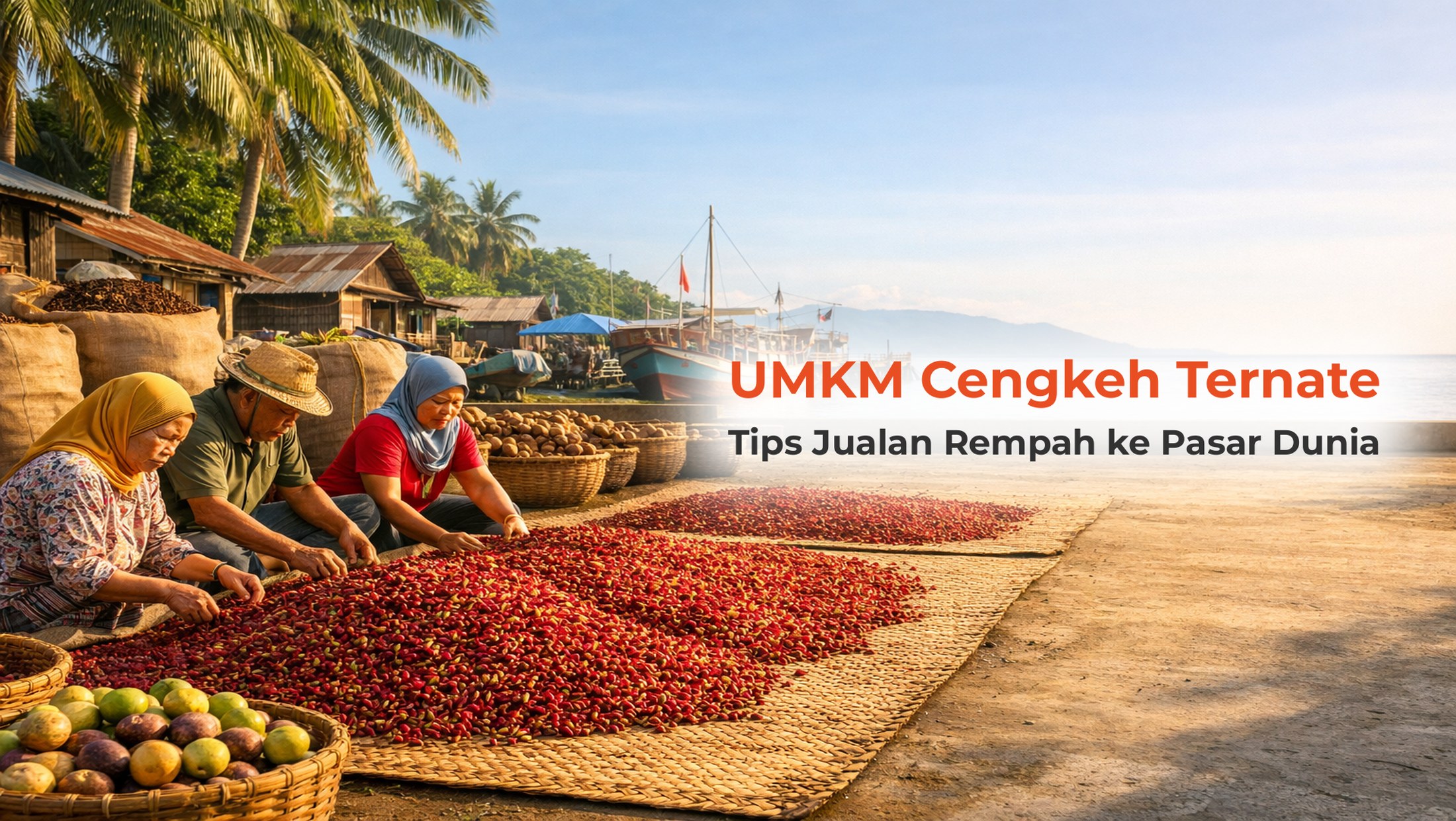
Quality for dried cloves is decided long before the goods reach a buyer. In the Maluku islands, clove cultivation has been passed down for generations along the old Spice Route. Experienced farmers harvest the flower buds while they are still red-yellow, before they fully bloom, then dry them on woven mats or trays until completely dry. Harvesting at the right stage is what locks in the aromatic oil content.
Export-grade cloves, often called prime cloves, show dark brown color, whole unbroken buds, low moisture, and high essential oil content. Wet or moldy clumps can downgrade an entire batch, so drying areas must stay clean, ventilated, and off the ground. Grading before sale matters too: sort whole buds from broken ones, because mixing grades drags the whole batch down to the lowest price offered. Store dried cloves in dry sacks off the floor, away from direct sunlight, and check periodically for mold or insect infestation during the months between harvests.
| Aspect | Prime Cloves | Broken Cloves (Cengkeh Sesek) |
|---|---|---|
| Bud condition | Whole and unbroken | Shattered during drying or handling |
| Color | Even dark brown | Light brown to uneven tones |
| Moisture | Low, fully dried | Tends to be higher |
| Main buyers | Exporters and kretek cigarette factories | Essential oil and grinding industries |
| Price | Higher, follows the world market | Lower than prime cloves |
Local wisdom also helps smallholders compete: gotong royong, or mutual cooperation. By joining a farmer group, small growers can pool harvest volumes to fill large orders and share certification costs that no single farm could afford alone. Similar grassroots export stories have been covered in this blog's piece on Asahan shrimp paste producers, which shows how a local product with consistent quality can find its way to foreign buyers.
Tip 2: Add Value, Don't Just Sell Raw Material
Raw dried cloves are a commodity, and commodity prices swing with the world market. One way to reduce dependence on raw material prices is to process further — value-adding is the most practical hedge a small spice business has. Clove derivatives include essential oil, ground spice blends, premium kretek cigarette ingredients, and herbal spice teas. Each derivative has its own buyer and its own margin structure. Even simple steps count: re-packing bulk cloves into labeled half-kilogram pouches, or bundling ground spice blends with recipe cards for buyers who want the story as much as the spice.
There is also a brand story ready to use. Cengkeh Moloku Kie Raha is a registered geographical indication, an official mark that a product comes from a specific region with specific qualities. Packaging the story of the Spice Route, the historic zero point in Ternate, and the GI mark into your label gives small retail packs a reason to be chosen over anonymous bulk goods. Small sachets and gift-size packs also suit modern retail and online orders far better than one-kilogram bulk bags.
Tip 3: Open Digital and Export Channels
DEFA and the ASEAN Single Window are pushing cross-border trade paperwork into digital form, which gradually lowers the barrier for small exporters. Marketplaces and live commerce let a Ternate seller reach buyers in Jakarta, Surabaya, or overseas without a physical shop.
Export still requires legality: a business identification number (NIB), halal certification where relevant, and export permits — directly or through an aggregator. For export buyers, prepare product samples, a one-page company profile, and clear photos of your drying and storage setup; importers sourcing spice online typically ask for these before committing to a trial order. For digital selling, remember that marketplace fees eat into thin commodity margins, so use available fee discounts wisely. Some platforms offer programs that cut marketplace costs for MSMEs, as explained in this guide on getting a 50 percent marketplace fee discount.
FAQ
These are the questions new spice sellers ask most often, with practical answers you can act on this season.
How much do dried cloves cost per kilogram in Ternate?
Clove prices fluctuate because they follow the world market and local supply after each harvest, so any fixed number becomes outdated quickly. Check current references from the Ministry of Trade or ask local collectors before setting your selling price, and avoid locking in long-term supply deals without a price review clause. For farmers, the same logic applies in reverse: check the current farm-gate price before deciding how much of the harvest to sell immediately versus store.
What is the difference between prime cloves and broken cloves?
Prime cloves are whole, dark brown, low-moisture buds with high essential oil content — the grade sought for export. Broken cloves, called cengkeh sesek locally, are buds that shattered during drying or handling. They are still usable for grinding or oil distillation, but they are priced lower than whole prime buds, so keep the two grades separate from the start.
What is Cengkeh Moloku Kie Raha?
It is a geographical indication registered with the Directorate General of Intellectual Property at the Ministry of Law and Human Rights, covering cloves from the historic spice region of Maluku. The name refers to Kie Raha, the four mountains associated with the old spice sultanates, and the mark certifies origin and quality. Products carrying the GI mark sit alongside other registered North Maluku indications such as Pala Ternate and Kelapa Bido.
How can an MSME start exporting spices?
Start with legality: obtain a business identification number (NIB), keep product documents in order, and learn demand by selling through marketplaces first. Then join an exporter aggregator or a farmer group so your volumes, certification, and logistics can meet export requirements together with other small producers. Exporting is rarely a solo effort for a micro-business — it is usually a group achievement.
Business and Finance Tips
Running a spice micro-business becomes far easier when the finances are disciplined. A few general principles worth applying:
- Open a separate business account. Record daily income and expenses on the phone so personal and business money never mix, which makes margins visible at a glance.
- Track harvest-season capital separately from sales revenue. Drying labor, sacks, and transport during the harvest are costs that should be measured against that season's sales to know the true margin.
- Build an emergency buffer. Commodity prices swing, so setting aside a few months of operating costs protects the business when prices dip after a big harvest.
- Invoice every transaction. A written record of each sale to collectors protects you weeks later when quantities or prices are disputed.
- Use KUR for productive equipment. Government-backed KUR loans can finance drying racks, packaging tools, or working capital with light requirements, as explained in this guide on how to apply for a KUR loan.
- Explore the Free Nutritious Meals channel. The MBG program opens a local food supply market, and MSMEs can apply to become suppliers through this guide on becoming an MBG supplier.
Qasir Features for Selling Clove
Qasir is an Android app designed for MSMEs, and its features map well onto the daily reality of a clove trader in Ternate: buying wet harvests from farmers, drying and grading, storing, then selling onward to collectors or retail buyers. Here are the four features that matter most for this trade.
Digital Cashier to Record Sales
The digital cashier records every transaction from buying harvests from farmers to selling to collectors. The concrete benefit: daily sales totals are always accurate without paperwork, which makes reconciliation with buyers faster and removes disputes about what was agreed at the scales.
Stock Management to Control the Spice Warehouse
Stock management tracks dried clove inventory and processed products across harvest seasons. The benefit: you know exactly how many kilograms remain in the warehouse and can time purchases before stock runs out mid-season, instead of discovering shortages when a collector is already waiting.
Cash In, Cash Out, and Cash Recap
The cash in and cash out features with an automatic cash recap separate harvest capital from sales proceeds. The benefit: you can see at any moment whether the season's trading is actually profitable or still recovering capital.
Sales and Profit Reports
Sales and profit reports show which products sell best. The benefit: you can compare raw material versus processed products and decide where to focus production next season based on real numbers, not guesswork or the loudest buyer's opinion.
Conclusion
The opportunity for Ternate clove SMEs is real: DEFA opens a 693-million-person regional market, and the GI Tourism program is putting North Maluku spices on the international map. The winners will be businesses that guard quality from the harvest upward, process beyond raw material, and keep their books disciplined. None of this requires a large initial investment — it starts with habits, one record at a time, and the right tools to make those habits stick.
Manage Your Spice Sales Neatly with Qasir Features
To keep a clove business growing, daily records need to be as disciplined as the drying process. Whether you sell raw buds by the kilogram or packaged blends online, the same tools apply. Qasir bundles the essentials in one Android app, all usable from a single phone:
- Digital cashier — record every sale and purchase from farmers and collectors in seconds.
- Sales reports — see which products move fastest, from raw buds to processed goods.
- Stock management — monitor warehouse inventory across harvest seasons.
- Cash recap — review cash in and cash out automatically at the end of each day.
- QRIS payments — accept digital payments from buyers without transfer confirmation hassle.
- Customer records — remember regular collectors and their usual order volumes.
Download Qasir for free on the Play Store and start recording your spice business today.