
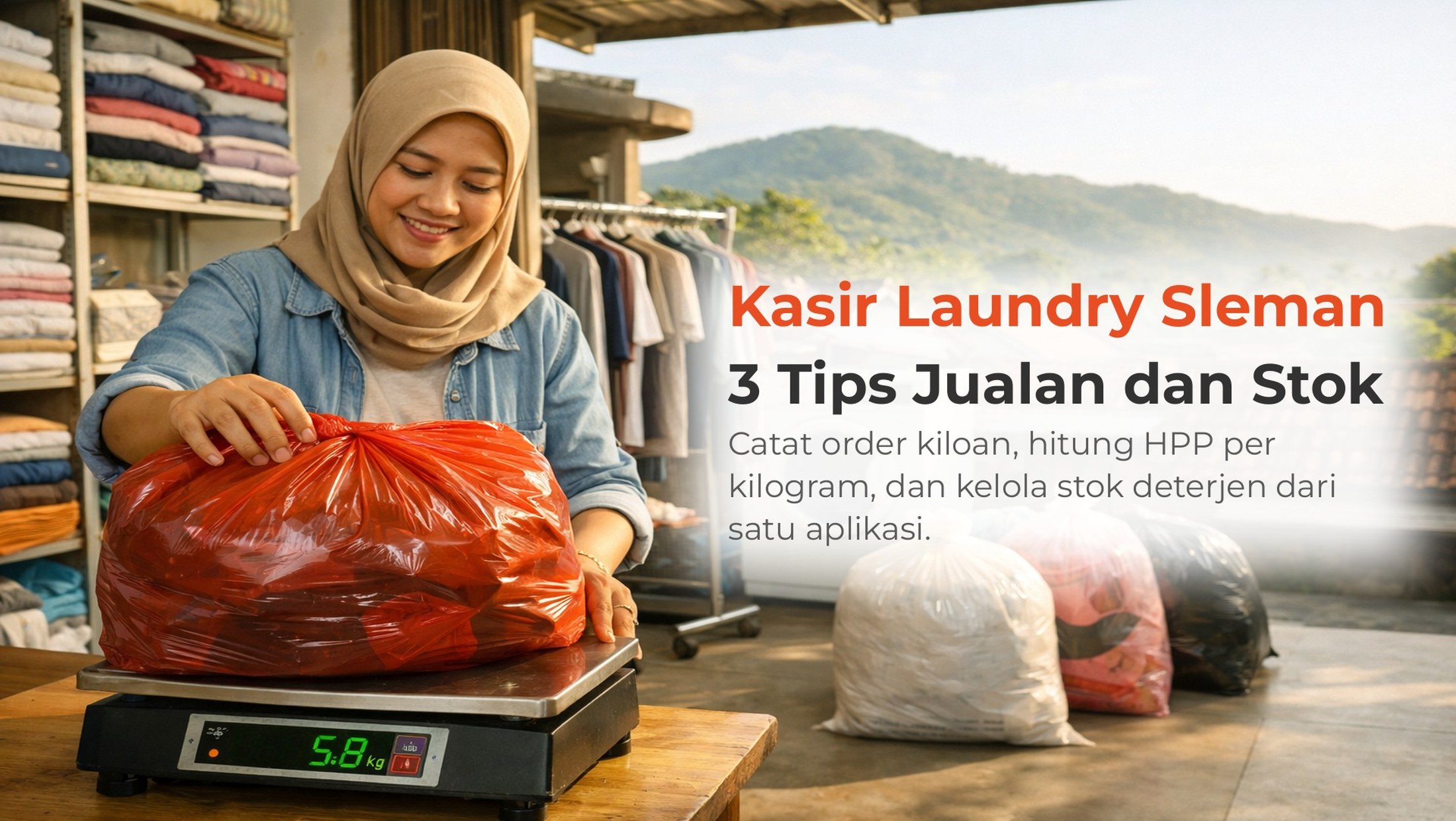
Laundry POS in Sleman Faces Tougher Competition
Running a wash-and-fold business in Sleman in 2026 means competing in a market that grows and crowds at once. A Kompas.com report on 14 November 2026 puts the global laundry market on a path from roughly USD 135 billion to USD 370 billion by 2050, with Indonesia among emerging markets growing about 4.5 to 7.5 percent a year.
Maria Eva Sriulina, chair of ASLI, argues that operators should improve management quality and professionalism. For a small shop, that is where a laundry POS earns its keep.
The Ministry of MSMEs encouraged owners to map business spreads as the sector expands into every region on 13 September 2026. He noted that more entrepreneurs do not always mean higher income.
Technology is reaching the smallest shops: on 20 November 2026, Purnamanews reported on a QRIS payment system used by self-service laundry shops in South Tangerang since 16 November 2026. Its founder says owners can track transaction data and control every machine remotely, reducing losses.
A healthy caution comes from Fadhila Maulida of INDEF Digital Economy and MSME Research Center, quoted by Kompas.com on 28 September 2026: similar services open in many locations, while demand is fairly stable and risks can be calculated, local markets can saturate until margins thin.
Sleman recorded 110,889 MSME units as of 3 March 2026, according to Harian Jogja. Signature products include jadah tempe, chips, bamboo, and batik crafts, with local coffee. A separate ANTARA report puts the count above 111 thousand and lists salak, bamboo, tilapia, batik, and jadah tempe as flagship commodities.
Two real businesses in Sleman show what the numbers look like. Laundry Express Jogja-Daris in Ngropoh, Condongcatur, Depok, handles 15 to 20 kilograms per day for roughly 30 to 40 active customers. It charges Rp7,000 dry washing and Rp10,000 for washing with pressing, gives free pickup and delivery within a 2 kilometer radius, and earns Rp2,500,000 to Rp3,500,000 a month, dropping during university holidays.
A home-based wash business shows the other route. Bu Jum, also known as Jumini, started in Padukuhan Kalitengah Kidul in 2013 and now handles 10 to 20 kilograms per day at Rp5,000 per kilogram. Radar Jogja reported on 17 November 2026 that she later received a larger machine through LAZ PPPA Daarul Qur'an's program, and the Ministry of Religious Affairs profile places the story inside the Kampung Qur'an Merapi journey.
Tempeh jadah has its own production center at Hargobinangun in Pakem district, Kaliurang, together with Omah Jadah Kaliurang as a production house and educational tour site, as ANTARA reported on Hargobinangun as a tempeh jadah industry center and on the launch of Omah Jadah Kaliurang. The batik side runs through Asosiasi Batik Sleman Mukti Manunggal, which produces around 5,000 sheets per month at prices from about Rp125,000 to Rp2.5 million per sheet, with about 80 percent of the material bought from the market, according to Kontan's coverage of the association.
How Yogyakarta batik SMEs upgrade their retail game is a useful read. Kontan's feature on the home wash businesses of Yogyakarta describes the pattern that runs through Sleman: washing done at home, a tariff per kilogram, and pickup and delivery for students.
Tip 1: Record Kiloan and Per-Item Orders with Accurate Weights
Most shops in Sleman sell more than one service format. Some take clothing by the kilogram, some price by the item, and many do both. Cash register apps used by laundry businesses in Jakarta show the same split, because each format carries its own margin and merging them hides which one supports the shop.
The fix is to separate order types at the moment of sale. In a laundry POS, an order type label attached to each transaction travels into the transaction history and the sales report, so a kiloan load and a single pressed shirt never share one line. That habit answers most end-of-day questions: which service paid the rent.
Tip 2: Calculate Cost per Kilogram and Set a Healthy Selling Price
Published prices in Sleman are a reference. The journal record of the Ngropoh shop lists dry washing at Rp7,000 and washing with pressing at Rp10,000, while the home operation run by Bu Jum charges Rp5,000. Those numbers describe what customers paid.
| Component | Estimated per Kilogram | Note |
|---|---|---|
| Dry washing service | Rp7,000 | Published price at the Ngropoh shop |
| Washing with pressing service | Rp10,000 | Same shop, and the ceiling the market accepts |
| Detergent, water, electricity | Needs own figure | Calculate this yourself from your own monthly spending |
| Labour, packaging, delivery | Needs own figure | Covers the free 2 kilometer pickup radius |
Divide your monthly spending on each line by the kilograms washed that month, and a laundry POS makes that arithmetic repeatable. A walkthrough of the wholesale price feature shows how to price dormitory and office contracts once the base rate is settled.
Tip 3: Use Order Status, Order Type, and Digital Receipts
A wash-and-press order passes through stages: received, in the wash, being pressed, ready for collection, and finished. The Order Status feature, on the Qasir Pro Plus package, lets you name those stages yourself, up to five in total. A laundry POS that shows the stage of every order replaces the paper note under the counter.
Order Type, on the Qasir Pro package, handles the other half by distinguishing kiloan orders, per-unit orders, and per-item orders so each appears separately in the transaction history and the sales report. Together, the two features let a customer ask where their clothes are.
Digital receipts close the loop. Receipts can be sent through WhatsApp, email, or social media, and the same records support reminders for unpaid bills, discounts for loyal customers, and extra charges for services beyond the standard list.
FAQ: Frequently Asked Questions
Is a kilo laundry business in Sleman always profitable?
No, and the published records show a range rather than a guarantee. The Ngropoh shop earns Rp2,500,000 to Rp3,500,000 with 30 to 40 active customers, dropping during university holidays. Margins depend on cost control and consistent machine operation.
What is a fair kilo laundry price in Sleman?
The published reference points are Rp7,000 dry washing and Rp10,000 for washing with pressing at the Ngropoh shop, and Rp5,000 at the home operation. A fair price covers your cost per kilogram and still leaves room for slow weeks.
How much capital do I need to open a laundry in Sleman?
It depends on the model. The home operation Bu Jum started in 2013, grew to 10 to 20 kilograms per day, and received a larger machine through LAZ PPPA Daarul Qur'an's program. A dedicated location needs more, and KUR loan for Indonesian SMEs in 2026 is worth studying first.
How do I track laundry that customers have not picked up yet?
Every uncollected bag is money that is finished but not paid for. Order Status moves each order through stages you define, and the customer transaction history keeps the receipt, weight, and collection date in one record. Why customer data matters for repeat business explains how the same records win the customer back, and a laundry POS turns paper notes into a readable list.
How do I calculate cost per kilogram and do I need a business licence?
Cost per kilogram is detergent, water, electricity, labour, packaging, delivery divided by kilograms washed, and the table in Tip 2 shows the structure. On licensing, requirements differ by scale and local regulation, so confirm the rule with the Sleman district office.
Business and Finance Tips for Laundry Owners in Sleman
Separate Business Cash from Personal Cash
Mixing the two is the most common reason a busy month ends with nothing left. Keep sales income and spending separate, and a guide to recording income and expenses shows the habit in practice. A laundry POS helps track every laundry transaction.
Calculate the Break-Even Point per Kilogram
Divide fixed monthly costs—rent, electricity, machine payments—by the kilograms you expect to wash. The result is the weight you must clear just to cover overhead, before other running costs are paid. Add those costs per kilogram to get the floor price below which each load loses money, and let a POS report show which service line carries volume. A guide to reading sales data explains how to check that figure.
Use Peak Season and Off-Season to Manage Capacity
University terms, board exam season, and family events move demand in out of a year. The Ngropoh shop earns less during holidays, so a slow month is normal, not a failure. Plan staff schedules around peaks, and use quiet weeks for maintenance and wholesale pricing for dormitory and office batches.
So far I am happy using Qasir. It is practical, the display is easy to understand, and it really helps record sales and monitor transactions. I hope it gets more interesting features going forward.
Irul, Google Play review, 5 stars, 10 November 2026
Qasir Features for Laundry POS in Sleman
Once records are in place, the daily work of a wash-and-fold shop becomes repeatable steps: record the order, weigh the load, follow status, send receipt. A laundry POS handles those steps in one place, and the features below matter most for kilo-based businesses in Sleman.
Digital Cash Register for Recording Kilo Laundry Orders
The cash register records every transaction under the right service category, whether dry washing, ironing, or a same-day package, and you set prices per item or per weight. Because the register supports decimal units for weighing, the price follows the real weight on the scale, which is what a kilo-based customer expects. QRIS payments, reminders for unpaid bills, and extra charges for services beyond the standard list sit on the same screen.
Order Type to Separate Kiloan and Per-Item Laundry
Order Type, on the Qasir Pro package, labels each transaction as kiloan or per-item work, and the label follows the order into the transaction history and the sales report. In a shop that handles a 20 kilogram load Monday and pressed shirts Tuesday, that separation turns a mixed day into a readable one.
Order Status to Track Laundry from Accepted to Finished
Order Status, on the Pro Plus package, is built for businesses with stages before an order is complete. The default flow starts with order received and ends with finished, and you can add stages such as washing, ironing, ready for collection, up to five in total. Each order then sits in a visible stage instead of on a paper note, so the counter can answer a customer question on the spot.
Raw Material Management
The raw material page stores name, unit, quantity, and minimum stock level of each consumable, and it notifies when detergent, perfume, or wrapping is running low. Recipes built from those inputs can be linked to products, and a product tied to a recipe no longer has its stock edited by hand, which keeps the register and storeroom aligned.
Digital Receipts and Daily Sales Reports
A digital receipt can be sent through WhatsApp, email, or social media the moment a transaction is recorded, removing a paper trail and speeding up collection for the free pickup and delivery radius. The same data feeds daily sales reports, including the order type report, so a laundry POS lets a shop owner check turnover, service mix, and outstanding balances from the POS before closing the day.
Conclusion
Sleman has the ingredients for a healthy trade: more than 110,000 MSME units, students and families as customers, and neighbouring industries such as jadah tempe and batik that run on the discipline of weighing, recording, and reporting. The market is also crowded, which is why margins depend on cost control rather than on customers walking in the door.
Three habits carry most of the weight. Record kiloan and per-item orders separately and with accurate weights, calculate cost per kilogram before setting a price, and use order status and digital receipts so nothing depends on a note under the counter. A laundry POS makes the numbers visible enough for you to act while the competition grows.
Run Your Sleman Laundry Business More Easily with Qasir Features
One app covers the daily routine of a wash-and-fold shop: digital cash register, order types, order status, raw material management, digital receipts, and sales reports. A single owner can run the counter, track detergent stock, and check turnover. The Qasir business solution page lists the full set of tools.
- Cash register with prices per item or per weight and decimal weighing units
- Order types separating kiloan, per-unit, and per-item work in every report
- Order status on Pro Plus from accepted to finished, up to five stages
- Raw material management for detergent, perfume, and wrapping stock
- Digital receipts through WhatsApp, email, or social media, plus daily sales reports
Start with one month of honest records, then decide from the data. Sales tips for jamu businesses in Yogyakarta show how a neighbouring sector keeps books in the same way, and why customer data brings people back is worth reading before building promotions.
Download Qasir for free on Google Play and begin recording the first order today. The app is on the official Qasir page on Google Play. A laundry POS is the partner that keeps your records tidy and customers steady in Sleman.