
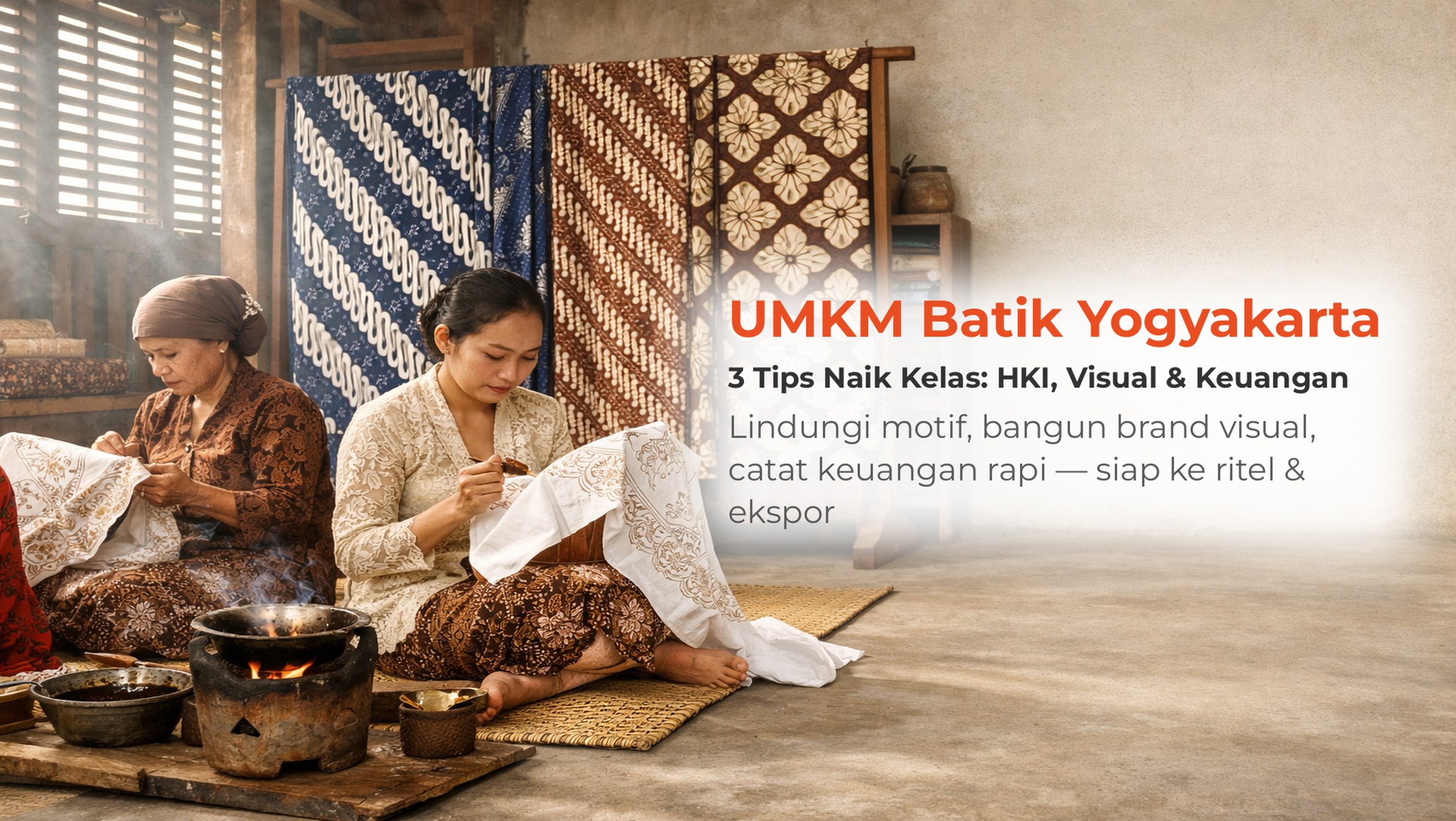
Yogyakarta once again captured the attention of the business world. Last Saturday (14/11/2026), fifteen Yogyakarta batik UMKM players from the city — alongside jamu, bakpia, and local crafts artisans — showcased their products at the Indonesia City Expo at Alun-Alun Simpang Lima, Semarang. The event was part of the XIV APEKSI National Working Meeting, and the results were surprising: cap batik innovated with printing tools made from paper waste, ancestral jamu recipes penetrating modern markets, and Pathuk bakpia ready to step into national retail and export. This mirrors the path taken by Pekalongan batik UMKM and Solo batik UMKM, which have similarly leveraged IP protection to scale their businesses.
Behind the scenes, the Yogyakarta City Industry, Cooperatives, and UMKM Agency is actively opening registration for Batik Segoro Amarto production partners — the official city motif protected by Intellectual Property Rights (HKI). As of November 13, 2026, eight cooperatives have obtained production permits. This policy opens opportunities for both incorporated and individual batik IKM to produce officially branded batik without fear of violating intellectual property rights.
Digitalization trends are also pushing forward. The Financial Literacy Workshop "Attractive Products, Smart Finances" took place on November 12, 2026 at the State Finance Building, attended by one hundred UMKM players from across DIY. Participants not only learned to manage cash flow and profits, but also practiced product photography for digital marketing. The signal is clear: local UMKM excelling in traditional products are now being pushed to level up through neat financial recording and visual presentation that sells.
Tip 1: Protect Product Identity with Intellectual Property Rights
Products from this city possess brand strength built over decades — signature motifs, ancestral tulis and cap techniques, and cultural stories behind every pattern. But that strength is vulnerable to theft if not legally protected. The Batik Segoro Amarto case is living proof: without a license permit from the city government, products with similar motifs can be considered HKI violations.
Concrete steps:
- Register your product brand with DJKI (Directorate General of Intellectual Property) — from brand name, logo, to signature motifs whose authenticity can be proven.
- Leverage official licensing schemes like Batik Segoro Amarto — apply to the Yogyakarta City Industry, Cooperatives, and UMKM Agency with requirements: IKM with legal entity (foundation/PT/Cooperative) or individuals domiciled in the city, holding NIB KBLI 13133.
- Keep production process evidence (photos/videos of making batik tulis/cap, natural dye color records) as authenticity proof during disputes.
Local players who already have license permits not only avoid lawsuits but also gain legitimacy to penetrate modern retail and export with fairer prices.
Tip 2: Build Visual Presentation That Sells in the Digital Era
The November 12 workshop taught local UMKM players to photograph their own products — bakpia, batik, jamu, crafts — so they appear attractive on marketplaces and social media. Field fact: traditional products with low-quality photos struggle to compete with modern products that already have strong visual branding.
Concrete steps:
- Use natural morning or late afternoon light — avoid yellow lamps that alter colors and bakpia crust texture.
- Focus on details: fabric texture, cap patterns, jamu layers in bottles, bakpia crispiness when split open.
- Include cultural context in the background: fabric on a teak wood table, jamu beside fresh empon-empon ingredients, bakpia in a bamboo basket.
- Photo formats: 1:1 ratio for Instagram/Shop, 4:5 for feed, 16:9 for website. Minimum 1080px resolution.
Local players who have applied this report up to 40% click increase on their online stores. Sales visuals aren't about "pretty" — they're about "value communication" — online buyers can't touch the fabric or smell the jamu, so photos representing the sensory experience determine conversion.
Tip 3: Manage Finances Neatly for Wider Market Access
Ministry of Finance data: DIY UMKM players with neat financial recording pass modern retail and export product curation faster. The reason is simple — large buyers (supermarkets, exporters, hotels) need cash flow proof, COGS, and transparent margins before signing contracts.
Concrete steps:
- Record every daily transaction: sales per motif, jamu per recipe, bakpia per variant — use a digital POS app that automatically calculates COGS and profit per product.
- Separate business and personal accounts — mandatory for IKM wanting to become Batik Segoro Amarto production partners (legal entity IKM requirement).
- Create simple monthly reports: revenue, COGS, gross profit, operating expenses, net profit. This data becomes your "cover letter" when negotiating with modern retail.
Local wisdom "nrimo ing pandum" (accepting what comes with sincerity) doesn't mean being passive about numbers. Laweyan and Kauman artisans have been recording orders and payments in ledgers for generations — now it's just moving to a digital system that's faster, accurate, and accessible anytime.
FAQ: Common Questions from Local Batik UMKM Players
Can cap batik and tulis batik be registered under the same brand?
Yes, as long as the motifs and designs have distinctive characteristics that differentiate them from generic batik. DJKI evaluates based on visual uniqueness, not production technique. Many local artisans register family signature motif collections as a collective brand.
How to become a Batik Segoro Amarto production partner?
Register with the Yogyakarta City Industry, Cooperatives, and UMKM Agency with requirements: IKM with legal entity (foundation/PT/Cooperative) or individuals domiciled in the city, NIB KBLI 13133, valid legality. Selection runs periodically — check announcements on the official website warta.jogjakota.go.id.
Do Yogyakarta jamu and bakpia also need halal certification?
Mandatory starting October 2026 for products claiming halal. BPJPH certification requires raw material documents, production process, and facilities. Local culinary UMKM players should start preparing documents now to avoid missing modern retail curation.
Can local batik UMKM export without large capital?
Yes. Keris Batik Solo has exported to Myanmar and Singapore. Keys: clear product specifications (material, size, motif), export-standard packaging, BPOM permit for jamu, and halal certification for bakpia. The Ministry of Trade routinely facilitates market access through Dekranasda and B2B meetings.
Why is digital financial recording faster than manual books?
Digital POS apps automatically calculate COGS per product, raw material stock (wax, malam, natural dyes for batik; empon-empon for jamu), and generate real-time profit-loss reports. This data is instantly ready for investor or large buyer presentations without weekly manual calculations.
Business and Financial Tips for Yogyakarta Batik UMKM
In this cultural city, batik, jamu, and bakpia businesses aren't just about preserving heritage — they're also about building healthy finances so the business survives for generations. The principle of neat recording isn't new: don't use feeling, start recording income and expenses has been proven as a foundation for hundreds of UMKM. Here are additional principles proven in local clusters:
1. Productive Funds First, Consumptive Funds Later
Successful Laweyan artisans who leveled up always separate sales revenue: portions for buying malam, wax, natural dyes, and weaving wages (productive funds) are prioritized before household shopping. This principle maintains production continuity during low-demand seasons.
2. Grow Income from One Core Product to Variations
Don't wait for one motif to sell before creating another. Leverage the tulis batik customer base to introduce more affordable cap batik, or jamu recipes for bakpia customers. Local Industry Agency data: UMKM with 3+ product variants average 2.3x higher revenue than single-product ones.
3. Review Legal and Tax Obligations Periodically
The Batik Segoro Amarto scheme requires NIB KBLI 13133 and legal entity. UMKM not yet ready can start with P-IRT (home industry permit) for jamu and bakpia, then upgrade to PT/Cooperative when volume grows. UMKM tax (0.5% of revenue) is far lighter than late penalties — record monthly revenue so year-end tax filing doesn't become a burden.
4. Build Emergency Funds for Low Season
Local tourism is seasonal — school holidays and Eid are packed, regular months are quiet. Set aside 10-15% of peak month profits to cover 2-3 months of operations during low season. Senior artisans in Kauman have practiced this for decades: "save when busy, use when quiet" — so the business doesn't need working capital debt when seasonality dips.
| Financial Principle | Benefit for Local UMKM |
|---|---|
| Productive funds priority | Production continues during low season |
| 3+ product variants | Average 2.3x higher revenue |
| Regular legal & tax review | Avoid penalties, ready for official partnership |
| Emergency fund 10-15% of profit | Survive 2-3 quiet months without debt |
Qasir Features for Local Batik UMKM
Digital POS to Record Sales per Motif
Qasir's digital POS feature enables transaction recording per item down to variant level — for example Parang Kusumo tulis batik size M, Kawung cap batik size L, Beras Kencur jamu 250ml bottle, Pathuk bakpia 10-pack. Every transaction is automatically recorded in daily sales reports, so business owners know which motifs sell and which need promotion.
Raw Material Stock Management: Malam, Wax, Empon-empon, Bakpia Flour
Qasir Pro's raw material management (recipe) feature monitors malam, wax, natural dye stock for batik; turmeric, temulawak, kencur for jamu; wheat flour, mung bean, sugar for bakpia. When stock runs low, automatic notifications appear — preventing production halts during peak seasons like Eid or school holidays.
Automated Sales & Profit-Loss Reports for Retail Curation
Qasir Pro's sales report feature generates profit-loss statements, revenue per product, and real-time COGS without manual calculation. This data becomes the "cover letter" when local UMKM participate in city Industry Agency product quality curation for modern retail and export entry — large buyers need transparent numerical proof.
Wholesale Pricing for Batik & Souvenir Distributors
The wholesale pricing feature allows setting different prices for retail buyers (tourists buying 1-2 bakpia) vs distributors (souvenir shops buying 50+ boxes). The system automatically applies wholesale pricing when quantity exceeds the threshold — eliminating manual calculation and pricing errors that hurt profits.
Conclusion
Local batik UMKM currently stand at a favorable crossroads: strong cultural heritage (tulis batik, ancestral jamu recipes, Pathuk bakpia), tangible government support (Batik Segoro Amarto licensing, retail curation, financial literacy workshops), and digitalization push opening much wider markets. The key to leveling up isn't choosing one, but combining all three: protect product identity with IP rights, build digital visuals that sell, and manage finances neatly as proof of business credibility.
Local wisdom "nrimo ing pandum" teaches acceptance with sincerity — but local artisans also know when to act: when licensing opportunities open, when retail curation opens, when free financial workshops are available. Today's concrete actions determine whether local batik, jamu, and bakpia remain mere tourist memories, or become national and even global brands valued fairly — like Klaten lurik UMKM with their ATBM weaving.
Manage Local Batik UMKM More Easily with Qasir Features
- Digital POS: Record sales per motif, jamu per recipe, bakpia per variant without manual books.
- Raw Material Stock Management: Monitor malam, wax, empon-empon, bakpia flour — automatic alerts when low.
- Sales & Profit-Loss Reports: Revenue, COGS, margin data real-time ready for retail and export curation.
- Automatic Wholesale Pricing: Different prices for retail tourists vs souvenir distributors, system applies automatically.
- Daily Cash Recap: Cash inflow/outflow organized neatly, separate business and personal accounts.
Download Qasir free on Play Store, and start recording every batik, jamu, and bakpia transaction today — so local revenue isn't just busy, but also counted correctly.