
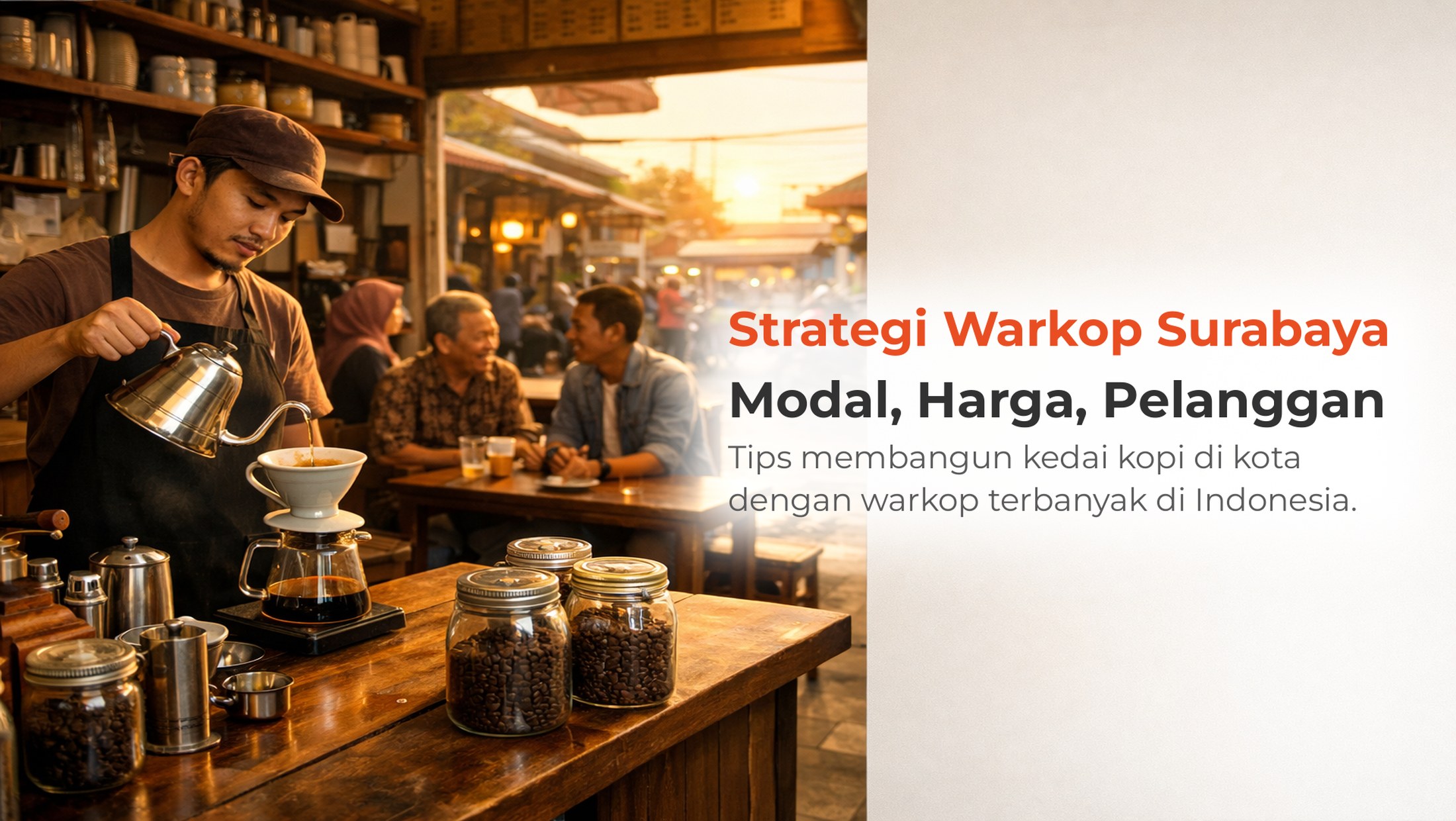
Surabaya has officially earned the nickname "the city of a million coffee stalls." Data from Good Stats Indonesia, compiled by Seasia Stats, records 12,510 stalls operating in the City of Heroes as of November 2025 - about 2.7 percent of the 461,991 coffee shops across the whole country. That figure places Surabaya as the largest single contributor to the national map of shop locations, ahead of Jakarta and Bandung. On the one hand, this is good news: the local thirst for a good cup is enormous. On the other hand, anyone who wants to open a business here must be ready to compete with thousands of other players fighting over the same customers.
This article covers the three things that matter most for a Surabaya coffee business: how to calculate your starting capital, how to set prices in the middle of fierce competition, and how to keep customers coming back. All of it is discussed from an MSME point of view, not from that of large coffee shop chains.
Profile of Surabaya Coffee and Warung Culture in the City of Heroes
Unlike bean-producing cities, Surabaya is a city of drinkers and a city of markets. The beans that circulate here come from the growing centers of East Java: arabica from the Ijen, Raung, and Argopuro areas, and Dampit robusta from Malang Regency, whose name is already known nationwide. Kadin Jawa Timur even describes the province as one of the largest production centers on the island of Java, with a projected output of 78,800 tons in 2025 while local absorption is still only about half of that, as reported by Bisnis.com. In other words, raw materials are abundant and their prices stay relatively affordable for coffee shops in Surabaya.
The warung culture is distinctive too. From roadside stalls that stay open until dawn to aesthetic coffee shops in the MERR area that run 24 hours a day, everything lives side by side. The city government supports this through 49 culinary tourism centers fostered by the Cooperatives and MSME Office, which provide organized places for small operators to do business. Customers come from every walk of life, with Generation Z as the segment that most strongly sets the direction of trends, because they are highly sensitive to online reviews, the atmosphere of a place, and the quality of service.
Market segmentation is just as varied. There are humble warungs with plastic tables that rely on sales volume, concept cafes that sell an atmosphere, and specialty bean shops for enthusiasts who brew at home. In this city, every segment has its own customers. You do not have to be the cheapest or the most luxurious; simply choose one segment, understand its habits in depth, and then serve it consistently day after day.
Tip 1: Plan Your Starting Capital with Three Realistic Scenarios
The most common mistake for beginners is opening a shop with barely enough capital, then getting shocked when the monthly costs arrive. Before you rent a place, first put together three budget scenarios: simple (a home-based warung with no rent), middle (a small rented shophouse in a dense area), and comfortable (a coffee shop with a custom design). Every scenario must contain the same line items: rent, light renovation, brewing and serving equipment, raw material stock for the first month, employee salaries, and an emergency fund equal to two months of operating costs.
For the Surabaya market, prioritize spending on the things customers can see: comfortable seating, lighting, and an internet connection. Competing with more than 12,000 warungs makes atmosphere a cheap but decisive differentiator. Expensive equipment can be scaled back at first; the emergency fund cannot be cut, because bean prices move at any time and rent in a big city like Surabaya climbs year after year.
Take advantage of used goods that are still serviceable: shelves, tables, and carts are often sold cheaply by shops that have stopped operating. For staff, start with one or two people who can cover several roles, then add more once the busy trade is proven. Buying raw materials is cheaper when you go directly to suppliers in producing regions, because a long chain of middlemen adds costs that can actually be trimmed.
| Shop Scenario | Spending Focus | Emergency Fund |
|---|---|---|
| Home-based warung | Brewing equipment and initial stock | 2 months of operating costs |
| Small shophouse | Rent, light renovation, seats and tables | 2 months of operating costs |
| Cafe with a custom design | Interior setup, equipment, staff | 2 months of operating costs |
Tip 2: Set Your Surabaya Coffee Prices with a Competition Map, Not Just Costs
A selling price is not simply cost plus profit. In the city with the highest number of coffee shops in the country, price is a signal of positioning. Before setting yours, note the prices at 5 to 10 warungs and cafes in the same area: what a glass of milk coffee, an espresso, and the accompanying snacks cost. That way you know whether your place belongs to the budget, middle, or premium segment, and you will not be mispositioned in the eyes of customers.
Calculate the cost of goods from local robusta beans as well, for example Dampit robusta, which costs friendlier than imported beans. If you want to aim at the middle segment and above, you can take price references from premium networks such as the % Arabica pop-up outlet at Pakuwon Mall, which prices its drinks between Rp50,000 and Rp80,000. Of course you do not need to follow that level; what matters is that the margin per glass stays healthy after the cost of milk, sugar, cups, and electricity is deducted.
Besides the price per glass, provide bundles that feel like a good deal, such as a snack-and-drink package for customers who come in groups. You can also sell packaged beans for brewing at home, with a special price for large purchases. This adds income outside the busy hours while introducing the shop's blend all the way to the customer's dining table.
Tip 3: Keep Customers Through Community and Consistent Service
In Surabaya, coffee shop customers grow out of communities: motorcycle communities, music communities, office workers, and students who need a place to work on assignments. A cafe like The Gade Coffee & Gold, for example, has survived a sluggish economy by opening up space for workshops and community events free of charge, plus collaborating with local MSMEs. You can copy the same pattern on a small scale: set aside one corner for gatherings, let communities hold small events during quiet hours, and offer drink vouchers to event participants.
Consistency also decides the outcome. The taste of the first glass and the hundredth glass must be the same, opening hours must be accurate, and staff must stay friendly even when the line is long. Generation Z will not hesitate to leave bad reviews that are read by other prospective customers. Conversely, consistent service turns one-time visitors into regulars who come several times a week.
One small thing that is often forgotten: memorize the names and the usual orders of regular customers. The right greeting and a phrase like "the usual?" make customers feel recognized, and that is far harder for competitors to copy than big discounts. Keep prices stable too; a reasonable increase that is communicated openly is better than quality quietly slipping because costs were squeezed.
FAQ: Questions About Surabaya Coffee Shops
How much starting capital do I need to open a shop in Surabaya?
Capital depends heavily on the concept and the location. A home-based warung with no rent can be started with figures in the millions of rupiah for basic equipment and stock, while a coffee shop with a rented shophouse and a specially designed space needs tens of millions. The breakdown is simple: equipment, material stock, rent where it applies, and an emergency fund equal to two months of operating costs that must not be used for anything else.
What kind of coffee do Surabaya residents consume the most?
Most warungs rely on local robusta such as Dampit robusta because the taste is strong and the price is affordable. Cafes that target young people usually add arabica variants from Ijen, Raung, or Argopuro for their manual brew menus.
Isn't the Surabaya market saturated with more than 12,000 warungs?
It is saturated in the uniform segments, but it stays open for shops that have a distinctive character, such as a signature blend, a comfortable atmosphere for working, or a focus on one community. A large market keeps even a small niche profitable when it is managed consistently.
How do I attract young customers or Generation Z?
Take advantage of online reviews and social media, offer an experience that is worth sharing, and build collaborations with surrounding communities and MSMEs. Drink vouchers and small events during quiet hours are also effective at bringing in new visitors.
What permits are needed to open a shop?
At a minimum there is the NIB, which can be registered through OSS, after which you adjust the other permits to your business scale and location, such as halal certification for food and beverage products.
Business and Finance Tips for Surabaya Coffee Shop Owners
Flavor and atmosphere are the interesting parts, but tidy finances are what keep a shop alive. The following principles can be applied from the very first day.
- Separate business and personal accounts. Daily cash should not be used for personal needs, so that you always know the real position of the business.
- Record every transaction every day. Do not rely on memory; revenue that feels busy is not necessarily profit once every cost is counted, including ingredient and electricity costs that rise during peak hours. A complete discussion is in the article how to calculate business profit.
- Prepare a separate emergency fund of at least two months of operating costs, because bean prices and rent can move at any time.
- Evaluate the menu every month using sales data. Items that do not sell should be replaced, and the best sellers can be used for bundles or discount packages during quiet hours. See how to do it in the article check the best-selling products from sales data.
Qasir Features for Surabaya Coffee Shops
A coffee shop's dense daily operations feel light once the record-keeping is digital. Here are four Qasir features that are most relevant.
Digital Cash Register
Qasir's digital cash register records every transaction straight from a phone, complete with the menu list and prices. Queues during busy hours move faster because the cashier never has to count manually or write in a book, even when a new employee is on duty.
Ingredient Stock Management
The stock feature records the inflow and outflow of ingredients such as beans, milk, and sugar automatically whenever a sale happens. You can find out when to shop again before ingredients run out in the middle of operating hours.
Sales Reports
The sales report displays daily revenue, best-selling menus, and busy hours on a single page. From this data you can determine promotions, staff schedules, and the amount of stock for the next day based on numbers rather than estimates, including for coffee shops with more than one branch in Surabaya.
Cash In and Cash Out Recap
The cash recap summarizes all business income and expenses in an orderly way. When it is time to evaluate monthly finances, every figure is ready without having to piece receipts together one by one.
Conclusion
The opportunity for a coffee shop in the City of Heroes is huge, but the competition is also the busiest in Indonesia. The keys come down to three things: capital planned with an emergency fund, prices set from a competition map and the cost of local beans, and customers kept through community and consistent service. Similar strategies have already been proven by business owners in other regions, as in the shop tips for Kerinci and Yogyakarta. Competition from more than 12,000 warungs in Surabaya does sound intimidating, but a large market also means that every niche managed seriously still gets its share. Start with small, consistent steps, and let your loyal customers grow the shop's name.
Run Your Surabaya Coffee Shop More Easily with Qasir
Qasir helps with the shop's daily operations so that you can focus on flavor and customers:
- Digital cashier for fast transaction recording on a phone without paper receipt books.
- Stock management for monitoring raw materials such as beans and milk down to their quantities.
- Sales reports that display revenue and best-selling menus every day.
- Wholesale price feature for those who also sell beans or packaged drinks, explained in full in the article maximize sales with the wholesale price.
- Customer data for maintaining relationships with loyal customers, as discussed in the article the importance of customer data for MSMEs.
Download Qasir for free on the Play Store, then start recording your shop's sales today.